Quick Answer: What Is a Garage Storage Lift?
A garage storage lift is a mechanical or motorized ceiling-mounted pulley system designed to raise and lower heavy gear between floor level and overhead ceiling space. Available in manual hand-crank, cordless drill-drive, and dedicated 110V electric winch formats, these lifts support working load limits between 250 and 600 pounds on 4×4 or 4×8 foot platforms. They eliminate dangerous ladder climbing by bringing bulky totes, seasonal tires, kayaks, and cargo boxes directly down to chest height with mechanical locking brakes.
Key Takeaways for Homeowners
- Mechanism Choices: Manual worm-gear winches offer reliable budget operation, drill-drive units speed up lifting, and electric motor hoists provide push-button convenience.
- Ceiling Joist Limits: Standard residential 2×6 ceiling joists require load distribution across multiple framing members using perpendicular 2×6 wood backing stringers.
- Cable Safety Standards: Industrial-grade lifts utilize dual braided 7×19 aircraft steel cables (1/8 inch or 5/32 inch) featuring a minimum 5:1 design safety factor.
- Safety Braking: Never purchase a lift without an internal worm-gear lock or secondary automatic mechanical anti-freefall pawl.
Every homeowner with high garage ceilings knows the frustration of dead overhead air. You install fixed stationary ceiling racks, load them with heavy plastic storage bins, and instantly dread having to pull anything down. Hauling 50-pound storage containers while balancing on the top rungs of an aluminum stepladder is one of the quickest ways to visit an emergency room.
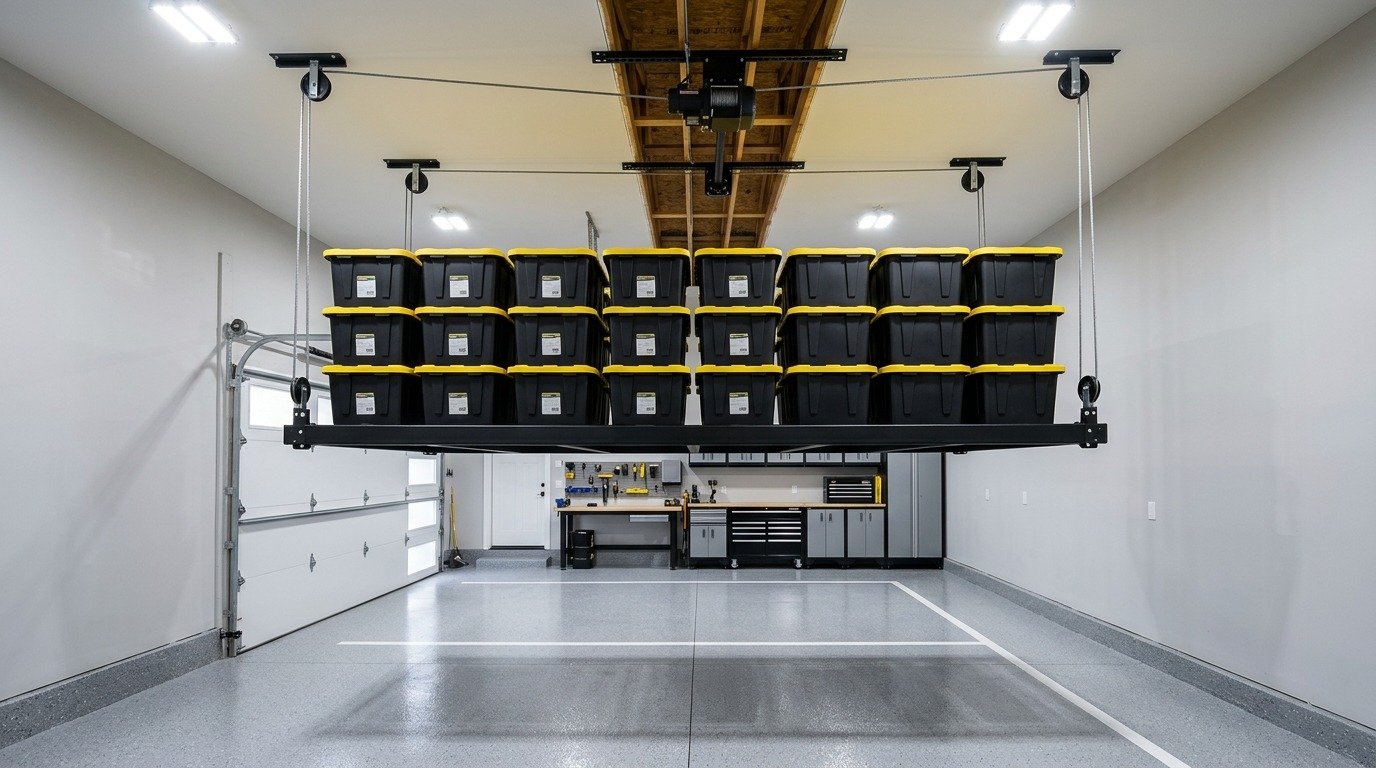
A modern garage storage lift solves this hazard by bringing your overhead storage directly to your feet. Instead of climbing into the ceiling joists, you operate a manual hand crank, a cordless power drill adapter, or an electric wall switch to lower the platform. You load your storage totes at comfortable working height, secure the cargo, and send the entire unit back up to the ceiling rafters.
However, selecting and installing a ceiling lift requires strict attention to structural framing and mechanical load limits. Hanging 400 pounds of active dynamic weight above parked vehicles or family workbenches leaves zero room for guesswork. Let us examine lift mechanisms, structural joist engineering, weight calculations, and critical installation protocols.
The 4 Primary Garage Storage Lift Mechanisms
Ceiling lifts rely on four distinct drive mechanisms to handle overhead weight. Understanding the mechanical differences helps you choose the right balance between installation budget and physical effort.
1. Manual Pulley and Rope Hoist Systems
Manual rope hoists represent the most economical category of ceiling lifts. These systems utilize a series of nylon or braided synthetic ropes routed through multiple ceiling-mounted sheaves to produce a 4:1 or 6:1 mechanical advantage. You pull a hanging rope by hand to hoist lightweight cargo like kayaks, road bicycles, ladders, or rooftop cargo boxes.
A spring-loaded cam lock or rope cleat engages automatically when you release tension to prevent the load from slipping. While affordable and simple to install, rope hoists are limited to light gear under 100 to 150 pounds. They also require physical pulling strength and can leave loose ropes dangling along garage walls.
2. Worm-Gear Manual Hand Crank Lifts
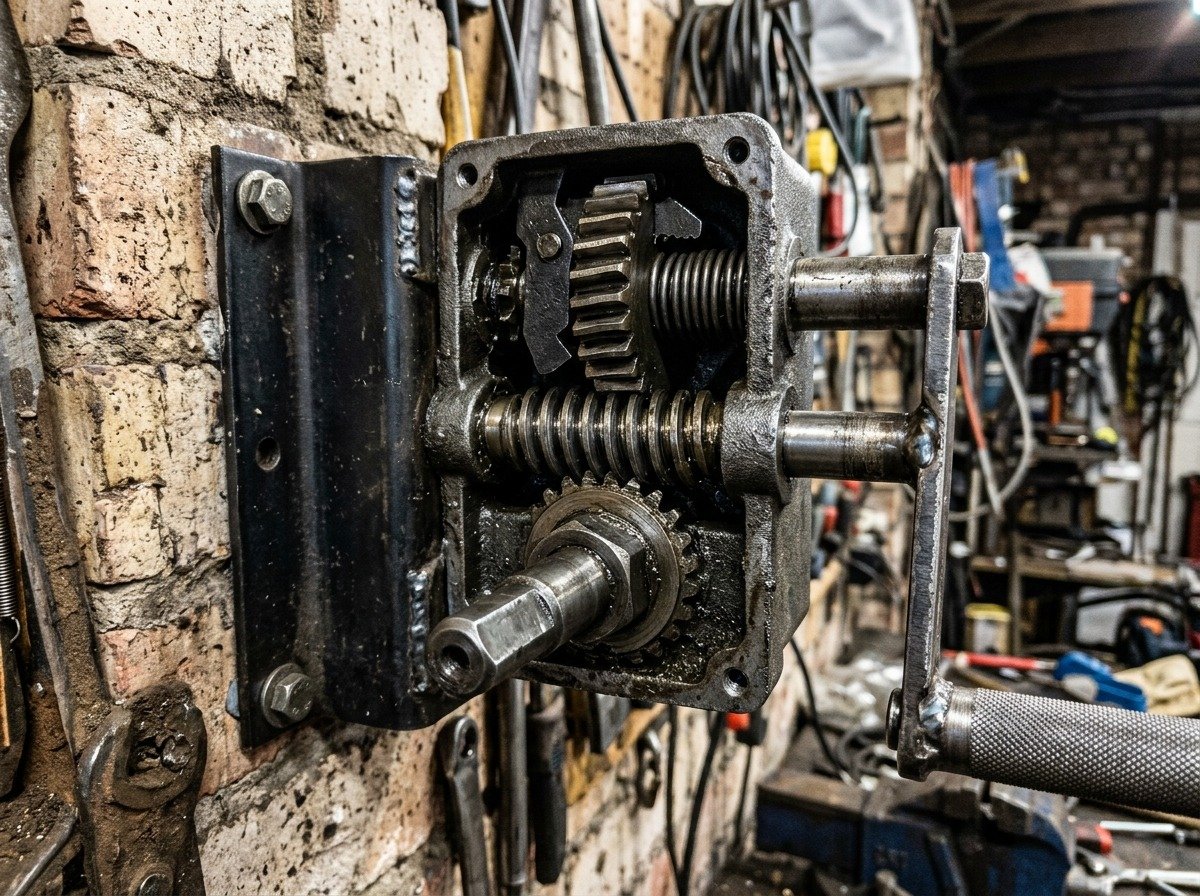
Worm-gear manual lifts replace loose ropes with durable steel aircraft cables and a wall-mounted or ceiling-mounted gearbox. A threaded worm screw drives a matching worm gear connected to the primary cable winding drum. Because a worm drive cannot be reverse-driven by weight on the platform, the gearbox acts as an automatic mechanical brake.
You turn a detachable manual hand crank to raise or lower the platform smoothly. This design supports heavier loads up to 250 to 300 pounds without requiring extreme physical effort. It serves as an excellent option for garages without electrical outlets near the ceiling framing.
3. Cordless Drill-Drive Winch Systems
Drill-drive lifts take the reliability of a worm-gear winch and add high-speed operation. The drive shaft features a standard 3/8-inch or 1/2-inch hex spindle fitting directly into your cordless drill chuck. Instead of cranking by hand for three minutes, your battery-powered drill spins the gearbox to raise the platform in twenty seconds.
Most drill-drive systems include an auxiliary manual hand crank as a backup if your drill batteries are depleted. They support 250 to 400 pounds and deliver near-motorized speed at a fraction of the cost of hardwired electrical units. For homeowners seeking stationary floor alternatives, check our heavy duty garage shelving guide.
4. Dedicated Electric Motor Hoist Systems
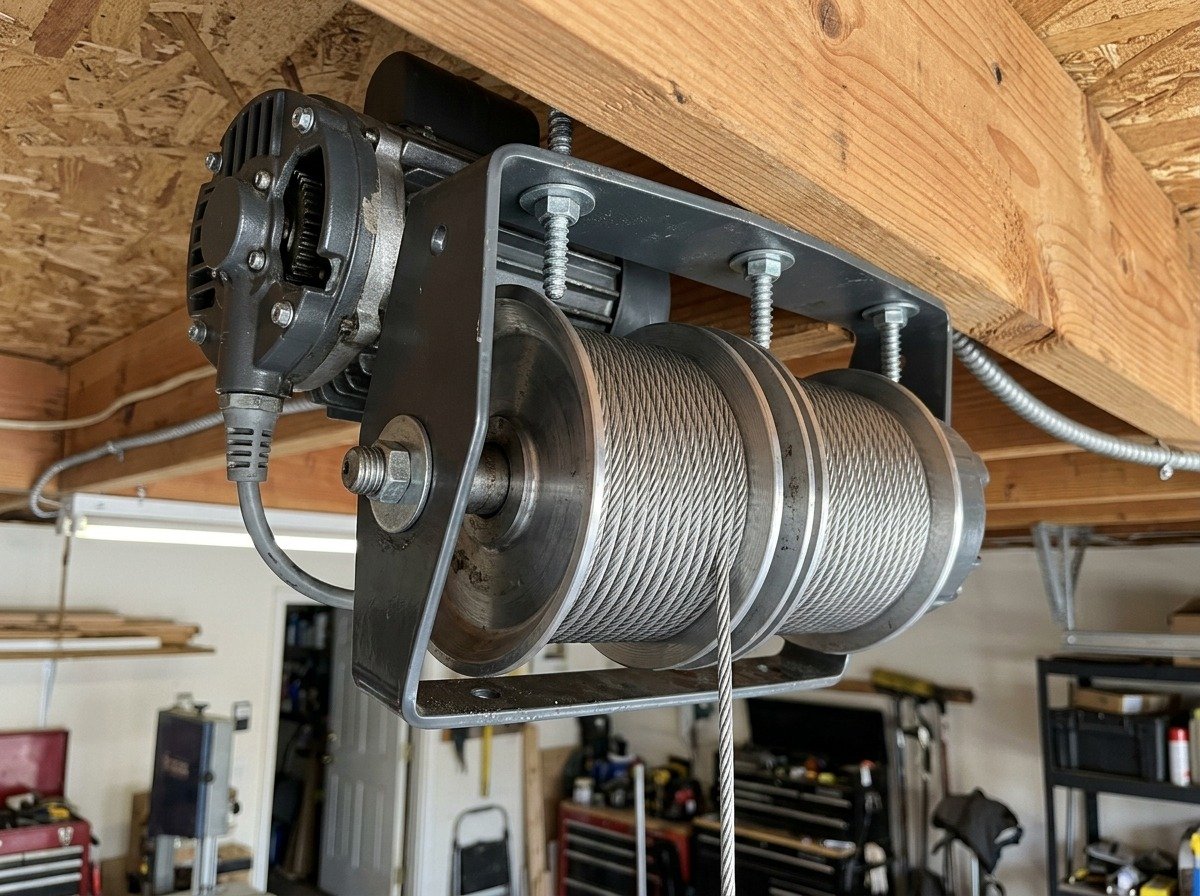
Electric motorized lifts represent the top tier of overhead convenience. These units feature an integrated 110V or 120V electric motor, an enclosed planetary or worm gearbox, and twin grooved cable drums. The motor mounts directly to ceiling joists and plugs into a standard overhead outlet.
You control the lift using a key-locked wall switch, a handheld radio-frequency remote, or a smartphone app connected via Bluetooth or Wi-Fi. Electric lifts handle 400 to 600+ pounds of cargo effortlessly. They include adjustable internal limit switches that stop the platform automatically at ceiling and floor levels. To explore dedicated motorized ceiling elevators, read our garage storage elevator guide.
Comparison of Garage Storage Lift Types
Review this side-by-side technical breakdown before selecting a ceiling lift for your garage:
| Lift Mechanism | Typical Capacity | Cable Spec | Safety Brake System | Price Range |
|---|---|---|---|---|
| Manual Rope Hoist | 50 to 150 lbs | Braided Nylon / Poly | Cam friction cleat | $40 to $90 |
| Worm-Gear Crank | 250 to 300 lbs | 1/8″ 7×19 Galvanized | Irreversible worm screw | $180 to $280 |
| Drill-Drive Winch | 250 to 400 lbs | 5/32″ 7×19 Aircraft | Internal brake + worm lock | $220 to $350 |
| Integrated Electric | 400 to 600 lbs | 5/32″ 7×19 Aircraft | Dynamic brake + auto pawl | $500 to $900 |
| Smart Hardwired Hoist | 400 to 650 lbs | 3/16″ High-tensile steel | Electronic stop + secondary lock | $900 to $1,500 |
Ceiling Joist Engineering: Structural Load Calculations
Before buying any overhead lifting equipment, verify that your garage ceiling framing can support the weight. Residential roofs and ceiling framing follow structural load guidelines established by the American Wood Council (AWC) wood construction standards.
Garage ceiling joists are engineered primarily for dead loads (drywall, insulation, light fixtures) and limited uninhabitable attic live loads. Standard 2×6 ceiling joists spaced 16 or 24 inches on center are rated for roughly 10 to 20 pounds per square foot of light storage. Suspending a 400-pound concentrated load from a single joist risks structural deflection, ceiling drywall cracking, or fastener withdrawal.
To hang a lift safely, you must distribute the load across at least three or four adjacent joists. Professional installers construct a wood backing grid using structural 2×6 Douglas fir or Southern yellow pine boards. Fastening these backing boards perpendicular across ceiling joists spreads the downward tension over multiple structural framing points. Compare this with our overhead garage storage racks that can be lowered.
Cable Engineering and Rigging Safety Standards
The safety of any overhead lift depends entirely on its wire rope cables. Overhead lifting hardware falls under the rigorous standards of ASME B30.16 overhead hoists safety standards and OSHA 1926.251 rigging equipment load ratings.
Quality garage storage lifts utilize 7×19 galvanized steel aircraft cable. The 7×19 designation indicates seven bundles of nineteen individual steel strands braided together. This specific strand pattern provides excellent flexibility as cables wrap around small-diameter pulleys without developing metal fatigue.
Commercial safety standards require a minimum 5:1 safety factor for overhead hoists. A 1/8-inch 7×19 galvanized aircraft cable features a breaking strength of approximately 2,000 pounds, yielding a safe working load limit (WLL) of 400 pounds. High-capacity 600-pound lifts utilize thicker 5/32-inch cables with breaking strengths exceeding 2,800 pounds. Never operate a lift if the wire rope shows signs of fraying, bird-caging, or severe kinking.
Platform Lifts vs. Dedicated Specialty Hoists
Storage lifts fall into two distinct form factors depending on what items you need to store:
General Purpose Steel Platform Lifts
Platform lifts feature a flat rectangular steel grid measuring 4×4 feet or 4×8 feet. The perimeter frame consists of powder-coated steel tubes, while the bed contains heavy wire grid panels. Corner cables connect to all four corners of the platform, keeping the surface perfectly horizontal during transit.
Platform lifts offer unmatched versatility. You can stack plastic storage totes, cardboard moving boxes, camping gear, Christmas trees, and ice chests side by side. Removable safety netting prevents loose items from shifting when the platform starts or stops.
Dedicated Specialty Hoists
Specialty hoists abandon the solid platform in favor of custom brackets, nylon webbing straps, or padded hooks. These units target single large, awkward items that consume floor space:
- Jeep & Truck Hardtop Lifts: Padded balance bars contour under vehicle hardtops, allowing one person to detach and hoist the roof directly off the vehicle into ceiling storage.
- Kayak & Canoe Hoists: Heavy-duty nylon straps wrap around the boat hull, lifting watercraft flush against ceiling joists above vehicle parking zones.
- Rooftop Cargo Carrier Lifts: Contoured crossbar brackets drop directly onto plastic automotive luggage capsules for effortless seasonal mounting and removal.
- Bicycle Multi-Hoists: Independent pulleys suspend multiple mountain or road bikes by handlebars and seat saddles. For wall alternatives, see our heavy duty garage hooks guide.
Step-by-Step Installation Protocol for Ceiling Lifts
Installing an overhead lift requires precise measurement and solid mechanical anchors. Follow this four-step installation procedure:
Step 1: Map Joists and Verify Clearance
Use a commercial deep-scanning stud finder to locate the centerlines of your ceiling joists. Mark the joist centers with chalk along the entire installation footprint. Ensure the lift platform clears the open garage door track, overhead opener motor, and tall vehicle antennas by at least 12 inches.
Step 2: Mount 2×6 Wood Backing Stringers
If your ceiling joists run parallel to the lift platform, mount two 2×6 Douglas fir backing stringers perpendicular across four adjacent joists. Secure each stringer into the center of each joist using two 3/8 x 4-inch galvanized steel lag bolts with flat washers. Pre-drill 1/4-inch pilot holes to avoid splitting dry ceiling timber.
Step 3: Bolt Ceiling Brackets and Pulleys
Fasten the steel pulley brackets and motor mounting plate directly into the solid 2×6 backing stringers. Use grade-5 or grade-8 hex head lag screws. Tighten until the flat washers sink flush against the bracket plates without stripping the wood grain.
Step 4: Reeve Cables and Calibrate Limit Switches
Route the steel aircraft cables through the ceiling pulleys and down to the platform corner brackets. Level the platform on the ground using adjustable turnbuckles or cable clamps. For motorized units, adjust the rotary limit screws so the motor halts automatically 4 inches below the ceiling joists. To protect wall areas beneath the lift, check our garage wall cabinets mounting guide.
5 Costly Garage Storage Lift Mistakes to Avoid
Avoid these five dangerous installation and operational traps:
- 1. Anchor Screws in Drywall Alone: Never rely on hollow wall anchors or toggle bolts in ceiling drywall. Every fastener must penetrate at least 2.5 inches into solid wood framing.
- 2. Uneven Weight Distribution: Storing all heavy toolboxes on one side of a platform causes cable spool bunching and binding in guide pulleys. Center heavy cargo over the middle of the frame.
- 3. Ignoring Upper Travel Limits: Failing to set mechanical or electrical upper limit switches can cause the winch motor to drive the platform into ceiling drywall, snapping cables or blowing circuit breakers.
- 4. Walking Under Suspended Active Loads: Never position workbenches, children’s play areas, or pet crates directly under a loaded ceiling platform. Always keep the transit path clear while operating.
- 5. Skipping Annual Cable Inspections: Wire ropes accumulate dust and friction over time. Inspect cables annually for broken strands, rust, or pulley wear, and lubricate pivot bearings with dry PTFE spray. For broader load guidelines, see our storage rack weight capacity guide.
Frequently Asked Questions
Can you install a garage storage lift on high vaulted ceilings?
Yes, but vaulted or sloped ceilings require angled joist brackets or self-leveling ceiling adapters. You must mount horizontal wood backing stringers across the rafters to create a level mounting plane for the pulleys and winch motor. Cable lengths must also be verified to ensure the platform reaches the floor from high peaks.
How much weight can a residential garage storage lift hold?
Standard manual and drill-drive garage lifts support between 250 and 400 pounds. Heavy-duty electric motorized systems support 400 to 600 pounds. However, the maximum allowable load is always limited by the structural rating of your home’s ceiling framing, not just the winch rating.
Can you operate a motorized ceiling lift during a power outage?
Most electric ceiling storage lifts feature a manual override hex spindle on the motor housing. In the event of a power outage, you can attach an emergency manual hand crank or cordless drill to raise or lower the platform manually.
What maintenance does an overhead garage storage lift require?
Overhead lifts require minimal but critical maintenance. Inspect steel aircraft cables every six months for kinks, frays, or rust. Check lag bolt tightness in ceiling framing annually, verify proper operation of the safety brake, and apply dry silicone or PTFE lubricant to pulley bearings.

Callum Langham
Founder & Technical Storage Editor
Callum Langham is the founder and technical editor of Rack System. With over 12 years of hands-on field experience in warehouse logistics, garage organization, and industrial storage installations, Callum specializes in engineering safety standards, beam load calculations, and OSHA/RMI compliance. Every guide on Rack System is audited against verified steel gauge tolerances and municipal building codes.