Quick Answer: Selecting a Tire Storage Rack
A tire storage rack is a specialized heavy-duty steel rack designed to store seasonal wheels and spare tires off the garage floor. Available in wall-mounted telescopic, mobile rolling cart, multi-tier floor, and ceiling loft configurations, these racks support between 300 and 1,000+ pounds. Proper selection requires calculating the combined weight of tires and wheels (typically 45 to 80 pounds per assembled wheel) and anchoring wall-mount units directly into wall stud centers with 3/8-inch grade-5 lag bolts to prevent fastener pull-out.
Key Takeaways for Garage Owners
- Weight Reality: A set of four mounted truck or SUV wheels weighs 260 to 340 pounds, exceeding the capacity of standard consumer garage shelves.
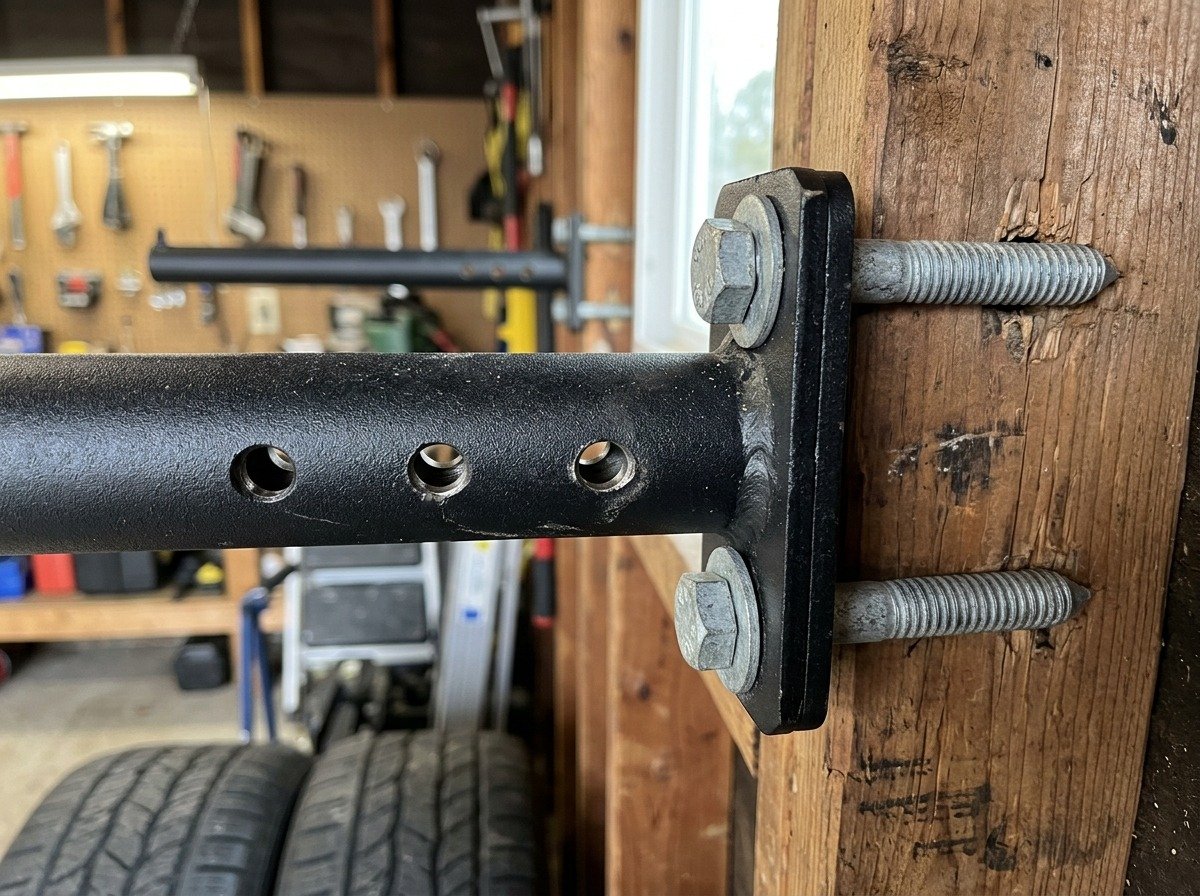
- Mounting Integrity: Wall-mounted racks must anchor into at least two structural 2×4 or 2×6 wall studs using 3/8-inch lag bolts penetrating at least 2.5 inches into solid wood.
- Tread Protection: Storing mounted tires vertically on round tubular crossbars prevents permanent flat-spotting and sidewall deformation during off-season months.
- Format Selection: Wall racks save floor space, rolling carts provide mobility for seasonal tire swaps, and floor racks handle multiple vehicle sets.
Every driver living in a region with freezing winter weather knows the pain of managing seasonal tires. When spring arrives and you swap your aggressive snow tires for performance summer rubber, you are suddenly stuck with four massive, filthy wheels cluttering your garage floor. Leaving loose tires stacked in a corner eats up precious parking space, creates a tripping hazard, and leaves dirty black rubber scuffs along your walls.
A purpose-built tire storage rack solves this problem by elevating heavy seasonal wheels into dedicated, organized storage. Instead of tripping over loose rubber or stacking wheels against baseboards, you place them securely on heavy gauge steel support bars designed specifically for cylindrical loads. Your garage floor stays clear, your vehicle parking path remains open, and your tires stay protected from floor moisture and chemical exposure.
However, storing heavy wheel assemblies high on a wall or ceiling demands strict engineering attention. Four mounted pickup truck wheels can easily weigh over 300 pounds. Anchoring that much dead weight requires proper hardware, accurate stud mapping, and correct weight calculation. Let us break down tire rack types, load formulas, stud fastening protocols, and rubber preservation rules.
The 4 Primary Types of Tire Storage Racks
Tire racks fall into four main structural designs. Choosing the right configuration depends on your ceiling height, wall stud layout, and how often you rotate your wheel sets.
1. Wall-Mounted Adjustable Steel Tire Racks
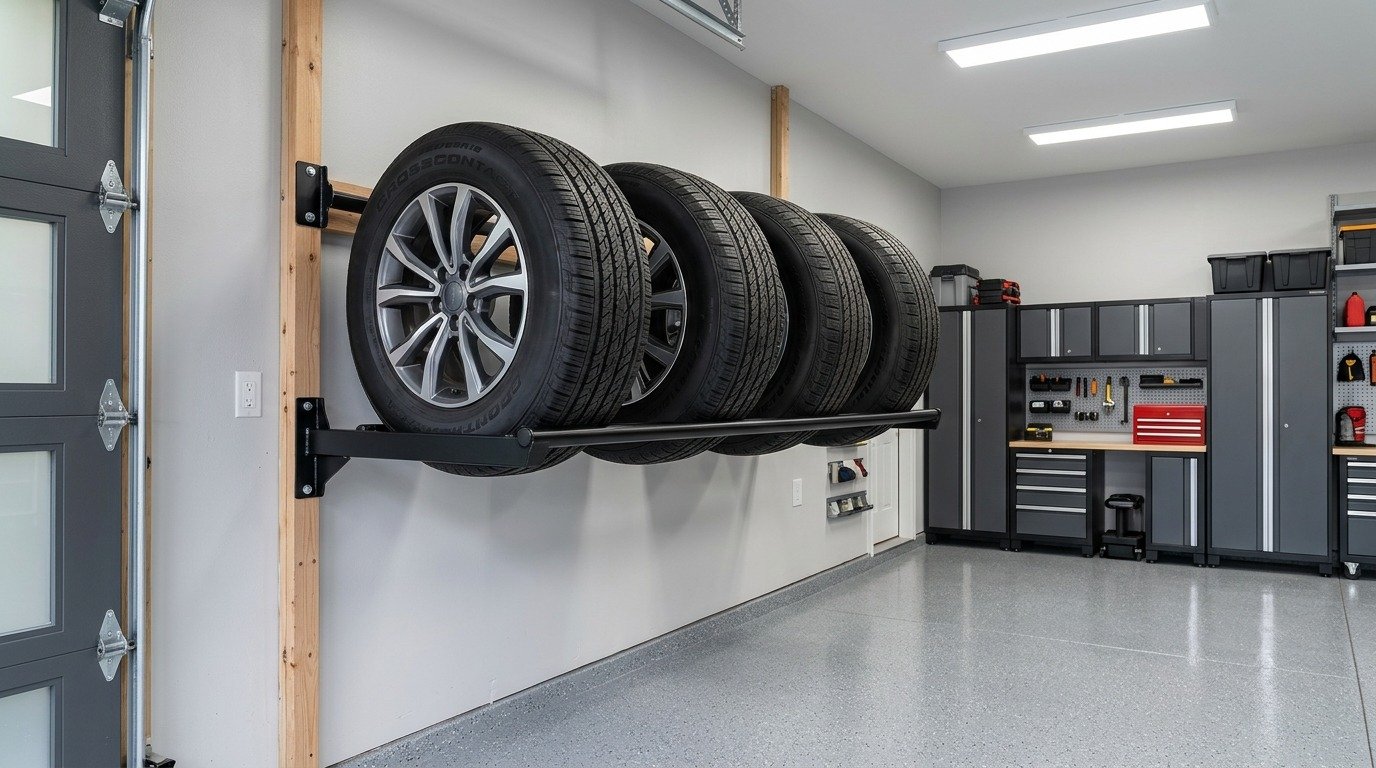
Wall-mounted racks represent the most popular choice for single-family residential garages. These units consist of two heavy gauge triangular steel wall brackets connected by two or three telescopic crossbars. The crossbars adjust in width from 32 inches to 56 inches to fit standard 16-inch, 24-inch, or 32-inch stud spacing.
The primary advantage of wall racks is floor clearance. By elevating four wheels above vehicle hoods or workbench areas, you recapture square footage that would otherwise be lost. Many models feature hinged side brackets that fold flat against the drywall when empty. High-quality wall units carry certified dynamic load ratings between 350 and 400 pounds.
2. Mobile Rolling Tire Carts
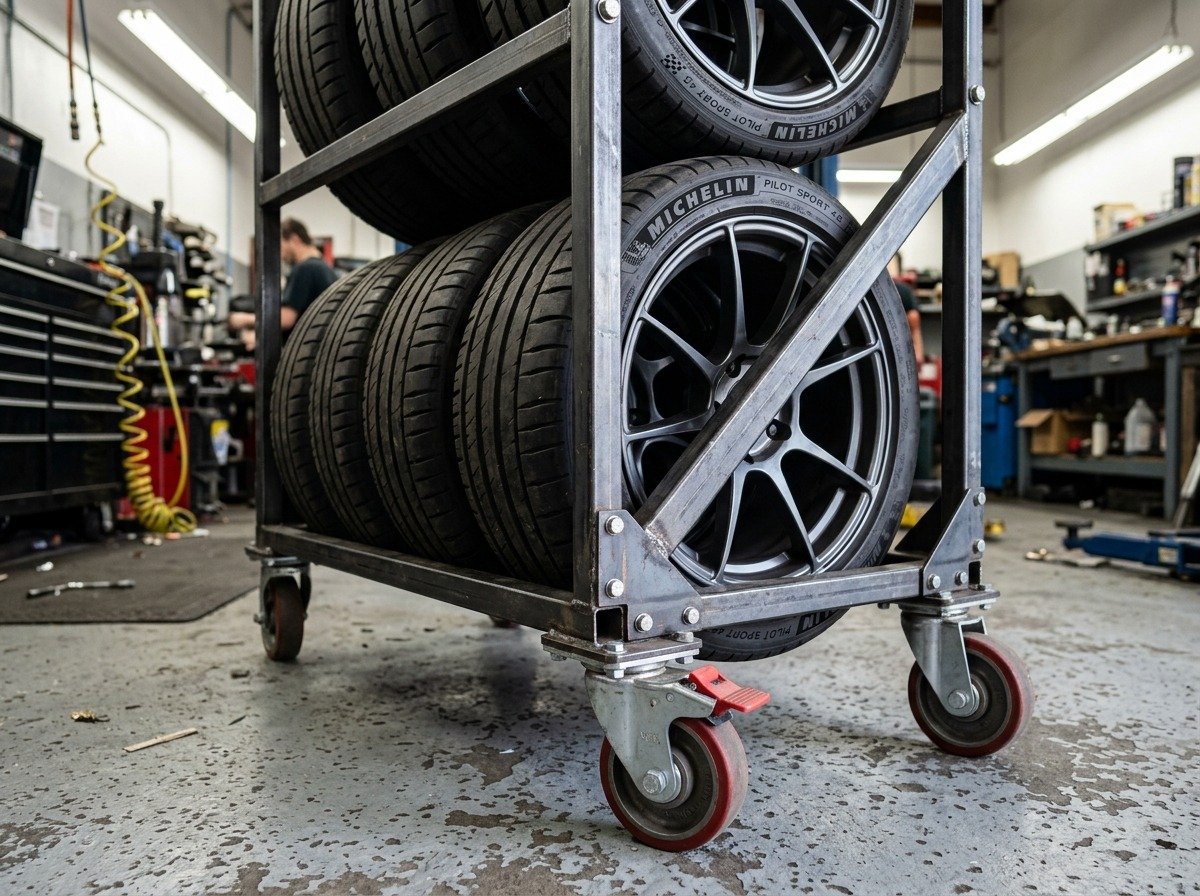
Mobile rolling tire carts are freestanding steel frames mounted on heavy-duty caster wheels. A typical rolling cart holds four to eight tires either standing vertically side by side or stacked horizontally on a central upright arbor post. The base features two rigid and two locking 3-inch or 4-inch polyurethane swivel casters.
Rolling carts are ideal for DIY mechanics and automotive hobbyists who perform seasonal tire swaps themselves. You wheel the entire rack directly next to your vehicle, unbolt your summer wheels, and install your winter set without carrying 60-pound assemblies back and forth across the garage. When finished, you roll the cart into a corner or under high shelving. Compare rolling options in our heavy duty garage shelving guide.
3. Freestanding Multi-Tier Floor Racks
Multi-tier floor racks are heavy stationary units designed for households with multiple vehicles, track day enthusiasts, or small commercial repair shops. Built from 12-gauge or 14-gauge structural steel tubing, these two-tier and three-tier shelving systems store 8 to 16 tires in vertical rows.
Floor racks do not require wall mounting, making them suitable for garages with metal stud framing, poured concrete walls, or obstructed drywall. They deliver immense weight capacities ranging from 800 to over 1,500 pounds. While they consume floor space, their vertical density organizes multiple wheel sets in a compact five-foot footprint.
4. Overhead Ceiling-Mounted Tire Lofts
Overhead tire lofts hang directly from ceiling joists using vertical steel drop brackets. These racks position tires in the unused dead zone above garage door tracks or overhead storage areas. They provide total floor and wall clearance in compact single-car garages.
Ceiling lofts require careful clearance verification to avoid interfering with garage door opener mechanisms, overhead rails, or tall vehicle rooflines. Lifting 60-pound wheels overhead requires solid ladder footing and physical stamina. For mechanical lowering alternatives, read our garage storage lift setup guide.
Comparison of Tire Storage Rack Configurations
Review this side-by-side technical specification table to determine which rack format fits your garage layout and storage needs:
| Rack Configuration | Tire Capacity | Weight Rating | Mounting Method | Typical Price |
|---|---|---|---|---|
| Adjustable Wall Mount | 4 Tires / Wheels | 350 to 400 lbs | 3/8″ Lag bolts into 2 wall studs | $70 to $140 |
| Heavy-Duty Wall Mount | 4 to 6 Truck Tires | 400 to 500 lbs | 3/8″ Lag bolts into 3 wall studs | $120 to $220 |
| Mobile Rolling Cart | 4 to 8 Tires | 300 to 600 lbs | Freestanding on locking casters | $80 to $180 |
| Multi-Tier Floor Rack | 8 to 16 Tires | 800 to 1,500 lbs | Freestanding (floor anchor optional) | $160 to $350 |
| Ceiling-Mounted Loft | 4 Tires / Wheels | 300 to 400 lbs | 3/8″ Lag bolts into ceiling joists | $90 to $160 |
Weight Calculations: Tires vs. Complete Mounted Wheels
The single most dangerous mistake buyers make when purchasing a tire storage rack is underestimating the weight of their wheel assemblies. There is a massive weight difference between bare unmounted rubber tires and complete inflated tire-and-wheel assemblies.
Consider the typical weights of common automotive wheel packages:
- Compact Car (195/65R15): Bare tire weighs roughly 18 to 20 pounds. When mounted on a lightweight aluminum alloy rim, the complete assembly weighs 35 to 40 pounds. Four wheels total 140 to 160 pounds.
- Midsize Sedan / Crossover (225/55R17): Bare tire weighs 24 to 28 pounds. Mounted on an OEM cast aluminum wheel, the assembly weighs 45 to 52 pounds. Four wheels total 180 to 208 pounds.
- Full-Size SUV / Half-Ton Truck (275/65R18): Bare tire weighs 38 to 44 pounds. Mounted on an OEM steel wheel or heavy cast wheel, the complete assembly weighs 68 to 82 pounds. Four wheels total 272 to 328 pounds.
- Heavy-Duty 3/4-Ton Truck (275/70R18 Load Range E): Heavy 10-ply commercial tires weigh 50 to 58 pounds alone. Mounted on heavy steel rims, each wheel assembly weighs 85 to 95 pounds. A full set of four totals 340 to 380 pounds.
If you own an SUV or light truck, a generic 300-pound rated rack will operate right at its physical breaking threshold. For heavy wheel assemblies, always select a rack with a minimum certified load limit of 400 to 500 pounds to maintain an adequate structural safety margin. Review general load engineering rules in our storage rack weight capacity guide.
Sizing Formulas: Rack Width and Section Width
To confirm that your four tires will fit side by side on a single rack tier, calculate the total section width of your tires in inches. Metric tire sizing indicates tread and sidewall dimensions directly in millimeters.
Take the first number on your tire sidewall (the nominal section width in millimeters) and multiply it by four. For example, if your winter tires measure 245/50R18, each tire has a section width of 245 millimeters (9.65 inches). Four tires side by side require:
245 mm x 4 tires = 980 mm (38.6 inches) of usable linear bar space.
Always add a two-inch buffer (one-half inch between each tire) so tires slide in and out smoothly without binding against side brackets. For 245mm tires, your rack crossbars must measure at least 41 inches wide. If you store wide pickup tires (e.g., 285mm / 11.2 inches), four tires require 45 inches of bare width plus buffer, necessitating an adjustable rack expanded to 48 inches or wider.
Wall Stud Mounting Protocol: Engineering Fasteners
Wall-mounted tire racks rely entirely on the mechanical connection between the steel bracket flanges and your garage wall studs. Safe storage practices must comply with OSHA 1910.176 materials storage rules to prevent overhead collapse hazards.
When you place 350 pounds of tires on horizontal cantilevered bars extending 28 inches from the wall, physics creates massive rotational leverage. The top mounting bolt experiences intense horizontal pull-out tension, while the bottom bolt experiences downward shear force. To install a wall rack safely, follow this four-step mounting sequence:
Step 1: Locate Wood Stud Centers with Precision
Never estimate stud locations by knocking on drywall. Use an electronic deep-scanning stud finder to locate both edges of the 2×4 or 2×6 framing lumber, then mark the exact dead center with a vertical pencil line. Most residential garages feature studs spaced 16 inches or 24 inches on center.
Step 2: Pre-Drill Pilot Holes
Never drive heavy lag bolts directly into dry framing lumber without pilot holes. Driving a 3/8-inch lag bolt into bare Douglas fir or Southern yellow pine will split the stud grain, reducing holding power by more than 60%. Drill a 1/4-inch pilot hole into the marked stud center to the full depth of the bolt.
Step 3: Fasten with Heavy Galvanized Lag Screws
Discard the cheap, low-grade Chinese hardware often supplied in import rack boxes. Use domestic grade-5 galvanized steel hex lag screws measuring 3/8-inch in diameter by 3 to 1/2 or 4 inches in length. Slide a heavy galvanized flat washer under each bolt head to distribute clamping force evenly over the bracket mounting slot.
Step 4: Tighten to Full Compression
Drive the lag bolts with a 9/16-inch socket and ratchet handle. Tighten until the flat washer compresses firmly against the bracket steel and crushes into the drywall paper. Stop tightening once firm resistance is reached to avoid stripping the wood threads inside the stud core. For wall shelf comparisons, explore our garage wall shelves stud mounting guide.
Proper Tire Storage Conditions: Protecting Rubber Compounds
Storing tires properly is not just about keeping the floor clean; it is about extending the operating life of your expensive rubber. The U.S. Tire Manufacturers Association (USTMA) tire storage guidelines emphasize four environmental factors:
- Avoid Ozone Generators: Never store tires adjacent to electric motors, central heating furnaces, air compressors, or welding equipment. Electric motors generate ozone gas, which breaks down synthetic rubber polymers and causes severe sidewall dry rot.
- Block Direct Sunlight: Ultraviolet rays degrade rubber compounding within months. Position your tire rack away from garage windows or drape an opaque tire storage cover over the rack.
- Keep Away from Chemicals: Garage floors often contain spilled motor oil, brake fluid, antifreeze, or gasoline. Elevating tires on a rack keeps delicate rubber compounds away from petroleum solvents that cause rubber softening and tread delamination.
- Maintain Moderate Temperatures: Extreme seasonal heat inside uninsulated garage attics accelerates compound hardening. Store tires along insulated interior walls rather than high in roof trusses.
According to technical bulletins from the Tire Industry Association (TIA) seasonal handling standards, mounted tires on wheels should always be stored vertically on dual tubular crossbars or stacked horizontally on a clean pallet. If stored unmounted without rims, standing tires vertically and rotating them slightly every six weeks prevents permanent casing flat-spotting.
5 Costly Tire Storage Rack Mistakes to Avoid
Avoid these five common procurement and installation blunders:
- 1. Fastening into Drywall with Toggle Bolts: Hollow drywall anchors have zero place supporting 350 pounds of dynamic weight. Every bracket must anchor into solid wood framing.
- 2. Hanging Racks Too High Above Head Height: Placing a wall rack eight feet off the ground forces you to lift heavy 70-pound truck wheels while standing precariously on stepladder rungs. Mount racks at chest height where lifting leverage is strongest.
- 3. Ignoring Vehicle Clearance Paths: Mount wall racks high enough that vehicle hoods or side mirrors do not strike the bottom bracket flanges when parking. Verify door swing clearance before drilling.
- 4. Over-Expanding Telescopic Crossbars: Extending telescopic tubular bars past their maximum etched stop lines weakens center beam stiffness, causing crossbar sagging under full loads.
- 5. Neglecting Annual Bolt Torque Checks: Seasonal garage temperature swings cause wood framing to expand and contract. Re-torque lag bolts annually with a socket wrench to maintain tight clamping pressure. For metal shelving options, review our metal shelving units guide.
Frequently Asked Questions
Should tires be stored inflated or deflated on a storage rack?
Mounted tires should remain inflated to their normal vehicle operating pressure or slightly reduced to roughly 15 to 20 PSI during storage. Storing mounted tires fully deflated can pinch internal rubber liners and crease the bead sealing surface against the rim flange. Always re-inflate tires to full manufacturer specification before reinstalling them on your car.
Is it better to store tires vertically on a rack or stacked horizontally?
For tires mounted on wheels, storing them vertically on a dual-bar tire rack is excellent because the two support bars cradle the tire tread evenly. If tires are unmounted without rims, storing them vertically side by side on a rack is also recommended, provided you rotate them ninety degrees once every two months to prevent flat spots.
Can you install a wall-mounted tire rack on metal garage studs?
Standard wood-thread lag screws will not hold in thin 25-gauge residential steel studs. If your garage framing utilizes light-gauge steel studs, you must fasten a structural 3/4-inch CDX plywood backing plate or 12-gauge unistrut channel across three studs using 1/4-inch heavy-duty toggle anchors, then bolt the tire rack to the unistrut.
How much clearance do you need above a wall-mounted tire rack?
Measure the total outside diameter of your largest tire (typically 26 to 33 inches). Add at least six inches of clear overhead space above the top tire edge so you can lift wheels up and over the front retaining bar without gouging your garage ceiling drywall.

Callum Langham
Founder & Technical Storage Editor
Callum Langham is the founder and technical editor of Rack System. With over 12 years of hands-on field experience in warehouse logistics, garage organization, and industrial storage installations, Callum specializes in engineering safety standards, beam load calculations, and OSHA/RMI compliance. Every guide on Rack System is audited against verified steel gauge tolerances and municipal building codes.