Quick Technical Summary
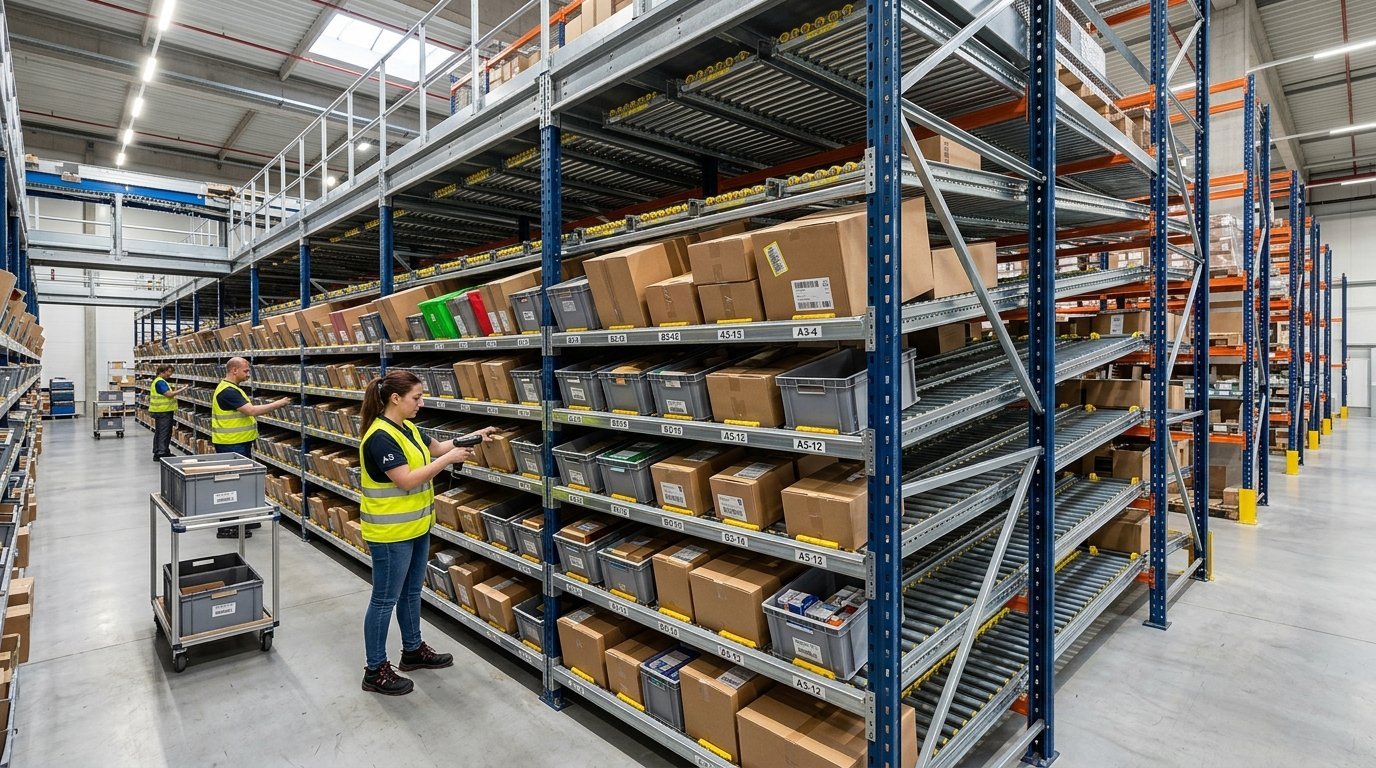
A carton flow racking system is a dynamic, high density gravity storage solution engineered specifically for split-case picking, piece-picking, and high velocity carton distribution. Utilizing inclined roller tracks or continuous wheel beds mounted inside structural steel frames, carton flow operates on a strict First-In, First-Out (FIFO) material handling discipline. Inventory cartons, cardboard boxes, and plastic totes are replenished from the rear charging aisle and glide forward smoothly under natural gravity to the front pick face, reducing order picker walking distance by up to 75 percent compared to static shelving.
Key Engineering Takeaways
- FIFO Order Velocity: Carton flow physically separates replenishment stockers in the rear aisle from order pickers in the front aisle, eliminating traffic collisions and boosting pick rates.
- Gradient Slope Standard: Effective carton flow requires a pitch of 1/4-inch to 1/2-inch of vertical drop per linear foot of track, creating a functional gravity slope of 1.2 to 2.5 degrees.
- Track vs Wheel Bed Mechanics: Dedicated roller tracks excel with uniform carton widths, while full-width staggered wheel beds allow flexible multi-SKU lane widths without track re-spacing.
- Ergonomic Knuckle Trays: Installing angled drop-knuckle pick trays at the front discharge point tilts open cartons 15 to 30 degrees toward the picker, improving visibility and wrist ergonomics.
- Carton Bottom Deflection: Thin corrugated cartons carrying heavy contents can bow downward between wheels, causing friction lockup if wheel spacing exceeds 1.5 to 2 inches center-to-center.
What Is a Carton Flow Racking System
Modern distribution facilities and fulfillment warehouses face immense pressure to accelerate piece-picking velocity while controlling labor overhead. In high-volume operations, walking time between static storage bays accounts for more than half of a warehouse worker total shift.
A carton flow racking system condenses pick locations into compact, gravity-fed picking faces. Rather than walking down long aisles of stationary metal shelving, workers remain in dedicated picking corridors while cartons automatically roll forward to replace picked inventory.
While heavy pallet handling requires a heavy-duty pallet flow racking system gravity lanes setup, carton flow systems are engineered specifically for smaller individual cartons, split cases, and distribution totes. Integrating carton flow levels underneath pallet racking creates a balanced inventory structure that maximizes warehouse cube space.
How FIFO Gravity Flow Functions in Split-Case Fulfillment
The operational logic of carton flow relies on gravity conversion across inclined tracks. Inventory clerks load replenishment cases onto the elevated rear charge shelf, and each carton rolls forward down the lane until it contacts the front stop beam.
When an order picker retrieves an item or removes an entire empty box, the trailing reserve cartons advance one position forward immediately. This automatic replenishment guarantees that pickers always have stock available right at the aisle pick face without reaching into deep shelves.
Because cartons are always loaded from the rear and picked from the front, First-In, First-Out lot rotation is maintained automatically. Facilities designing comprehensive material flow plans regularly reference warehouse storage solutions layout planning to optimize throughput across diverse product categories.
Track Hardware: Dedicated Roller Tracks vs Wheel Beds
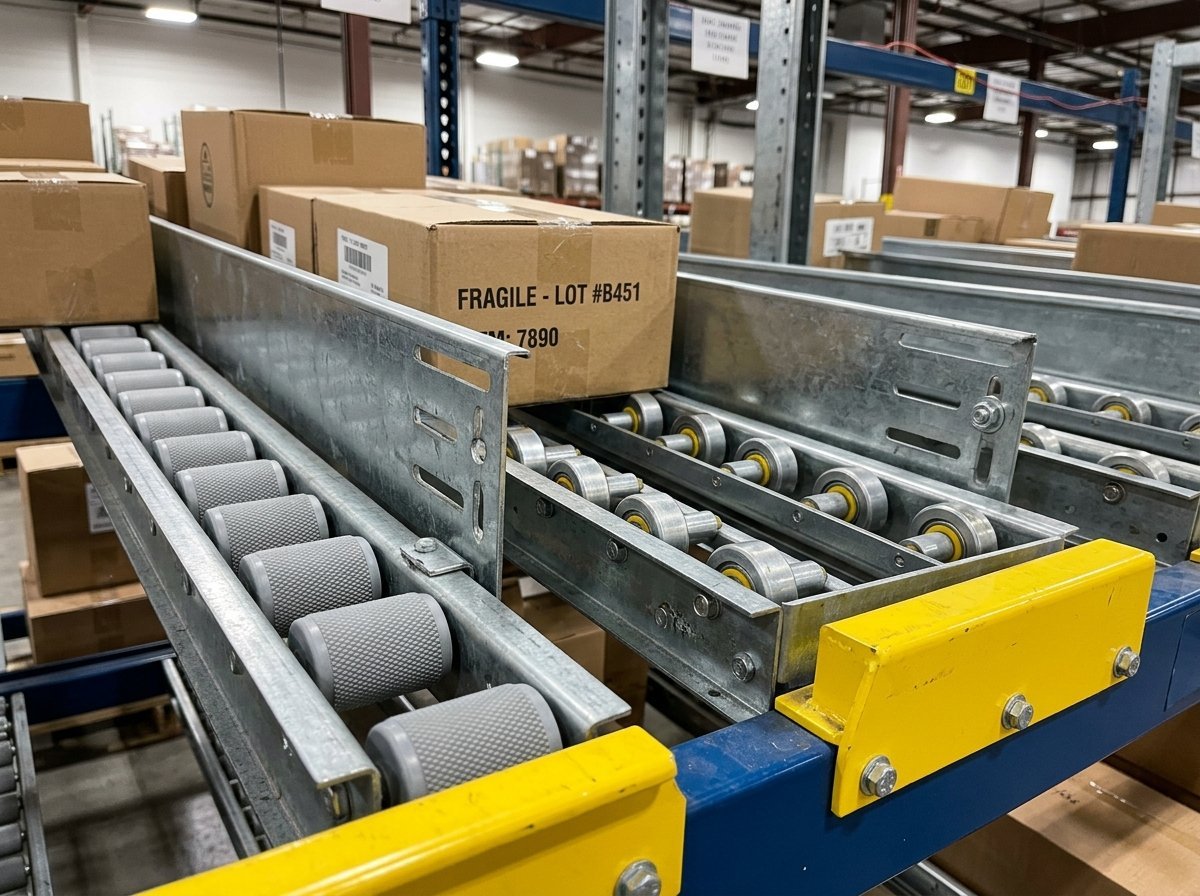
The mechanical efficiency of a carton flow system depends heavily on selecting the appropriate rolling media. Warehouse engineers select between two primary surface architectures: dedicated roller tracks and universal wheel beds.
1. Dedicated Roller Tracks
Dedicated roller tracks feature steel or high-impact polymer rollers mounted inside galvanized sheet steel channel side rails. Rollers typically measure 0.75 inches to 1.5 inches in diameter, spanning channel widths of 6 to 12 inches.
Each roller rotates on a steel axle pin, providing exceptionally low rolling friction. Dedicated tracks provide excellent tracking stability for uniform carton dimensions, making them ideal for high-volume manufacturing lines and standardized distribution packaging.
Because the tracks are fixed in position, establishing new lane widths requires unbolting or unhooking track brackets from shelf support beams. When configuring storage systems for variable carton dimensions, engineers evaluate the guidelines outlined in American National Standards Institute material handling specifications to calculate acceptable dynamic clearances.
2. Universal Wheel Beds
Universal wheel beds utilize continuous sheets of staggered polycarbonate or steel skate wheels spanning the entire width and depth of the rack shelf. Instead of distinct roller lanes, the shelf surface forms a dense field of rotating wheels.
This open layout allows warehouse managers to adjust lane widths instantly by moving snap-in steel divider guides. If packaging dimensions change from 8 inches wide to 14 inches wide, workers simply reposition the divider rails without tools.
Wheel beds are exceptionally versatile for third-party logistics (3PL) providers whose product profiles fluctuate with seasonal contracts. Facilities integrating wheel beds alongside manual hand-loading bays frequently pair them with bulk storage racking load capacities to stage oversized goods.
Incline Gradient and Slope Math
Establishing the correct pitch angle is the foundational engineering step in carton flow design. If the slope gradient is too flat, light cartons will stall midway down the lane, forcing workers to push boxes manually. If the slope is excessive, heavy cases build speed, resulting in carton impact damage and package rupture at the discharge stop.
The Slope Formula for Gravity Lanes
Standard carton flow track pitch requires 1/4-inch to 1/2-inch of vertical drop per linear foot of shelf depth. This corresponds to an incline angle between 1.2 degrees and 2.4 degrees from horizontal.
The formula for calculating shelf elevation drop is straightforward:
Total Vertical Drop (Inches) = Track Length in Feet × Pitch Factor (Inches per Foot)
For example, a shelf lane measuring 10 feet deep with an engineering pitch factor of 3/8-inch per foot requires a total elevation change of 3.75 inches between the rear charge beam and front discharge beam. In a 16-foot deep lane, the required vertical drop reaches 6 inches, which must be accounted for when establishing vertical shelf clearance.
Friction Factors and Temperature Influences
Different materials exhibit distinct rolling resistance values across gravity rollers. Smooth plastic totes with flat bottoms roll easily and require only 1/4-inch to 5/16-inch per foot of pitch.
Conversely, recycled corrugated boxes with soft fiber bottoms experience higher rolling drag, requiring 3/8-inch to 1/2-inch per foot. In cold storage distribution rooms running at 34 degrees Fahrenheit, roller bearing grease becomes stiffer, demanding steeper slopes to maintain consistent motion under Rack Manufacturers Institute flow lane standards.
Pick Tray Ergonomics: Straight vs Knuckle Trays
At the front pick face, the geometric interface between the flow track and the warehouse worker dictates picking speed and physical strain. Manufacturers provide two primary front-end discharge configurations: straight shelf discharge and drop-knuckle pick trays.
Straight Shelf Discharge
In a straight shelf configuration, the inclined roller track terminates directly at a horizontal front beam equipped with a steel carton stop. Cartons rest flat against the stop bracket at the same angle as the flow track.
Straight discharge works well for full-case picking operations where workers lift entire boxes off the shelf and place them directly onto pallet jacks or conveyor belts. However, for split-case picking where workers must peer inside open boxes to grab individual parts, straight shelves force awkward neck bending and deep wrist extension.
Drop-Knuckle and Tilt Trays
To optimize piece-picking ergonomics, modern carton flow shelves utilize angled drop-knuckle trays. A knuckle tray bends downward at the front discharge point, tilting the leading carton toward the picker at an angle of 15 to 30 degrees.
This tilted presentation provides clear sightlines into the contents of open totes and split cases. Workers can reach straight into the carton without straining their shoulders, significantly reducing repetitive motion injuries covered under OSHA general materials handling standards.
Drop-knuckle trays also prevent items from falling out of high shelf levels, improving both pick accuracy and warehouse safety. Warehouses staging lighter parts alongside dynamic flow lanes often utilize boltless shelving units setup guide for non-dynamic reserve parts.
Lane Dividers and Tracking Alignment
Without proper lateral confinement, cartons traveling down long gravity lanes tend to drift sideways, steer into adjacent rows, or twist out of square. This lateral drift causes carton shingling, where one box wedges under or over another, creating frustrating lane jams.
Rigid Steel Lane Dividers
Lane dividers are rigid sheet metal or wire guides that mount vertically between adjacent flow tracks. They extend the full depth of the shelf bay, forming distinct physical channels for each unique stock-keeping unit.
High-quality dividers feature snap-in mounting hooks that lock into punched slots along front and rear tie beams. This allows warehouse staff to reconfigure lane widths in seconds as carton sizes shift over seasonal product cycles.
Entry Guides and Flare Brackets
At the rear replenishment aisle, loading clerks often place cartons into lanes quickly. Entry guide flares widen the entrance of each lane by 1 to 2 inches, funneling incoming cartons cleanly into the center of the track.
These entry guides protect carton corners from crushing against divider edges and prevent operator misalignments. When integrating carton flow modules into heavy pallet rack uprights, facilities frequently install protective guards detailed in pallet rack accessories and column protectors to prevent lift truck damage at aisle entrances.
Carton and Container Specifications: Preventing Flow Stalls
Not all packaging materials roll smoothly on gravity tracks. The mechanical success of a carton flow system depends entirely on how the bottom surface of the package interacts with the rolling hardware.
Corrugated Box Quality and Bottom Sag
Standard corrugated cardboard cartons must possess adequate bottom rigidity. If a box is overloaded with heavy hardware or dense liquids, the bottom center of the carton can sag downward between roller wheels.
This condition, known as bottom deflection, causes the sagging cardboard to drag directly against track side rails or wheel axles, stopping carton motion completely. Bottom deflection should never exceed 0.25 inches under full payload.
To eliminate bottom sag issues, facilities handling heavy or fragile goods transition to rigid reusable plastic distribution totes with textured, ribbed bottom bases that roll effortlessly across wheel beds.
Banded and Strapped Boxes
Plastic strapping bands wrapped around cartons can create severe flow obstructions if the plastic seals or loose strap tails catch on roller edges. Strapping buckles must always be oriented on the top or sides of the box rather than the rolling bottom surface.
Similarly, cartons with peeling packing tape, crushed bottom corners, or wet fiberboard should be repacked or placed onto rigid slave trays before entering the flow lane.
Engineering Comparison: Carton Flow vs Alternative Picking Architectures
Selecting the optimal picking system requires evaluating pick frequency, inventory velocity, SKU variety, and physical footprint. The table below compares carton flow against three conventional warehouse picking configurations.
| Storage System | Picking Logic | Aisle Access | Pick Density | Labor Efficiency |
|---|---|---|---|---|
| Carton Flow Racking | Strict FIFO Split-Case | Separate Load & Pick | High (30+ SKUs/Bay) | Very High (Zero Travel Wait) |
| Static Industrial Shelving | Manual Static Reach | Shared Front Aisle | Low to Moderate | Moderate (High Walk Time) |
| Push Back Racking | Strict LIFO Pallets | Single Front Aisle | High (Pallet Level) | High for Full Pallets |
| Selective Pallet Racks | Individual Pallet Access | Aisle Every Row | Low Cube Density | Moderate (Forklift Travel) |
Operations that manage high-turnover e-commerce lines achieve maximum return on investment by implementing carton flow for fast-moving items while utilizing static shelving for slow-moving parts.
For operations staging full pallet loads behind pick lines, comparing this configuration with push back racking system sizing and cart mechanics helps identify optimal storage density for bulk reserve inventory.
Facilities seeking full unit-load pallet selectivity across hundreds of unique stock items rely primarily on selective pallet racking layout specifications on upper building levels above carton flow picking tunnels.
Integrating Carton Flow Under Pallet Racks
One of the most efficient warehouse space configurations is the integrated carton flow pick tunnel. In this layout, carton flow beds occupy the bottom two to three shelf tiers of standard pallet rack bays, while the upper tiers hold heavy bulk reserve pallets.
Pick Module Structural Design
In an integrated pick module, heavy structural step beams support drop-in carton flow shelf frames. Forklift trucks operate exclusively in dedicated upper replenishment aisles, placing full pallets onto the upper beam levels.
Order pickers walk safely along protected lower ground aisles, picking split-case inventory directly from carton flow discharge trays. This vertical segregation completely isolates pedestrian pickers from forklift traffic, delivering superior warehouse safety.
Beam Spacing and Load Capacities
Carton flow shelf assemblies typically support between 35 and 65 pounds per square foot of uniformly distributed load. A standard 96-inch wide by 96-inch deep carton flow shelf bay carries a total rated capacity of 2,000 to 3,500 pounds across all lanes.
Upright frames supporting combined pallet and carton flow loads must be engineered with heavy gauge steel to withstand combined static and dynamic load weights. Upright baseplates must be securely anchored into concrete floor slabs using heavy-duty wedge anchors.
Maintenance Schedules and Jam Resolution
Routine preventative maintenance preserves roller track responsiveness and prevents unexpected picking delays. Distribution centers should enforce structured inspection intervals.
Monthly Maintenance Tasks
Facility maintenance technicians should execute the following inspection checklist monthly:
- Inspect skate wheels and rollers for accumulated packing tape, string, and plastic film wrap that bind axles.
- Check lane divider alignment to verify tracks remain parallel and securely seated in beam punches.
- Examine front carton stop brackets for bent metal, loose mounting hardware, and impact cracks.
- Verify that drop-knuckle trays maintain structural rigidity without sagging under fully loaded boxes.
Safe Clearing of Jammed Lanes
When a box stalls inside a carton flow lane, workers must never climb onto the flow beds or crawl beneath inclined tracks. Stepping onto roller wheels can cause sudden slips and severe falls.
The standard protocol for clearing a stalled box is top-charging. The replenishment operator loads a second carton onto the track behind the stuck item and nudges it gently forward to break initial friction.
If charging fails, workers use specialized lightweight aluminum clearing poles with hooked ends operated safely from the access aisle, keeping personnel completely outside the rack frame.
Frequently Asked Questions
What is the difference between carton flow and pallet flow racking?
Carton flow is designed for split cases, individual cardboard boxes, and plastic totes, handling weights between 10 and 80 pounds per unit. Pallet flow handles full wooden or plastic pallets weighing 1,500 to 4,000 pounds, requiring heavy structural steel rollers and centrifugal speed controller brakes.
What is the ideal slope angle for carton flow shelves?
Standard carton flow systems require a pitch of 1/4-inch to 1/2-inch of vertical drop per linear foot of track, creating a slope angle between 1.2 and 2.4 degrees. Plastic totes typically run smoothly at 1/4-inch per foot, while soft recycled corrugated cartons often require 3/8-inch to 1/2-inch per foot.
What is the purpose of a drop-knuckle pick tray?
A drop-knuckle tray angles the leading carton downward 15 to 30 degrees toward the picker at the discharge point. This presentation improves visibility into open boxes and reduces wrist strain during high-velocity piece picking.
Can existing pallet racks be converted to carton flow?
Yes, standard pallet racks can be retrofitted with drop-in carton flow shelves or hanging track assemblies. Manufacturers produce universal shelf hangers and step beam brackets that attach directly to roll-formed step beams without structural modifications.

Callum Langham
Callum Langham is a warehouse storage consultant and structural racking specialist with over 14 years of hands-on experience specifying, installing, and certifying commercial storage solutions across North America.