Quick Answer: Selecting a Garage Storage Elevator
A garage storage elevator is an electric motorized ceiling platform or hoist system that lowers overhead storage down to waist height at the push of a button, completely eliminating ladder climbing. Commercial and residential units feature 120V electric motors powering worm-gear winches that spool braided steel aircraft cables or high-tensile nylon straps. Typical platform sizes range from 4×4 feet to 4×8 feet with weight capacities from 170 to 600 pounds. Selecting the right elevator requires matching motor horsepower and cable tensile strength to your garage ceiling joist span, ensuring automatic braking transmissions prevent load drops during power failures, and installing a dedicated 15-amp or 20-amp electrical circuit.
Key Takeaways
- Zero Ladder Fall Risks: Motorized ceiling elevators bring heavy bins, tires, and holiday gear down to floor level, removing the leading cause of garage ladder injuries.
- Worm-Drive Self-Locking Transmissions: Quality lifts use irreversible worm gearboxes that mechanically lock the spool in place, preventing the platform from dropping even if the power cuts out mid-lift.
- Multi-Joist Load Distribution: Heavy platforms carrying 400 to 600 pounds must span across at least three or four wood ceiling joists with 5/16-inch lag bolts to comply with residential framing limits.
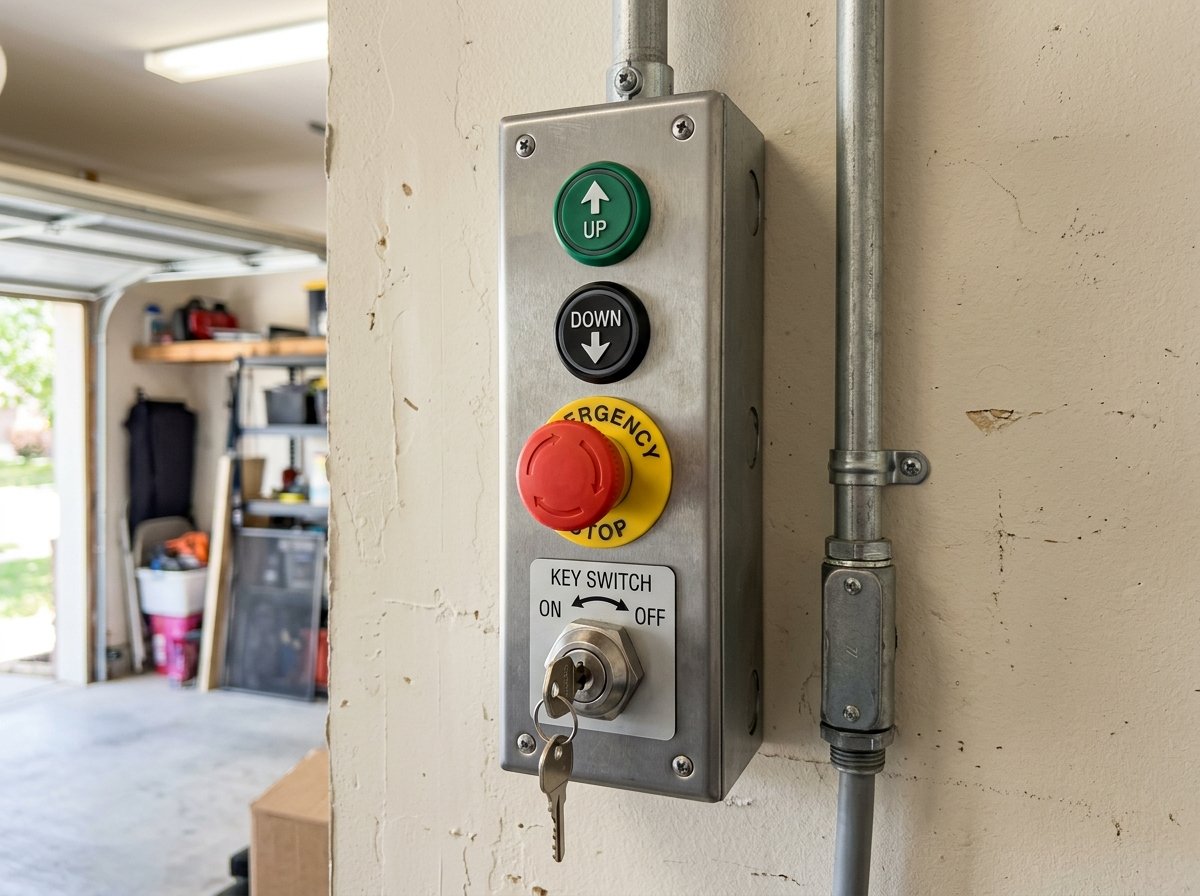
- Safety Lockout Controls: Choose elevator systems equipped with keyed wall switches, upper mechanical limit shutoffs, and emergency stop buttons to prevent accidental crushing over parked cars.
The Mechanics of Ceiling Storage Elevators
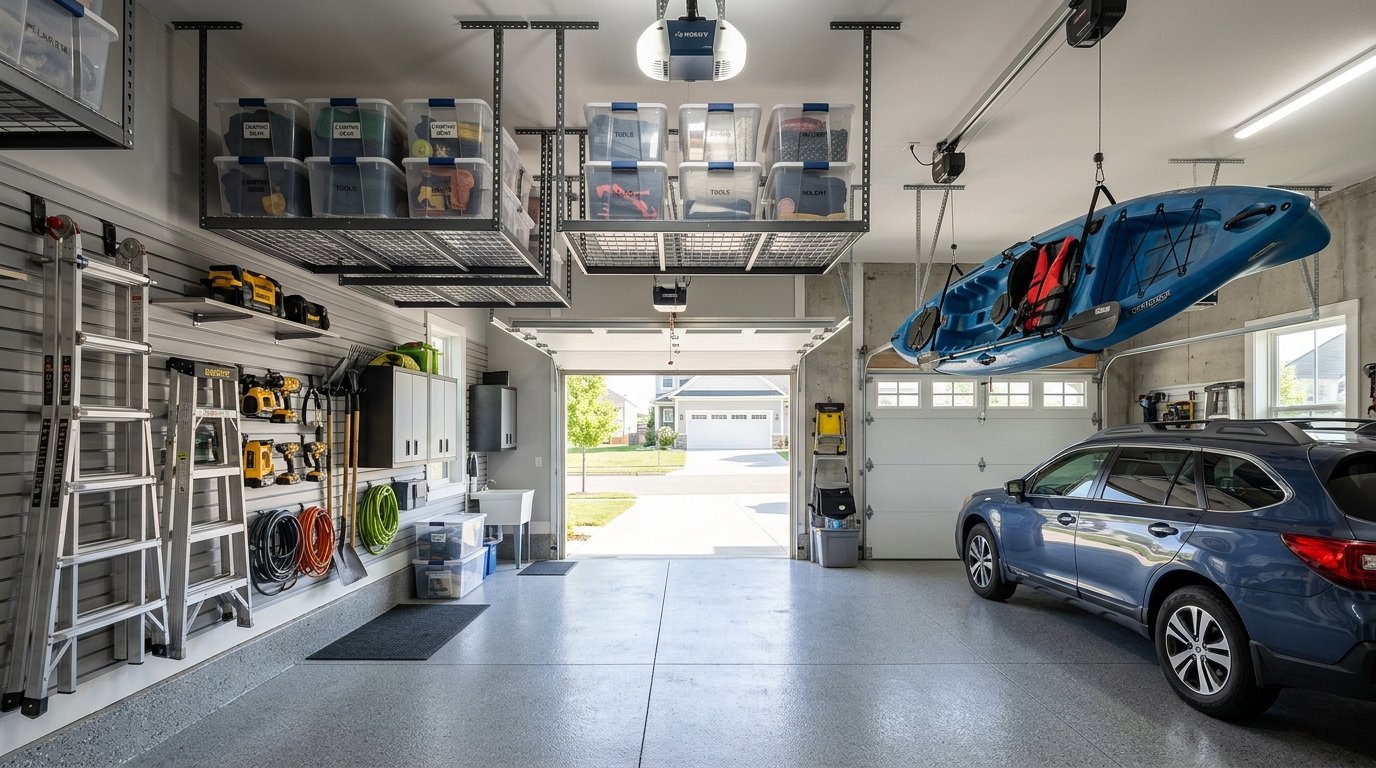
Stationary overhead wire shelves make excellent use of unused vertical volume, but accessing them requires balancing on an eight-foot stepladder while hoisting fifty-pound storage containers. For homeowners with physical limitations or simply zero interest in wrestling heavy gear overhead, stationary platforms become dangerous dead zones. To review manual lowered options, check our guide on overhead garage storage racks that lower.
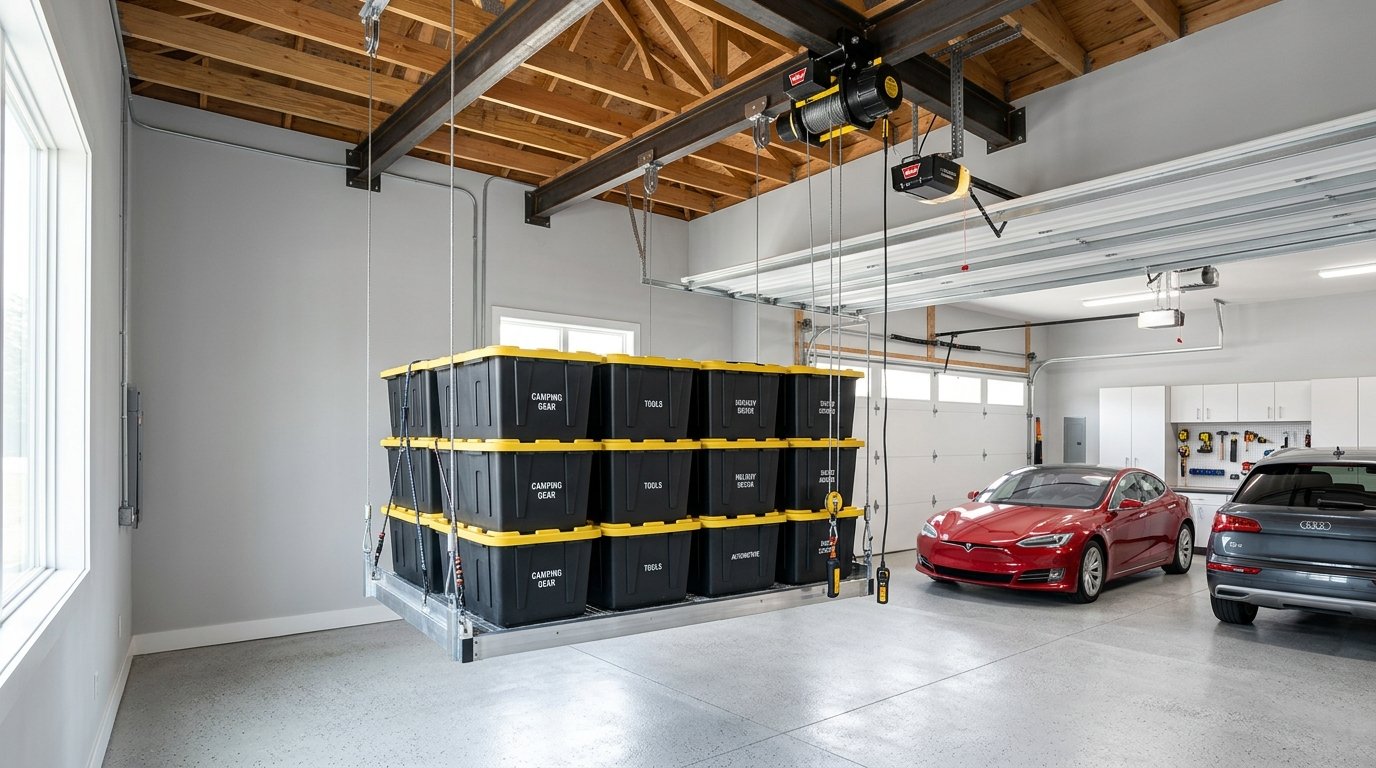
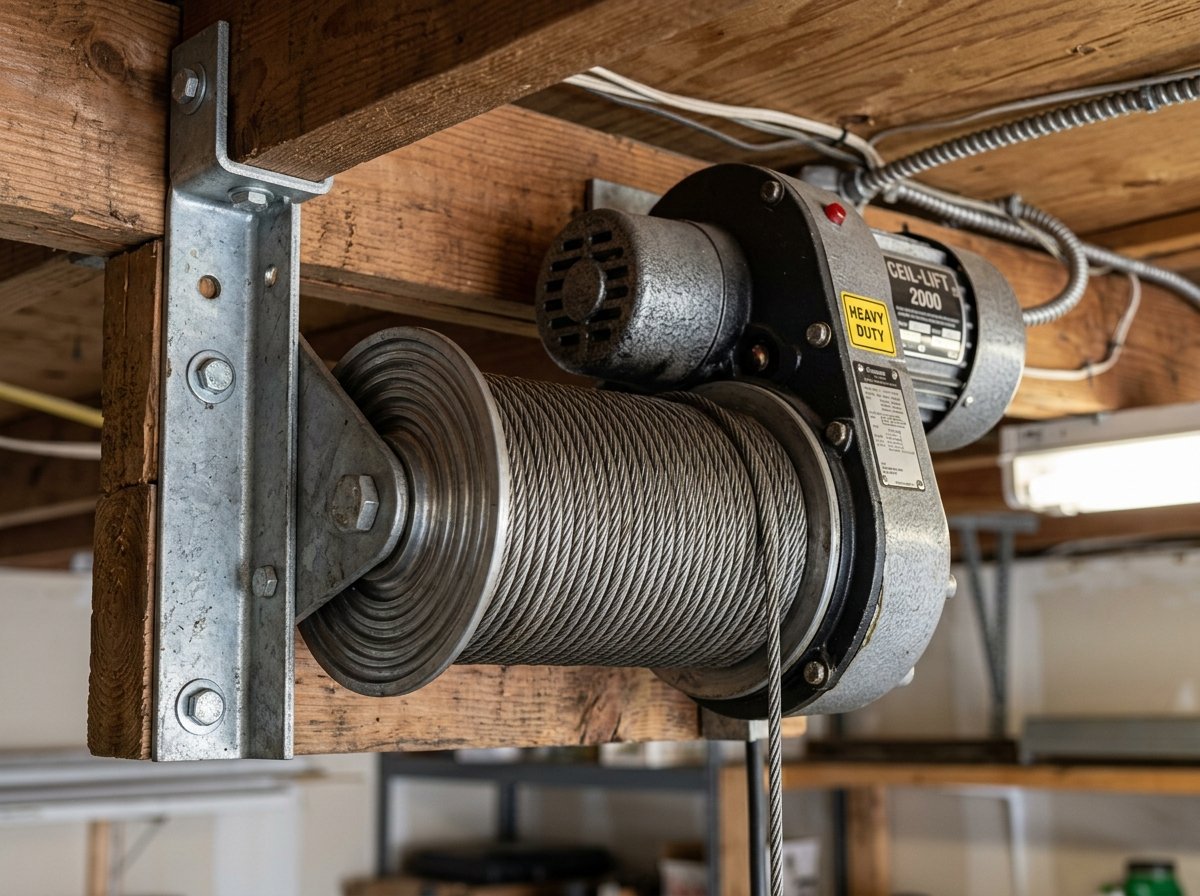
A motorized garage storage elevator solves this ergonomics issue by transforming stationary ceiling decking into a mechanized vertical dumbwaiter. The core mechanism consists of an electric winch motor, heavy-gauge ceiling mounting channels, synchronized cable drums, and a rigid structural steel platform.
When you depress the wall control switch, the motor drives a geared drive shaft that turns synchronized cable spools. Four high-strength aircraft cables lower the perimeter of the platform evenly to floor or tailgate height. After loading or unloading your supplies, pressing the upward switch winds the cables back onto their grooved drums, seating the platform flush against the ceiling framing.
Cable Hoists vs. Nylon Strap Drives
Manufacturers employ two primary suspension mediums to raise and lower garage elevator platforms: braided galvanized steel aircraft cables and high-tensile woven polyester straps. Both designs carry pros and cons that dictate maintenance routines and service lifespans.
Braided steel aircraft cables (typically 1/8-inch to 5/32-inch diameter) offer superior ultimate tensile strength, often exceeding 2,000 pounds per line. Steel wire does not degrade under prolonged heat exposure near garage ceiling drywall. The primary challenge with wire cables is spool nesting; if a cable slacks during descent, it can bird-nest inside the winch housing.
Woven polyester or nylon webbing straps (similar to heavy vehicle seatbelts) operate with zero cable chatter and wind flat across smooth spindles without tangling. Strap systems run significantly quieter than steel cables. However, nylon straps must be inspected annually for edge fraying caused by friction against ceiling bracket edges.
5 Types of Garage Storage Elevators Compared
Garage ceiling elevators vary widely based on lifting capacity, motor configuration, and physical footprint. To compare broader ceiling mounting hardware, explore our garage hanging storage and ceiling hoists guide.
Understanding the five primary product categories helps you select the correct hardware for your specific storage items and ceiling height:
- 1. Motorized Platform Elevators (Auxx-Lift, ONRAX Ascension): Heavy-duty residential lifts featuring full 4×8-foot or 4×4-foot steel wire decks. Dual synchronizing motors lift 400 to 600 pounds of heavy equipment, storage bins, and automotive parts straight up to the ceiling.
- 2. Integrated Motorized Hoist Bars (Garage Gator): Compact motorized bars that lower from the ceiling with specialized hanging hooks. Rated for 125 to 220 pounds, they excel at raising bicycles, golf bags, ladders, and spare tires without occupying a large flat footprint.
- 3. Attic Floor Storage Elevators (SpaceLift, Versa Lift): Specialized electric dumbwaiters installed directly into a framed opening between the garage ceiling and the attic floor deck. Instead of parking below the ceiling, the cargo passes through the ceiling drywall into the attic space above.
- 4. Cordless Drill & Manual Crank Hoists (Racor Ceiling Lift): Mechanical platforms raised using a hand crank or a chuck adapter driven by a standard 18V cordless drill. While slower than dedicated motorized units, they carry up to 250 pounds without requiring hardwired 120V electrical circuits.
- 5. Specialized Smart Hoists (Garage Smart Lifter): Modular smart winches controlled via smartphone Bluetooth applications. Multiple synchronized hoist units communicate wirelessly to balance uneven loads like hardtop Jeep roofs, kayaks, or cargo carrier boxes.
Technical Sizing & Specification Comparison Table
Always evaluate motorized storage platforms by their continuous lifting ratings, platform dimensions, and motor safety features. For slide-rail tote alternatives, review our SafeRacks storage bin rack sizing guide.
| Elevator Model / Type | Platform Size | Weight Capacity | Hoist Medium | Control System | Best Use Case |
|---|---|---|---|---|---|
| Auxx-Lift Pro 4×8 | 48″ × 96″ (32 sq ft) | 600 lbs | Dual Steel Cables | Wireless Remote + Keyed Wall Switch | Heavy bulk totes, tools, spare vehicle wheels |
| Garage Gator GG8220PL | 36″ × 72″ (18 sq ft) | 220 lbs | Braided Steel Cable | Tethered Keyed Hand Controller | Medium residential bins, camping gear, coolers |
| SmarterHome 4×4 Platform | 48″ × 48″ (16 sq ft) | 400 lbs | Polyester Straps | Smartphone App + Bluetooth Wall Switch | Smart home integration, precise programmable stops |
| SpaceLift 5228 Attic Lift | 24″ × 41″ Floor Pass | 200 lbs | Poly-Webbing Straps | Keyed Two-Button Wall Station | Direct attic transport, hidden overhead storage |
| Racor PHL-1R Mechanical | 48″ × 48″ (16 sq ft) | 250 lbs | Steel Aircraft Cable | Hand Crank / Cordless Drill Chuck | Budget-friendly setup without electrical wiring |
Ceiling Framing & Structural Joist Load Limits
Lifting a 600-pound loaded platform into your ceiling space introduces substantial dead loads that residential roof trusses were not originally engineered to support as single concentrated points. Never hang a motorized hoist from a single wood joist without load-spreading cross members.
According to structural wood framing guidelines published by the American Wood Council (AWC) wood structural guidelines, ceiling joists carrying drywall and bottom-chord truss loads are typically designed for a maximum uniform dead load of 10 to 20 pounds per square foot. Mounting a heavy hoist requires transferring vertical shear across multiple framing members.
Always bolt two 2×6 or 2×8 dimensional lumber cross-spanners perpendicular across at least three ceiling joists. Fasten the spanners using 5/16-inch by 4-inch structural wood screws into the exact centerline of each joist. Bolt your motorized elevator ceiling channels directly through these spanners to distribute the weight across multiple building trusses.
Motor Horsepower, Gearboxes & Fail-Safe Braking
The safety of any overhead hoist rests entirely on its drive transmission. Standard consumer utility winches frequently use planetary gearsets that rely on dynamic motor friction to stop descent. If power is interrupted while raising a load, standard winches can backdrive and freewheel downward.
High-end garage storage elevators use high-reduction worm-gear transmissions. A worm gear can easily turn the worm wheel, but the wheel cannot mechanically rotate the worm shaft in reverse. This mechanical lockout guarantees that even if a circuit breaker trips or your home loses power, the platform remains suspended securely in place.
Select hoist units certified under industrial lifting rules, such as OSHA 1910.179 overhead and gantry cranes standards. Quality hoist motors feature internal thermal overload switches that shut down the unit if continuous cycling creates excessive winding heat.
Electrical Requirements & Safety Lockout Controls
Electric garage elevators require steady, unshared voltage to operate safely without tripping household breakers. Most electric hoist motors draw between 6 and 12 continuous amps during peak ascent loads.
Under the National Electrical Code (NEC / NFPA 70) branch circuit rules, garage electrical receptacles require GFCI protection. If your hoist motor shares an outlet with a heavy-draw deep freezer or air compressor, startup surges can cause breaker trips mid-operation. Always plug your ceiling motor into a dedicated 15-amp or 20-amp ceiling circuit.
Safety lockouts are equally critical in family homes. Children must never have unfettered access to downward directional buttons. Ensure your wall station features a keyed lockout cylinder. Remove the safety key when the elevator is parked in its top position to prevent unauthorized operation.
Step-by-Step Installation & Commissioning Protocol
Installing a motorized ceiling storage elevator requires two adults, a heavy-duty drill, sockets, level, and two sturdy ladders. Follow this sequence to ensure safe setup:
Step 1: Map Joists and Clear Garage Door Paths
Open your garage door completely before marking ceiling bracket positions. Measure the clearance between the highest point of the garage door track and the ceiling. The elevator platform must sit far enough back from the door opener so raised storage bins do not contact moving door panels.
Step 2: Mount Cross-Spanners and Ceiling Channels
Locate joist centers with a deep-scanning stud finder. Pre-drill 3/16-inch pilot holes at least 2.5 inches deep into solid framing. Fasten heavy lumber spanners perpendicular across three joists, and bolt the metal hoist mounting channels to the spanners using grade 5 lag screws and flat washers.
Step 3: Hang Motor and Thread Suspension Cables
Hoist the electric motor unit into place and secure it to the ceiling brackets with locking nuts. Carefully unspool the steel cables or polyester straps, threading them through ceiling guide pulleys down toward the four platform corner positions. Keep uniform tension on all lines to prevent cable slack.
Step 4: Assemble and Level the Steel Platform
Assemble the perimeter steel frame and wire mesh decking on the garage floor directly underneath the hoist. Fasten the lifting cables to the four corner eye-bolts. Adjust the turnbuckles on each cable line until the platform hangs completely level in both horizontal planes.
Step 5: Calibrate Upper and Lower Travel Limit Stops
Before loading weight onto the platform, cycle the elevator up and down while completely empty. Adjust the rotary travel limit switches on the motor housing so the platform stops automatically 3 inches below the ceiling framing. Set the bottom limit so the platform rests gently at waist height for comfortable loading.
For ground-level static options to pair with overhead lifts, compare our overhead rack garage storage systems overview and our heavy duty storage racks for garage guide.
Frequently Asked Questions
Can you install a garage storage elevator on an angled or vaulted ceiling?
Yes, but specialized angled mounting brackets are required. Most motorized ceiling lifts feature adjustable pivot brackets that accommodate ceiling pitches up to 30 or 45 degrees. When installing on a vaulted ceiling, ensure the lifting cables hang plumb and perpendicular to the garage floor so the platform ascends level without swinging laterally against walls.
How much does a motorized garage storage elevator cost?
A basic manual crank ceiling lift costs between $250 and $400. Motorized bar hoists for bikes and ladders range from $350 to $600. Heavy-duty 4×8-foot motorized platforms capable of lifting 400 to 600 pounds (such as Auxx-Lift or SmarterHome) typically cost between $1,200 and $2,200 depending on motor horsepower and smart control options. Specialized pass-through attic dumbwaiters range from $2,000 to $3,500 before installation.
What happens if the power goes out while the elevator is raised?
Quality motorized ceiling lifts utilize worm-gear transmissions or electromagnetic fail-safe brakes. When electrical power is cut off, the worm drive mechanically locks the cable drum, preventing the platform from dropping even a fraction of an inch. Some premium models also include a manual hex drive socket on the motor housing, allowing you to lower the platform manually using a cordless drill during extended power outages.
How much weight can a ceiling storage elevator lift safely?
Residential motorized platform lifts are rated to carry between 200 and 600 pounds of uniformly distributed load. Never exceed the manufacturer’s stated gross weight capacity. Always account for the weight of your storage containers in addition to the items stored inside, and ensure your ceiling framing is structurally reinforced across multiple joists to support the concentrated dead load.

Callum Langham
Founder & Technical Storage Editor
Callum Langham is the founder and technical editor of Rack System. With over 12 years of hands-on field experience in warehouse logistics, garage organization, and industrial storage installations, Callum specializes in engineering safety standards, beam load calculations, and OSHA/RMI compliance. Every Rack System guide is audited against verified steel gauge tolerances and municipal building codes.