Quick Technical Summary
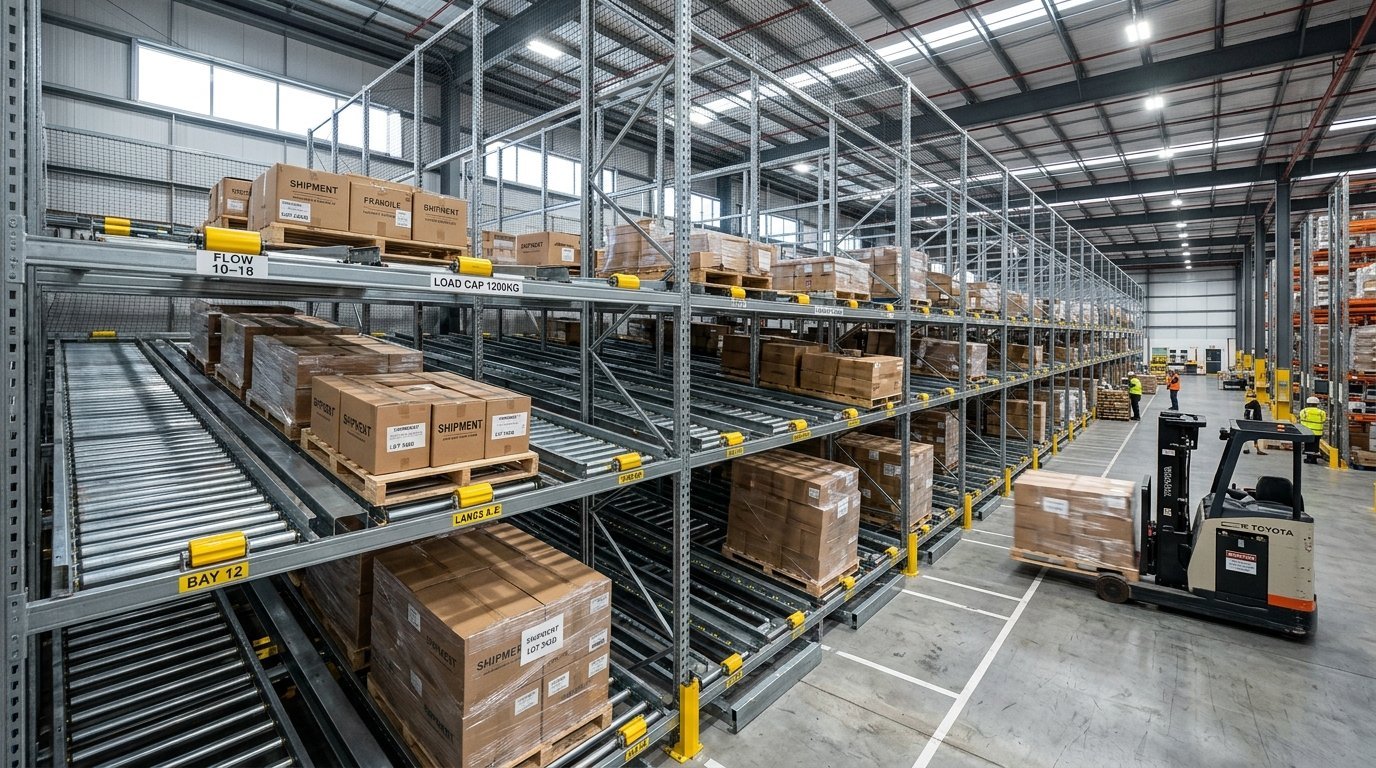
A pallet flow racking system is a high density dynamic storage solution utilizing slightly sloped wheeled tracks or steel rollers to move palletized loads via natural gravity. Operating on a strict First-In, First-Out (FIFO) material handling sequence, pallet loads enter at the rear replenishment aisle and glide forward along a controlled incline toward the front discharge face. Engineered with mechanical centrifugal speed controllers and physical pallet separators, pallet flow lanes span from 2 to over 20 pallets deep, maximizing warehouse floor space utilization while isolating loading traffic from discharge traffic.
Key Engineering Takeaways
- FIFO Dynamic Inventory: Pallet flow is the premier choice for perishable inventory, date-sensitive goods, and rapid turnover distribution centers needing strict lot code rotation.
- Gradient Slope Standard: Standard pallet flow track incline requires 3/8-inch to 1/2-inch of vertical drop per linear foot of track, establishing an effective gravity pitch of 2 to 4 degrees.
- Centrifugal Speed Regulation: Internal speed controller brake drums engage automatically as line velocity exceeds 50 feet per minute, absorbing kinetic energy and preventing catastrophic runaways.
- Line Pressure Relief: Mechanical pallet separators lock the line of reserve pallets behind the lead discharge unit, eliminating excessive hydrostatic forward push against the unloading forklift.
- Pallet Quality Requirement: Smooth pallet flow demands rigid wood or plastic bottom deckboards free of cracked stringers, protruding fasteners, and bottom surface deflection exceeding 0.25 inches.
What Is a Pallet Flow Racking System
Modern distribution centers handling fast-moving consumer products and cold storage operations face constant pressure to conserve floor area while sustaining rapid throughput. Traditional selective configurations consume immense square footage by requiring a dedicated forklift access aisle for every single storage row.
A pallet flow racking system eliminates interior access aisles by compacting storage rows into deep continuous gravity lanes. The system operates through two distinct working faces: dedicated entry charging aisles where lift trucks deposit pallets, and dedicated picking discharge aisles where lift trucks retrieve loads.
Because replenishment operations and picking activities take place in separate aisles, traffic congestion drops significantly. Facilities combining dynamic pallet flow lanes with a structural pallet racking system engineering guide achieve high density storage without sacrificing fulfillment velocity.
How FIFO Gravity Flow Mechanics Operate
The operational core of every pallet flow lane relies on pure potential energy converted into controlled kinetic motion. When a forklift operator sets a pallet onto the charge end, the inclined track allows the unit load to roll smoothly toward the pick face under the influence of gravity.
First-In, First-Out inventory sequencing is enforced automatically by the physical geometry of the lane. The first pallet placed into the charge entrance glides all the way down to the discharge stops, making it the first pallet retrieved during order picking cycles.
This automated rotation protects manufacturing operations from stock obsolescence and spoilage. When evaluating warehouse floor plans, industrial managers frequently consult warehouse storage solutions layout planning to establish optimal lane depths across active stock-keeping units.
Track Architecture: Full-Width Rollers vs Skate Wheels
Specifying the internal rolling hardware is the most critical mechanical decision during flow system engineering. Manufacturers offer two primary rolling media: full-width steel rollers and polycarbonate or steel skate wheel tracks.
1. Full-Width Heavy Duty Steel Rollers
Full-width rollers consist of galvanized or structural steel tubes measuring 1.9 inches to 2.5 inches in diameter, spanning the full bottom surface of the pallet. Each roller rides on precision commercial ball bearings packed with low-temperature synthetic grease to ensure smooth rotation in freezer environments.
Full-width rollers distribute heavy loads across broad contact patches, reducing concentrated pressure on bottom pallet boards. These systems handle uneven wooden pallets, corrugated skids, and heavy metal storage containers weighing 2,500 to 4,000 pounds per pallet position.
Because full-width rollers provide complete bottom support, they tolerate minor board split defects that would cause skate wheels to bind. Industrial facilities seeking dependable long-term durability typically specify full-width steel rollers conforming to ASTM structural steel specifications.
2. Multi-Track Skate Wheels
Skate wheel systems utilize staggered rows of zinc-plated steel or reinforced polymer wheels mounted on structural steel angle tracks. A standard three-track skate wheel lane provides six distinct contact lines along the pallet baseboards.
Skate wheel lanes require less initial capital outlay than continuous full-width rollers and perform well with standard 40-inch by 48-inch GMA wooden pallets in uniform condition. However, skate wheels exert concentrated point loads on bottom deckboards, making them sensitive to cracked bottom runners.
For operations staging uniform plastic grocery pallets or light distribution totes, skate wheels deliver reliable gravity flow. When managing hand-picked bulk storage lines alongside pallet flow lanes, engineers frequently incorporate bulk storage racking load capacities for non-palletized inventory.
Pitch and Incline Gradient Calculations
Achieving reliable gravity flow without uncontrolled pallet acceleration demands precise geometric slope design. If the incline angle is too shallow, pallets stall halfway down the lane, requiring dangerous manual operator intervention. If the slope is too steep, heavy pallets build excessive momentum that can damage equipment and structural frames.
The Standard Slope Formula
The standard slope specification for commercial pallet flow systems is 3/8-inch to 1/2-inch of vertical drop per linear foot of track length. In angular measurements, this translates to an incline of 1.79 degrees to 2.38 degrees from horizontal plane.
To calculate the total elevation change from the rear charge aisle to the front discharge stop, use the following engineering formula:
Total Pitch Elevation (Inches) = Lane Length in Feet × Slope Gradient (Inches per Foot)
For a 5-pallet deep lane measuring 20 feet in clear length with a 7/16-inch per foot slope factor, the charge beam must sit 8.75 inches higher than the discharge beam. In deep lanes spanning 15 pallets (60 feet), the total elevation differential reaches 26.25 inches, requiring careful vertical clearance planning inside the building envelope.
Environmental and Pallet Resistance Variables
The required pitch varies depending on ambient temperatures and pallet construction materials. Cold storage and deep freezer warehouses operating at minus 10 degrees Fahrenheit require a steeper gradient (typically 1/2-inch per foot) to overcome increased bearing grease viscosity.
Plastic pallets with smooth bottom runners generally experience lower rolling resistance than rough hardwood pallets, allowing shallower pitch settings. Before finalizing upright beam levels, engineers conduct physical flow testing using the client actual inventory pallets to calibrate starting inertia and coasting velocity under Rack Manufacturers Institute design specifications.
Speed Controllers: Mechanics of Centrifugal Braking
In pallet flow lanes exceeding three pallets in depth, gravity accelerates unchecked loads to hazardous velocities. A 3,000-pound pallet traveling unrestricted down a 50-foot lane will accumulate enough kinetic force to shear discharge stops and buckle structural steel uprights.
Centrifugal Brake Drum Principles
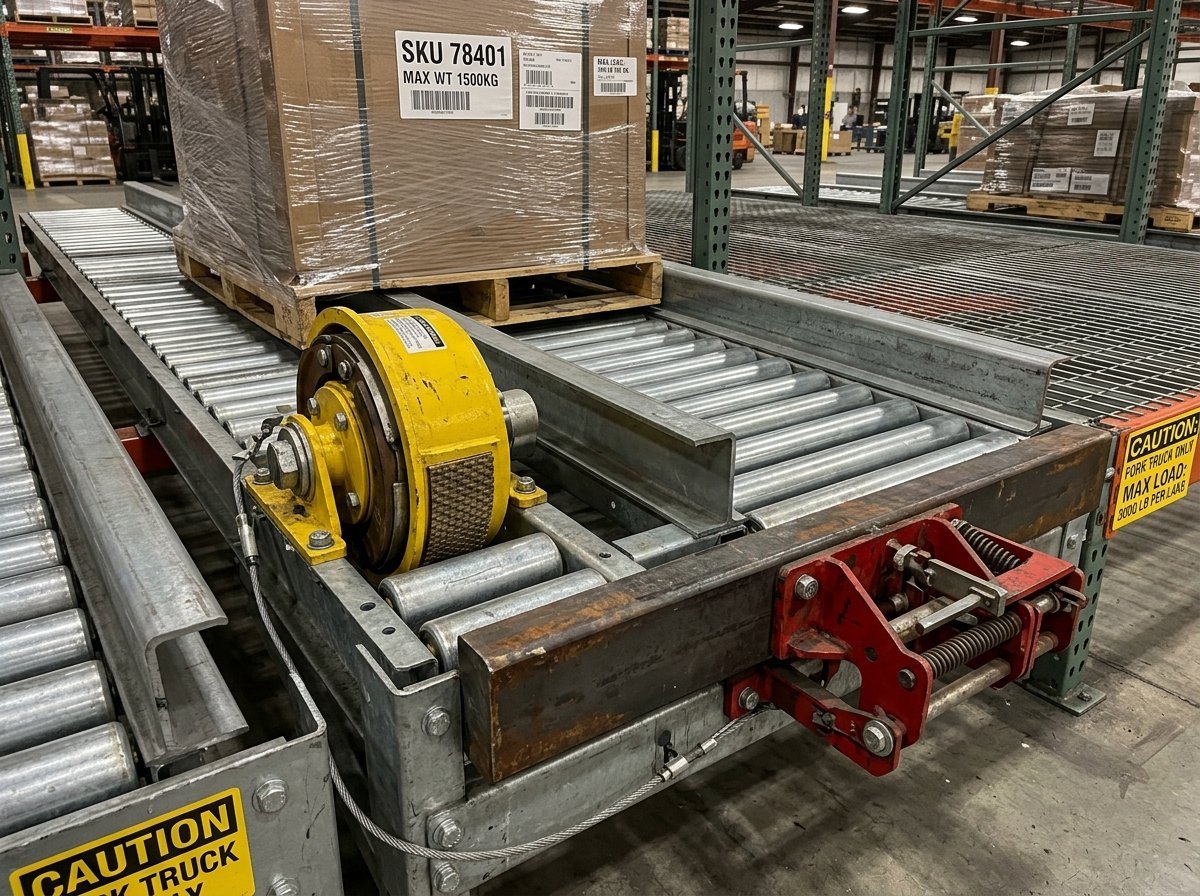
Centrifugal speed controllers prevent runaway pallet motion by providing passive, mechanical velocity governing directly inside the roller track. These devices consist of internal flyweights and friction pads housed inside a specialized steel roller drum.
When a pallet glides over the speed controller at low velocity, the internal flyweights remain retracted, producing negligible resistance. As the pallet velocity approaches 45 to 50 feet per minute, centrifugal force flings the weighted friction shoes outward against the drum perimeter, generating proportional braking torque.
Because braking friction increases exponentially with rotational speed, centrifugal controllers maintain uniform pallet travel regardless of unit weight variations. A 1,200-pound carton load and a 3,000-pound drum skid both glide smoothly at approximately 50 feet per minute down the entire lane.
Controller Spacing Rules
Proper controller frequency depends on total lane depth and pallet gross weight ratings. Standard engineering guidelines dictate positioning the first speed controller two pallet depths down from the charge entrance.
Subsequent speed controllers are installed at intervals of every one to two pallet positions along the remaining run of track. In ultra-deep lanes holding 15 to 20 pallets, continuous speed governing prevents kinetic energy accumulation and protects warehouse operators working under OSHA general materials handling standards.
Pallet Separators: Eliminating Dangerous Line Pressure
One of the most dangerous mechanical phenomena in deep gravity flow lanes is cumulative line pressure, also known as hydrostatic pallet thrust. Understanding line pressure dynamics is essential for operational warehouse safety.
The Physics of Hydrostatic Thrust
When five or ten heavy pallets rest nose-to-tail in an inclined lane, each pallet transfers its downhill gravity component to the pallet ahead of it. The lead pallet resting against the front discharge stop absorbs the combined downward thrust of every trailing load in the bay.
In a 10-pallet lane with 2,500-pound loads on a 2-degree slope, the forward pressure exerted on the lead discharge stop can exceed 1,800 pounds of continuous force. When a forklift operator attempts to lift the front pallet, this trapped pressure pinches the forks tightly against the upright frames, creating severe equipment jams or sudden catastrophic pallet ejection.
Mechanical Pallet Separator Function
Engineers solve hydrostatic thrust by installing mechanical pallet separators near the discharge end. A pallet separator consists of a spring-loaded foot pedal and an automatic rear holding brake or steel chock.
When the lead pallet arrives at the pick face, it depresses the trigger mechanism, engaging a heavy steel stop arm that locks the second pallet six inches behind the front unit. This physical gap completely isolates the lead pallet from the weight of trailing inventory.
Once the forklift operator lifts and removes the front pallet, the trigger arm resets automatically, releasing the second pallet to roll forward into the pick position while re-engaging the separator for the next cycle. Operations balancing high-density picking rows frequently install heavy-duty column buffers detailed in pallet rack accessories and column protectors to shield discharge corners from lift truck impact.
Pallet Quality and Defect Protocols
Pallet flow racking is fundamentally an automated conveyor system embedded within structural steel framing. The physical pallet acts as the direct mechanical interface with the rollers. Inferior or damaged pallets represent the primary cause of flow lane stoppages.
Critical Pallet Requirements
To ensure consistent movement across flow lanes, facilities must implement strict pallet quality standards at receiving inspection:
- Bottom Deckboard Continuity: Wooden pallets must feature minimum 5/8-inch thick bottom boards oriented parallel to the roller travel direction without missing end slats.
- Fastener Flushness: All nails, screws, and staples must sit flush or countersunk below the wood surface to prevent gouging soft rollers.
- Bottom Deflection Limits: Pallet bases must not sag or bow more than 0.25 inches under full rated payload, ensuring uniform contact across all lane rollers.
- Stringer Integrity: Cracked stringers, broken companion boards, and protruding wood splinters must be disqualified before charging into flow lanes.
Plastic and slave pallets provide exceptionally consistent rolling surfaces. However, plastic runners must incorporate anti-slip friction strips on top surfaces to prevent loads from shifting during dynamic deceleration.
Engineering Comparison: Pallet Flow vs Alternative High-Density Systems
Choosing the correct racking geometry requires balancing inventory turnover rates, stock depth requirements, capital expenditure, and forklift accessibility. The table below compares pallet flow against three common storage configurations.
| Racking System | Flow Logic | Lane Depth | Aisle Efficiency | Capital Investment |
|---|---|---|---|---|
| Pallet Flow | Strict FIFO | 2 to 20+ Pallets | High (2 Aisles Total) | High (Tracks & Brakes) |
| Push Back Racking | Strict LIFO | 2 to 6 Pallets | Moderate (1 Aisle) | Moderate (Cart Nest) |
| Drive-In Racking | Strict LIFO | 5 to 12 Pallets | High (1 Aisle) | Low to Moderate |
| Selective Racking | FIFO or LIFO | 1 to 2 Pallets | Low (Aisle Every Row) | Low (Static Beams) |
When operations handle products with rapid expiration cycles, pallet flow is advantageous because it guarantees strict FIFO compliance. Conversely, facilities managing non-perishable goods with lower turnover often compare this setup with push back racking system sizing and cart mechanics to reduce initial capital expenditure.
For operations needing high density bulk staging with minimal selective picking, exploring drive in racking system density configurations offers an economical alternative for single-SKU manufacturing batches.
Warehouses requiring complete selectivity for thousands of unique low-volume parts consistently prefer selective pallet racking layout specifications despite lower floor space utilization.
Structural Frame Sizing and Upright Engineering
Pallet flow racks impose unique dynamic and dead weight stresses on structural framing. Unlike static shelving, dynamic lanes transfer sudden deceleration forces into upright columns during pallet impact.
Upright Column Gauge and Steel Profiles
Engineers specify heavy-duty roll-formed or structural steel channels for flow lane uprights. Upright columns typically utilize 12-gauge or 13-gauge high-strength steel with reinforced front column corners.
Because the discharge face experiences repeated impact as forklift operators retrieve pallets, structural front posts or heavy steel insert reinforcements are highly recommended for the lowest 48 inches of the pick column.
Frame baseplates must feature oversized steel footings measuring at least 6 inches by 8 inches by 3/8-inch thick. These baseplates spread vertical column loads evenly across the warehouse concrete slab to prevent punch failures.
Beam Tie and Track Bracing Standards
Track assemblies must remain square throughout decades of continuous operation. Any diagonal twist or frame racking causes the rollers to skew, steering pallets directly into side guide rails.
To preserve structural alignment, engineers install rigid horizontal beam ties and diagonal structural sway bracing between upright bays. Welded structural channel ties lock parallel roller tracks into fixed positions, maintaining millimeter-precise wheel spacing.
Anchoring schedules require minimum 1/2-inch by 4.5-inch wedge anchors embedded into 4,000 PSI concrete floor slabs to resist lateral shear loads created by moving inventory.
Maintenance Protocols and Troubleshooting Jammed Lanes
A proactive preventative maintenance program prevents lane stoppages and extends roller hardware service life. Operations should establish weekly and quarterly inspection schedules.
Weekly Inspection Tasks
Warehouse supervisors should conduct visual walks along charge and discharge aisles weekly:
- Check discharge stops for metal deformation, cracked welds, and missing mounting bolts.
- Inspect entry guide flares to verify they guide incoming pallets cleanly into lane centerlines.
- Examine roller tracks for pallet wood chips, stretch wrap fragments, and debris obstructing wheel rotation.
- Verify that mechanical pallet separator linkages return smoothly to locked positions without sticking.
Safe Clearing Protocols for Stalled Pallets
When a damaged pallet or foreign object causes a unit load to hang up inside a lane, personnel must never enter the rack bay on foot. Climbing into an active gravity flow lane is extremely dangerous because dislodging the stuck pallet can cause trailing loads to rush forward without warning.
To safely clear a stalled lane, trained forklift operators utilize the charging method. The operator positions a second loaded pallet at the charge entrance and gently nudges the stuck load forward until gravity re-engages the rollers.
If charging fails, maintenance personnel utilize specialized overhead remote winch lines or mechanical pole tools operated strictly from outside the rack envelope while wearing certified fall protection harnesses.
Frequently Asked Questions
What is the primary difference between pallet flow and push back racking?
Pallet flow operates on a First-In, First-Out sequence using separate loading and unloading aisles, allowing lanes to extend over 20 pallets deep. Push back racking operates on a Last-In, First-Out sequence from a single front aisle using nested sliding carts, typically limited to 2 to 6 pallets deep.
What slope gradient is required for reliable pallet flow operation?
Standard pallet flow systems require an incline of 3/8-inch to 1/2-inch of vertical drop per linear foot of track, which corresponds to approximately 2 to 4 degrees. Cold storage freezers typically utilize a slightly steeper 1/2-inch per foot slope to overcome colder bearing grease resistance.
How do speed controllers prevent pallets from crashing into discharge stops?
Speed controllers utilize internal centrifugal flyweights and brake shoes that spin inside the roller drum. As pallet velocity reaches approximately 50 feet per minute, centrifugal force presses the brake shoes outward, generating continuous mechanical resistance that regulates pallet speed safely down the lane.
Can standard wooden pallets run reliably on pallet flow tracks?
Standard 40-inch by 48-inch GMA wooden pallets perform reliably provided they are in good structural condition with intact bottom deckboards. Pallets with broken stringers, cracked bottom boards, or protruding nails must be rejected because bottom defects can jam against rollers or cause skate wheels to stall.

Callum Langham
Callum Langham is a warehouse storage consultant and structural racking specialist with over 14 years of hands-on experience specifying, installing, and certifying commercial storage solutions.