A NewAge Bold locker is rated for 800 pounds. Each shelf inside it is rated for 150. That gap trips up a lot of shop owners. The big number on the box describes the cabinet, not the shelf you’re about to fill with a bench grinder and three cases of fasteners.
Shop cabinets live a harder life than kitchen or laundry cabinets. They hold dense tools, take knocks from carts and lumber, and often store fuel and solvents. This guide sorts shop cabinets by steel gauge and load rating, then covers the layout and fire rules most buying guides skip.
The angle here: buy for the per-shelf and per-drawer rating, not the cabinet total. You’ll see exactly where those numbers come from for the brands you’re most likely shopping.
Quick Answer
Shop cabinets are enclosed storage units built for workshops and garages, usually in welded steel or shop-built plywood. Steel cabinets fall into three tiers. Consumer lines like NewAge Bold use 24-gauge steel, with lockers rated around 800 lb total and 150 lb per shelf. Prosumer lines like NewAge Pro 3.0 move to 18-gauge steel and up to 1,000 lb per cabinet. Industrial cabinets use 12- to 14-gauge welded steel for the heaviest loads. Lower gauge numbers mean thicker steel. Always size by the per-shelf rating, since the cabinet total assumes weight spread across every shelf. In a workplace, gasoline and solvents belong in a listed flammable storage cabinet, capped by OSHA at 60 gallons of Category 1 to 3 liquids.
Key Takeaways
- Gauge runs backwards: 18-gauge steel is about twice as thick as 24-gauge steel (0.048 inch vs. 0.024 inch).
- Shelf rating beats cabinet total: An 800 lb locker with 150 lb shelves can’t hold one 400 lb tool on a single shelf.
- Wall cabinets carry the least: NewAge Bold wall cabinets are rated for 100 lb total, so keep heavy gear low.
- Fuel needs its own cabinet: A standard shop cabinet is not a flammable storage cabinet, and OSHA treats them differently.
- Plywood is a real option: Shop-built 3/4-inch plywood cabinets often outlast thin steel for heavy, everyday use.
What Counts as a Shop Cabinet?
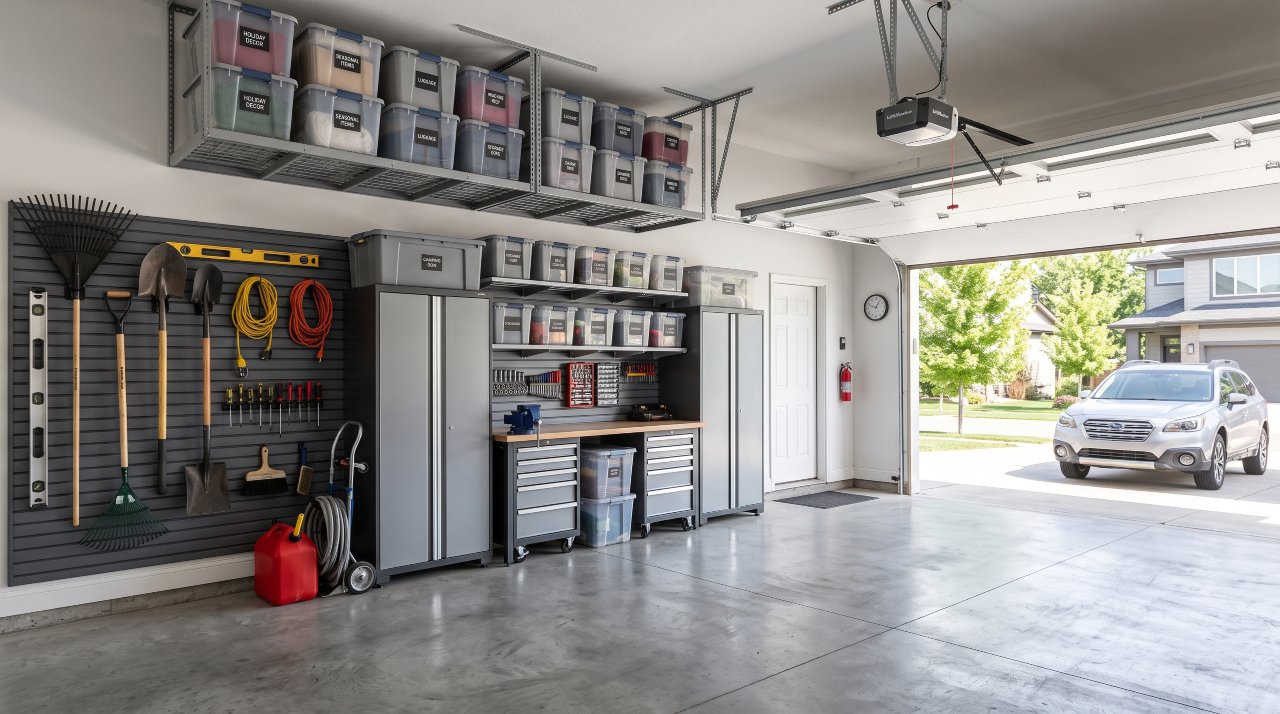
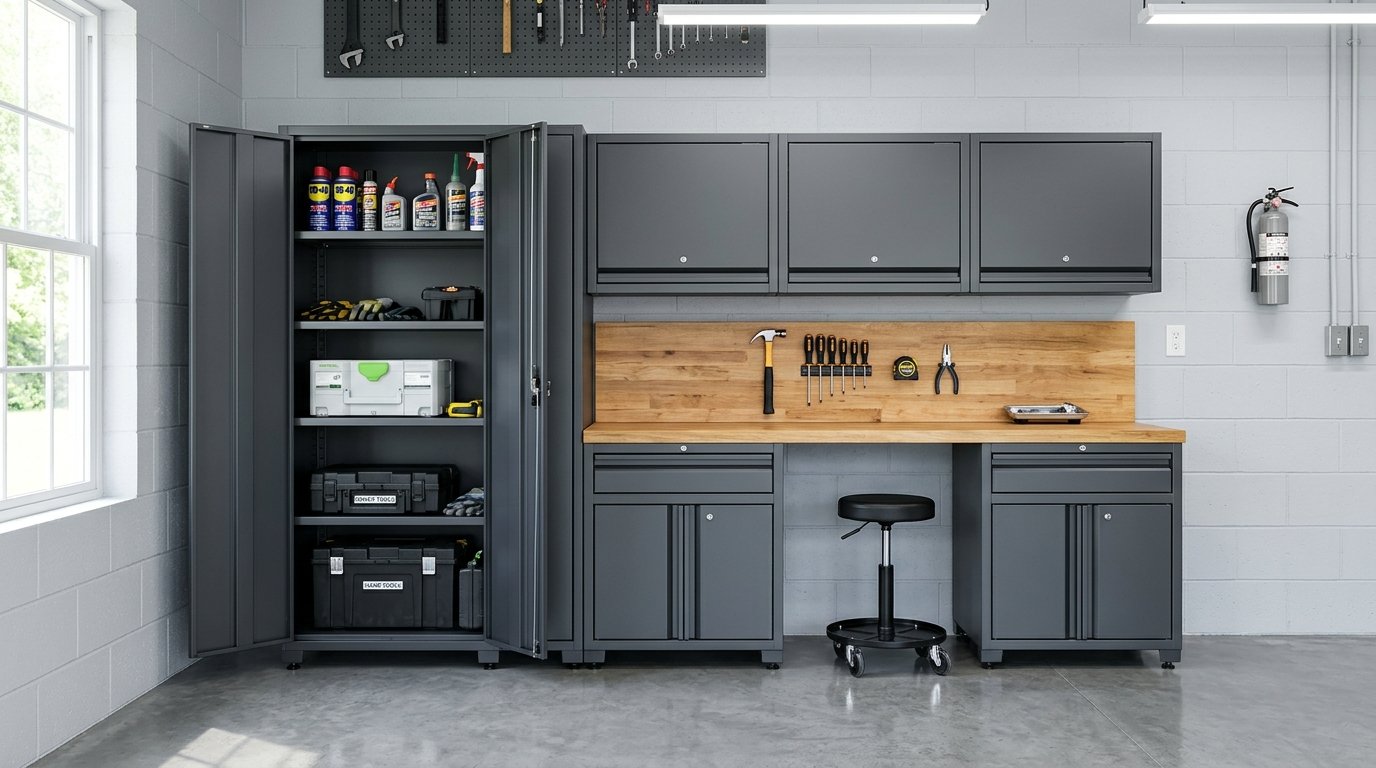
“Shop cabinets” covers any enclosed storage built for a workshop rather than a living space. In practice, that means four main types.
- Tall lockers: Floor-standing units around 72 to 80 inches high with adjustable shelves. They hold bulk supplies, cases of fluids and long-handled tools.
- Base cabinets: Waist-high units that double as work surfaces. Many come with a worktop or sit under a workbench.
- Wall cabinets: Mounted above the bench to keep small parts, finishes and hand tools within reach.
- Rolling tool cabinets: Drawer units on casters for mechanics’ tools and anything you carry to the job.
Each type carries a very different load rating, even inside one brand’s lineup. That’s why the next section matters more than the color or handle style.
Steel Gauge: The Spec That Decides Everything
Steel gauge is a thickness scale where lower numbers mean thicker steel. It feels backwards until you see the actual measurements.
| Gauge | Thickness (approx.) | Where You’ll See It |
|---|---|---|
| 24-gauge | 0.024 in | Budget and consumer garage lines (NewAge Bold, Husky freestanding) |
| 20-gauge | 0.036 in | Mid-range doors and drawer fronts |
| 18-gauge | 0.048 in | Prosumer welded cabinets (NewAge Pro 3.0); minimum for metal flammable cabinets |
| 14-gauge | 0.075 in | Industrial cabinet bodies |
| 12-gauge | 0.105 in | Heavy industrial cabinets (Strong Hold and similar) |
Going from 24- to 18-gauge doubles the wall thickness. You’ll feel it in how the doors close, how the body handles a dent and how much the shelves flex under load.
Here’s where most people get this wrong. Many brands quote gauge for the frame only. Doors, back panels and shelves can be thinner, so check the spec sheet line by line before comparing two “18-gauge” cabinets.
Shop Cabinet Tiers Compared
Most shop cabinets on the market fall into one of three steel tiers, plus the shop-built route. Here’s how published specs line up.
Consumer Tier: 24-Gauge Steel
NewAge’s Bold Series is the best-known example. Its locker cabinet is rated for 800 lb total, with three adjustable shelves at 150 lb each. The two-door base cabinet carries 600 lb, and the wall cabinet carries 100 lb.
Pricing reflects the gauge. Bold sets run from roughly $700 for a 4-piece starter to around $3,000 for a full wall, at current retail listings. Single freestanding cabinets from Husky and Kobalt sit around $449.
This tier works well for household shops that store paint, fluids, spare parts and boxed tools. It struggles with dense, concentrated loads like vises, engine parts or full fastener bins.
Prosumer Tier: 18-Gauge Welded Steel
NewAge’s Pro 3.0 Series steps up to fully welded 18-gauge steel. The brand lists capacities up to 1,000 lb per cabinet and depths up to 24 inches. A Pro 3.0 28-inch wall cabinet is rated for 200 lb total with a 100 lb shelf.
That wall cabinet figure is double the Bold equivalent. If you want to store power tools or full cans of finish overhead, this is the tier where it starts to make sense. One Reddit comparison put a 7-piece Pro set near $3,000 against about $1,800 for a larger 12-piece Bold set.
Industrial Tier: 12- to 14-Gauge Steel
Industrial cabinets from makers like Strong Hold use 12-gauge welded steel. A 60 x 24 x 78-inch unit with four adjustable shelves lists for around $1,600 to $2,200, depending on the seller.
These are built for production shops, maintenance departments and anyone storing heavy parts daily. They’re also heavy to move and usually need a pallet jack or several people to place.
Shop-Built: 3/4-Inch Plywood
Woodworkers often build their own shop cabinets from 3/4-inch plywood. A well-built plywood carcass with a full back and screwed or glued joints handles heavy tools without denting. It also costs far less per cubic foot than welded steel.
The trade-off is moisture and time. Plywood needs a finish in damp garages, and a run of cabinets takes a few weekends to build. For a deeper comparison of steel options, see our guide to metal garage cabinet load limits.
Reading Weight Ratings the Right Way
Every cabinet lists at least two numbers: a total capacity and a shelf or drawer capacity. The total assumes weight spread evenly across every shelf. By contrast, the shelf number is the limit for any single level.
Take the Bold locker again. Its three shelves add up to just 450 lb at their rated limits, well short of the 800 lb headline. Put 300 lb of tool cases on one shelf and you’re at double that shelf’s rating, even though the cabinet total looks fine.
Drawer slides have their own ratings too. A rolling tool cabinet with 100 lb slides will sag and bind if you pack one drawer with sockets and impact guns. Our rolling tool cabinet guide covers slide and caster ratings in detail.
Wall cabinets carry an extra condition. NewAge’s own installation guide notes that some claimed wall cabinet capacities only apply when its worktops are installed underneath. Check the fine print before you load anything heavy overhead.
Laying Out Shop Cabinets
Good layout matters as much as gauge. A strong cabinet in the wrong spot still ends up overloaded or in the way.
- Measure your wall twice. Note outlets, light switches, windows and the garage door track. Cabinet sets are sold by total run length, such as 132 inches for an 8-piece Bold set.
- Put the heaviest storage low. Base cabinets and lockers take tools and bulk supplies. Wall cabinets get light, frequently used items.
- Plan your work surface height. A base cabinet plus worktop should land near your comfortable working height. Test it at a friend’s bench or a store display before buying.
- Leave clearance for doors and carts. Doors need swing room, and a rolling cabinet needs a clear path. Keep at least a cart’s width open in front of the run.
- Mount wall cabinets into studs. Use the brand’s rail or bracket system and hit framing, not just drywall.
For stud-finding, rail heights and bracket hardware, see our garage wall cabinet mounting guide.
Storing Fuel and Solvents Safely
Many shops keep gasoline, thinners, lacquer and aerosol cans in the same cabinet as their sandpaper. A standard shop cabinet is not designed for that. Flammable storage cabinets are a separate product with their own construction rules.
For workplaces, the OSHA flammable liquids storage standard sets clear limits. One storage cabinet may hold up to 60 gallons of Category 1, 2 or 3 flammable liquids. For Category 4 liquids, the cap is 120 gallons.
Metal flammable cabinets under that standard need at least 18-gauge sheet steel, double-walled with a 1.5-inch air space. The door needs a three-point latch, and the sill must sit at least 2 inches above the cabinet floor to contain spills.
Home shops aren’t covered by OSHA, but the same physics apply. Fire codes based on NFPA 30 flammable liquids code drive most local rules. Keep fuel in approved cans, store it away from ignition sources and don’t stack oily rags inside a closed cabinet.
Common Shop Cabinet Mistakes
- Buying by total capacity. The shelf or drawer rating is the real limit for heavy tools.
- Overloading wall cabinets. Consumer wall cabinets are often rated around 100 lb total. Keep heavy items low.
- Mixing fuel with general storage. Solvents and gasoline belong in a listed flammable cabinet, or outside the shop.
- Skipping leveling. Garage slabs slope toward the door. Unleveled cabinets have doors that drift open and won’t line up.
- Ignoring depth. An 18-inch-deep cabinet won’t take a 24-inch tool case. Measure the largest thing you plan to store.
Frequently Asked Questions
What gauge steel is best for shop cabinets?
For heavy daily use, 18-gauge or thicker is a solid baseline. 24-gauge cabinets work for lighter household storage. Industrial shops storing dense parts often go to 12- or 14-gauge welded steel.
Is 24-gauge steel good enough for garage cabinets?
It’s fine for paint, fluids, boxed supplies and light tools. Shelves at this gauge typically carry around 150 lb each, so it isn’t the right choice for heavy equipment.
How much weight can a shop cabinet shelf hold?
It depends on the model. NewAge Bold locker shelves are rated for 150 lb, while some industrial cabinets carry far more. Always check the per-shelf figure, not the cabinet total.
Are plywood shop cabinets better than metal?
Plywood resists dents, handles heavy tools well and costs less per cubic foot. Metal holds up better in damp garages and needs no finishing. Many shops mix both.
Can I store gasoline in a regular shop cabinet?
It’s not recommended. Workplaces must use listed flammable storage cabinets, which have double walls, raised sills and self-latching doors. At home, use approved fuel cans and keep them away from ignition sources.
How deep should shop cabinets be?
Consumer garage lines often run about 18 inches deep. Prosumer lines like NewAge Pro offer up to 24 inches. Measure your largest tool case and pick the depth that fits it.
Picking the Right Tier for Your Shop
Start with what you’ll store, then work backwards to gauge. Light household storage is fine in 24-gauge cabinets. Heavy tools and overhead power-tool storage call for 18-gauge or better, and production shops should look at industrial 12- to 14-gauge units or well-built plywood.
Size every purchase by the shelf and drawer ratings. Keep heavy items low and fuel in its own listed cabinet. Bookmark this guide for your next shop upgrade, and share it with anyone planning a garage workshop build.