Quick Answer: Rolling Tool Cabinet Specs
A professional rolling tool cabinet requires at least 16-gauge cold-rolled steel for the body and 14-gauge reinforcements on drawer banks and base corners. Always calculate caster capacity using the 3-corner rule: divide total loaded weight by 3 instead of 4 and add a 20 percent safety buffer to prevent blowouts when crossing concrete floor expansion joints. Insist on 100-pound ball-bearing drawer slides for hand tools, 200-pound double slides for deep power tool drawers, and positive mechanical detents to stop runaway drawers on sloped garage slabs.
Key Takeaways
- The 3-Corner Caster Rule: On uneven shop slabs, only three casters bear the load at any instant; divide total weight by 3 plus 20 percent safety margin.
- 16-Gauge vs. 20-Gauge Steel: Thin 20-gauge steel twists under torque and binds drawer slides; commercial 16-gauge keeps drawer tracks rigid.
- Sloped Slab Runaway Defense: Garages pitch 1/4 inch per foot toward the overhead door; positive drawer latches prevent spontaneous opening.
- Dynamic Shock Reduction: Rolling across concrete expansion seams cuts safe weight limits by 30 to 50 percent compared to static ratings.
The Definitive Guide to Rolling Tool Cabinets
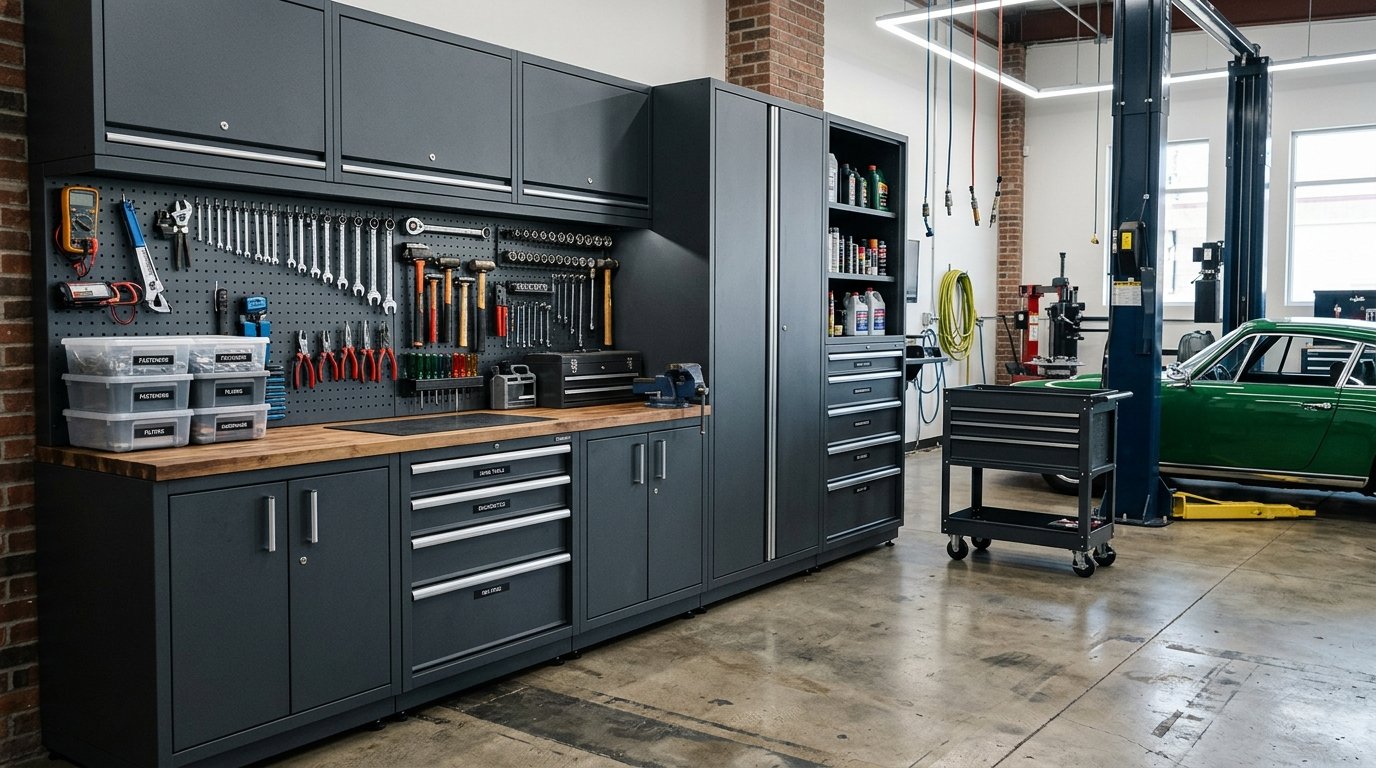
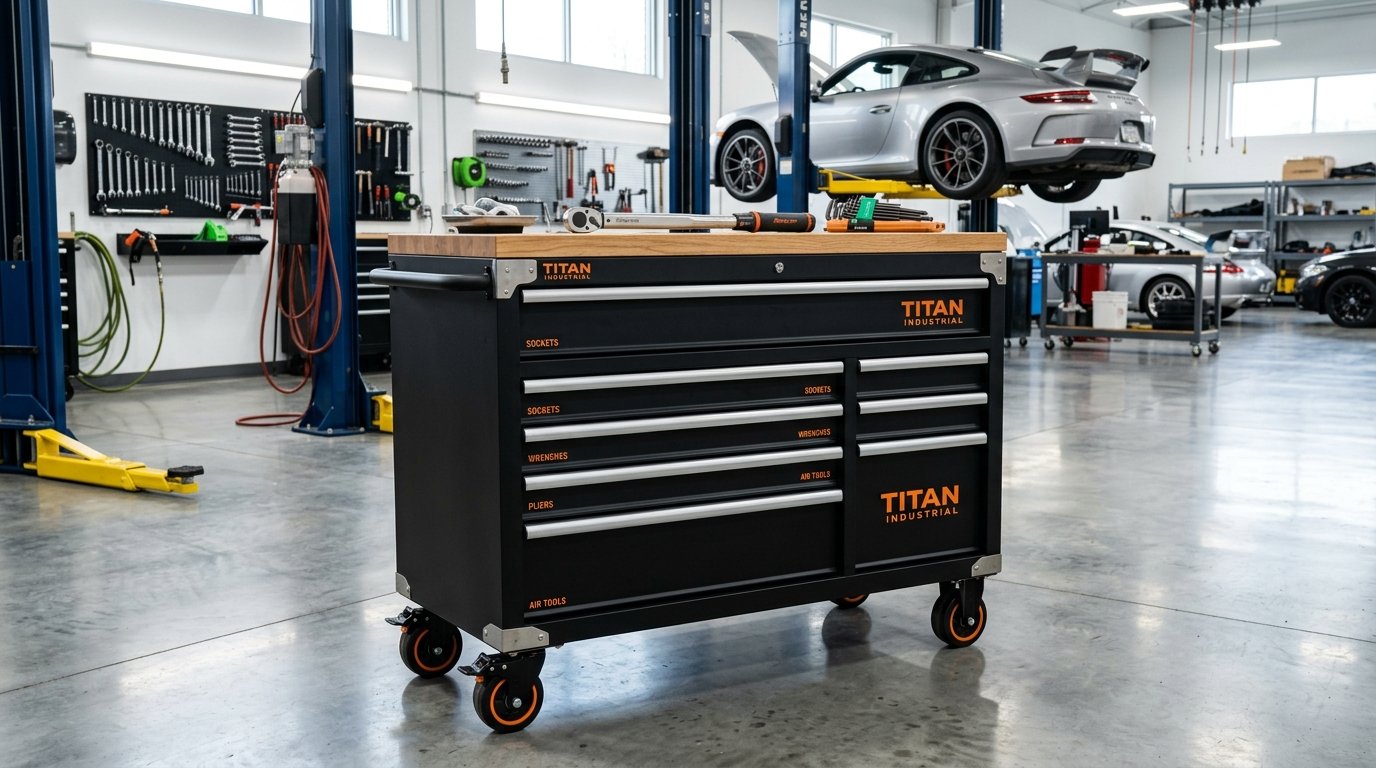
Rolling tool cabinets are the backbone of any organized workshop, from the home garage to the heavy industrial facility. But beneath the polished surface lies a world of critical engineering specifications that dictate durability, safety, and long-term performance. This guide delves into the often-overlooked details, empowering you to make informed decisions and optimize your tool storage strategy.
1. Core Competitor Baseline: Decoding Industry Standards
the fundamental specifications of rolling tool cabinets is crucial for discerning quality and matching the right cabinet to your needs.
Cabinet Steel Gauge Standards
The thickness of the steel directly correlates with a cabinet’s structural integrity and resistance to dents and deformation.
- Consumer/Light-Duty (Big Box Stores): Typically 18-20 gauge (1.2-1.0 mm). While adequate for light household tools and occasional use, these gauges are prone to flexing under heavy loads and are not designed for demanding environments.
- Commercial/Professional Grade: Often 16 gauge (1.6 mm) for the body and drawers, with 14 gauge (2.0 mm) for critical structural components like the top and drawer fronts. This offers a significant increase in rigidity and longevity.
- Heavy Industrial/Heavy-Duty: Primarily constructed from 14-16 gauge (2.0-1.6 mm) steel throughout, with reinforced internal structures. These cabinets are built to withstand daily abuse in demanding industrial settings, supporting extreme weight and frequent movement.
Standard Cabinet Widths and Depths
These dimensions cater to various storage capacities and space constraints.
- Common Widths:
- 26 inches (66 cm): Compact, for smaller workshops or as a supplementary unit.
- 36 inches (91 cm): A popular mid-size option, offering a good balance of storage and footprint.
- 42 inches (107 cm): Ample storage without being overly cumbersome.
- 52 inches (132 cm): A option for professionals with extensive tool collections.
- 72 inches (183 cm): The “workbench on wheels” for serious professionals and industrial applications, often featuring multiple banks of drawers.
- Common Depths:
- 18 inches (46 cm): Standard for consumer-grade and some professional cabinets, suitable for hand tools.
- 20-22 inches (51-56 cm): More storage depth for larger tools and organizers.
- 24 inches (61 cm): Found on heavy-duty and industrial cabinets, accommodating power tools, specialty equipment, and larger parts.
Drawer Slide Specifications
The quality of drawer slides directly impacts the user experience and the longevity of the cabinet.
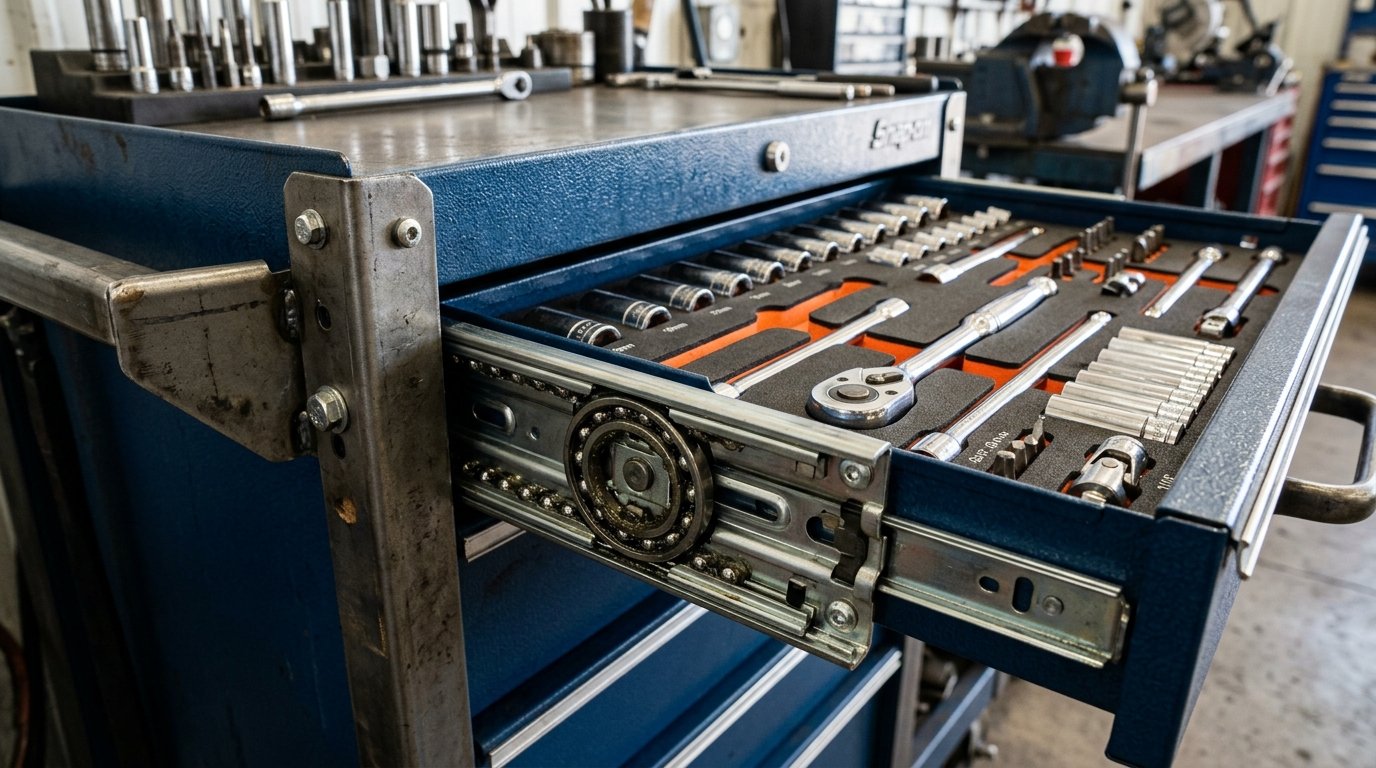
- 100 lb Single Ball-Bearing Slides: Standard for most consumer and light-duty professional cabinets. These slides use a single row of ball bearings and are suitable for general hand tools. They offer smooth operation but can bind or fail under consistent heavy loads.
- 200 lb Double Ball-Bearing Slides: A significant upgrade, featuring two rows of ball bearings for enhanced load capacity and smoother operation. These are essential for bottom drawers intended for power tools, heavier parts, or specialized equipment. Many industrial cabinets feature 200 lb slides on all drawers, with some offering even higher capacities (e.g., 300-500 lb) for specialty applications.
- Over-Travel Slides: Allow the drawer to extend beyond the cabinet frame, providing full access to items at the very back of the drawer.
Caster Load Calculation: The “3-Corner Rule”
The most common and dangerous oversight in rolling tool cabinet specifications is the miscalculation of caster load capacity. Manufacturers often state a “total load capacity” based on the sum of all four casters, implying an even distribution of weight. This is fundamentally flawed in real-world applications.
- Why the “4-Caster” Rule Fails: On any uneven surface, such as a concrete garage floor with expansion joints, minor dips, or debris, it is statistically improbable that all four casters will bear an equal load simultaneously. In most scenarios, the cabinet will be supported by a maximum of three casters at any given moment.
- The “3-Corner Rule” Explained: To ensure safe operation and prevent catastrophic caster blowout, the total weight of the cabinet (empty weight + maximum intended load) **must be divided by 3, not 4.**
- Incorporating a Safety Margin: An additional safety margin is critical. A **20% safety margin** is an industry best practice to account for dynamic loads, shock, and potential manufacturing inconsistencies.
- Formula for Minimum Required Caster Capacity:
`Individual Caster Capacity = (Empty Cabinet Weight + Max Load) / 3 * 1.20`
*Example:* A cabinet weighing 300 lbs empty, designed to hold 1,000 lbs of tools, has a total loaded weight of 1,300 lbs.
`Individual Caster Capacity = (1300 lbs / 3) * 1.20 = 433.33 lbs * 1.20 = 520 lbs`
Therefore, each caster on this cabinet should be rated for at least 520 lbs to ensure safe operation over uneven surfaces. Failure to adhere to this rule is a leading cause of caster failure and potential injury. This concept is further explored in our tool box on wheels guide.
Caster Types and Specifications
Casters are not just wheels; they are engineered components critical to mobility and stability.
- Diameter:
- 5 inches (12.7 cm): Common for most professional and heavy-duty cabinets. Offers a good balance of maneuverability and load capacity.
- 6 inches (15.2 cm): Preferred for very heavy cabinets, rough surfaces, or when frequent movement is anticipated. Larger diameter wheels roll more easily over obstacles and reduce rolling resistance.
- Wheel Material:
- Polyurethane: The most common and versatile. Offers good floor protection, quiet operation, and excellent load capacity. Resistant to many chemicals. for concrete, tile, and warehouse floors.
- Thermoplastic Rubber (TPR): Softer than polyurethane, offering superior floor protection and quieter rolling. Excellent for delicate flooring or environments where noise reduction is critical. Lower load capacity than polyurethane.
- Cast Iron: Extremely durable and high load capacity. Resistant to oils and solvents. However, they are noisy, can damage floors, and offer poor shock absorption. Primarily used in very heavy industrial applications where floor damage is not a concern.
- Braking Systems:
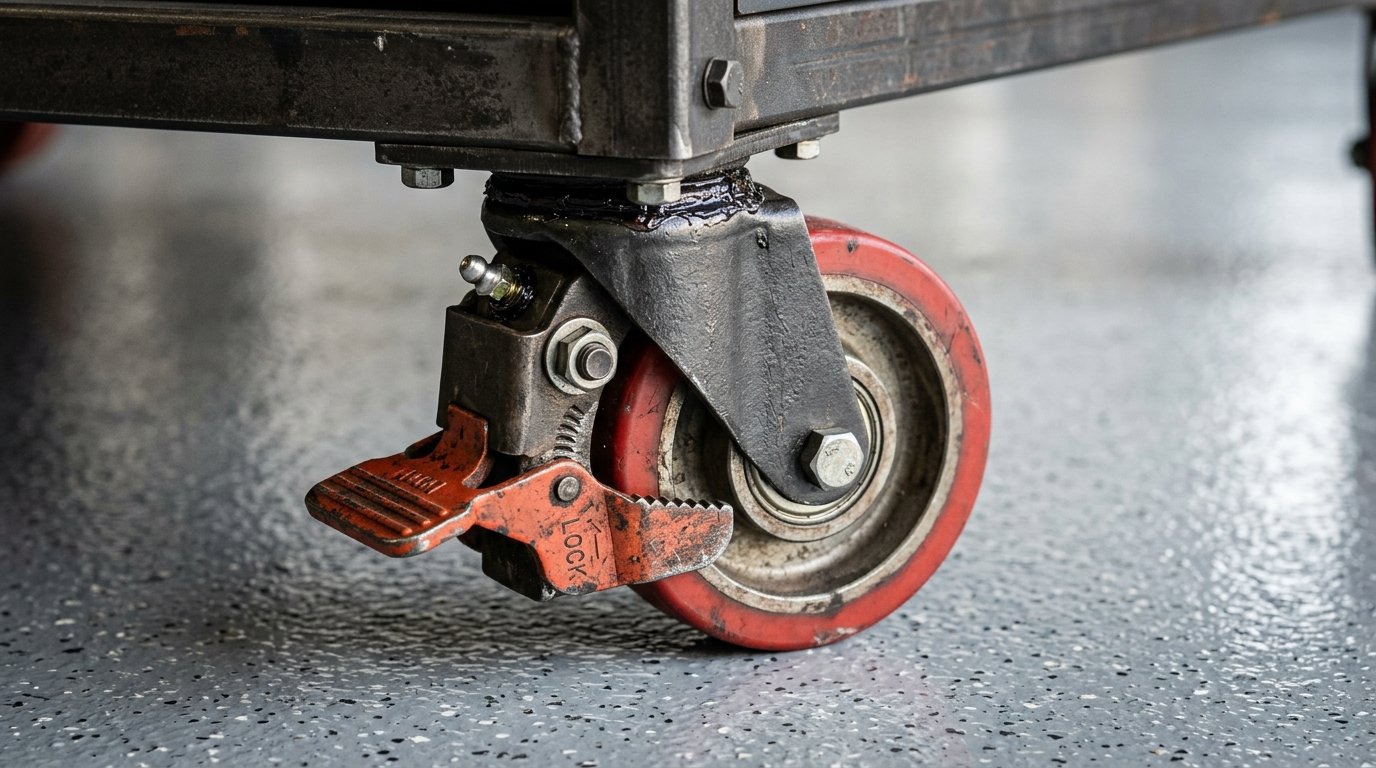
- Total-Lock Brakes: The gold standard. These brakes simultaneously lock both the wheel’s rotation and the caster’s swivel mechanism. This provides maximum stability, preventing both rolling and unwanted pivoting, crucial for safety when working on or near the cabinet.
- Wheel-Lock Brakes: Only lock the wheel’s rotation, allowing the caster to still swivel. Less secure than total-lock brakes, often found on consumer-grade units.
- Configuration: Most rolling tool cabinets feature two fixed casters (at the back, for directional stability) and two swivel casters (at the front, for maneuverability). This setup is aligned with Material Handling Industry mobile storage standards.
2. Key Product Specs & Physics: Beyond the Basics
the physics of rolling tool cabinets is vital for safe operation and maximizing their lifespan.
Dynamic vs. Static Load Capacity
- Static Load: The maximum weight a cabinet can support when stationary on a perfectly flat, level surface. This is often the higher number quoted by manufacturers.
- Dynamic Load: The maximum weight a cabinet can safely support while being moved. Rolling across uneven surfaces, such as garage expansion joints, thresholds, or debris, introduces significant shock loads and dynamic stresses. This can effectively **reduce the safe load capacity by 30-50%** compared to the static rating. A cabinet rated for 2,000 lbs static might only be safely moved with 1,000-1,400 lbs of tools over rough terrain. This reduction factor must be considered, especially in busy, active workshops. OSHA also provides guidelines on material handling and rolling equipment safety, which can be found on their website: OSHA material handling and rolling equipment safety guidelines.
Overturn / Tip-Over Risks
- Center of Gravity Shift: Opening multiple loaded drawers, especially upper ones, significantly shifts the cabinet’s center of gravity forward. When this center of gravity moves beyond the axis of the front casters, the cabinet becomes unstable and prone to tipping over. This risk is exacerbated by heavy tools in upper drawers.
- Safety Interlocks: High-quality cabinets feature **anti-tip drawer interlock systems** that prevent more than one drawer from being opened at a time. This mechanical safety feature is crucial for preventing accidents and is a hallmark of professional-grade equipment. Always look for this feature.
Detents and Latching Systems
- Preventing Runaway Drawers: Garage floors are rarely perfectly level; a common slope of **1/4 inch per foot (2.1%)** the overhead door is standard for drainage. On such a slope, drawers without proper retention systems can “run away,” opening unexpectedly, creating a tripping hazard, and potentially spilling tools.
- Drawer Detents: Simple indentations in the drawer slide mechanism that provide a slight resistance to opening and closing, holding the drawer in place.
- Positive Latching Systems: Superior to simple detents, these systems actively latch the drawer closed, requiring a deliberate pull to open. Some systems incorporate a “self-latching” mechanism where the drawer audibly clicks into a locked position when closed. This is essential for safety on sloped floors and during cabinet movement.
Work Surfaces
The top surface of a rolling tool cabinet serves as a critical workspace.
- Stainless Steel: Durable, easy to clean, resistant to corrosion and many chemicals. Offers a professional aesthetic. Can be prone to scratching.
- Solid Rubberwood Butcher Block: Aesthetically pleasing, provides a durable and impact-absorbing work surface. Excellent for general assembly and light to medium-duty tasks. Requires occasional maintenance (oiling) to prevent drying and cracking.
- Heavy Nitrile Rubber Mat: Often used as an overlay on a steel top. Provides excellent grip for tools, protects the underlying surface, and dampens noise. Resistant to oils and many chemicals. Can be replaced when worn.
3. Content Gaps / Unique Angles for racksystem.org
To truly differentiate racksystem.org’s guide, we must highlight the often-ignored, yet critical, engineering considerations.
The 3-Corner Caster Sizing Rule That Big Box Stores Hide
This is a non-negotiable safety principle. Most consumer-grade cabinets are dangerously underspecified in their caster ratings when dynamic loads and uneven floors are considered. By the physics (weight distribution over three points on an uneven floor), you can avoid caster failure and potential injury. Always apply the formula: `Individual Caster Capacity = (Empty Cabinet Weight + Max Load) / 3 * 1.20`.
Floor Expansion Joint Traversal Shock Loads
Even a small bump, like a concrete expansion joint, can generate forces many times the static weight. This is why a cabinet’s dynamic load capacity is significantly lower than its static rating. Larger diameter wheels (6 inches versus 5 inches) and proper caster material (polyurethane) are crucial for mitigating these shock loads. They protect both the tools and the cabinet structure by absorbing impact. Without this, tools can shift or even fall out of drawers, and the cabinet frame can deform over time.
Sloped Garage Slab Runaway Drawer Hazard and Latching Mechanisms
Home garages often have a 1/4 inch per foot slope for drainage. This seemingly small incline can cause drawers to open spontaneously if not properly secured. Friction detents offer some resistance, but positive mechanical latches actively lock the drawer closed, requiring a deliberate pull to release. This is a must-have safety feature for any rolling cabinet on a sloped floor, preventing tripping hazards and spilled tools. For more on garage storage, check our metal garage cabinets guide.
Power Strip / Internal Charging Dock Heat Dissipation and Fire Safety
Integrating power strips or charging docks inside a cabinet for cordless tools presents a fire risk if not handled correctly. Enclosed spaces trap heat, and charging batteries generate heat. Overloaded power strips add to this.
- Ventilation: Cabinets designed for internal power integration need adequate ventilation (louvered panels, fan cutouts) to let heat escape.
- Dedicated Compartments: Some high-end cabinets offer vented, dedicated compartments for charging stations.
- Surge Protection: Always use power strips with surge protection and circuit breakers.
- Battery Safety: Avoid charging batteries unattended or in completely sealed compartments. Use only manufacturer-approved chargers.
- Cable Management: Proper cable routing prevents pinching or damage.
Rolling Tool Cabinet Comparison Table
| Cabinet Class | Steel Thickness & Frame | Slide & Drawer Ratings | Caster Setup & Safe Capacity (Static) |
|---|---|---|---|
| Consumer / DIY | 18-to-20 gauge cold-rolled | 75 to 100 lb single ball-bearing | 4×2 inch TPR casters (800 to 1,200 lb) |
| Professional Shop | 16-gauge frame / 14-gauge top | 100 to 120 lb single, 200 lb double | 5×2 inch polyurethane total-lock (1,800 to 2,500 lb) |
| Heavy Industrial | 14-to-16 gauge fully welded | 200 lb double slides all drawers | 6×2 inch polyurethane on cast iron (3,000 to 4,500 lb) |
| Mobile Workstation (72″) | 12-to-14 gauge box-beam base | 200 to 300 lb heavy slides | 6-caster heavy rig (dual center swivel) (5,000+ lb) |
People Also Ask (PAA)
How much weight can a rolling tool cabinet hold?
A rolling tool cabinet’s capacity is split into static and dynamic loads. Consumer-grade cabinets typically hold 300-800 lbs static, while professional and heavy-duty industrial cabinets can hold 1,000 lbs to over 3,000 lbs static. However, when rolling, especially over uneven surfaces, the safe dynamic load capacity can be 30-50% lower than the static rating. Always apply the “3-Corner Rule” for caster capacity to ensure safety: divide the total loaded weight by 3, then add a 20% safety margin for each individual caster’s rating.
What steel gauge is best for a rolling tool cabinet?
For optimal durability and longevity, 16-gauge (1.6 mm) steel for the body and drawers, with 14-gauge (2.0 mm) for critical structural components, is for professional and heavy-duty use. While 18-20 gauge steel (1.2-1.0 mm) is common in consumer-grade cabinets, it is more prone to flexing and damage under heavy loads. For extreme industrial applications, look for consistent 14-gauge construction.
Why do rolling tool cabinets have 2 swivel and 2 fixed casters?
This configuration provides the optimal balance of maneuverability and directional stability. The two swivel casters (typically at the front) allow the cabinet to pivot and turn easily, making it simple to navigate tight spaces. The two fixed casters (typically at the back) prevent unwanted side-to-side drift and provide a straight tracking path when pushing the cabinet, ensuring controlled movement.
What size casters are best for rolling tool chests on rough garage floors?
For rough garage floors with expansion joints, cracks, or debris, 6-inch (15.2 cm) diameter casters are significantly better than 5-inch casters. Larger wheels roll more smoothly over obstacles, reducing shock loads and making movement easier. Polyurethane wheels are generally the best material choice as they offer excellent load capacity, shock absorption, and floor protection on concrete surfaces, outperforming harder materials like cast iron or softer TPR. Ensure these casters feature total-lock brakes for maximum stability when stationary.

Callum Langham
Founder & Technical Storage Editor
Callum Langham is the founder and technical editor of Rack System. With over 12 years of hands-on field experience in warehouse logistics, garage organization, and industrial storage installations, Callum specializes in engineering safety standards, beam load calculations, and OSHA/RMI compliance. Every guide on Rack System is audited against verified steel gauge tolerances and municipal building codes.