Quick Answer: Sizing an Entryway Shoe Rack
A shoe rack entryway organizer must balance footwear capacity against hallway walking clearance. For narrow foyers measuring 36 to 48 inches wide, select a slim-profile rack with a maximum depth of 10 to 12 inches to maintain the minimum 32-inch unobstructed egress corridor required by residential building standards. Multi-tier vertical wire or slatted steel racks holding 12 to 24 pairs provide the highest density, while seating benches combine lower shoe shelves with a 250-pound dynamic sitting capacity.
Key Takeaways for Homeowners
- Depth Restrictions: Standard 14-inch deep racks crowd narrow hallways; choose 8-inch to 11-inch angled shelf units to preserve door swing clearances.
- Ventilation Needs: Open wire grid or slatted wood shelves allow airflow around wet footwear, preventing odor accumulation and moisture damage to hardwood floors.
- Anti-Tip Safety: Tall vertical shoe towers exceeding 30 inches in height require anchoring into wall studs to satisfy child safety standards.
- Boot Clearance: Ensure the bottom shelf offers at least 12 to 14 inches of vertical spacing to accommodate winter boots and high-top work footwear.
Every home experiences the daily evening traffic jam right at the front door. Family members kick off running shoes, muddy boots, and school sneakers, turning your foyer into an obstacle course within minutes. Beyond looking chaotic, footwear piles block natural walking corridors and cause family members to trip in low light.
Selecting the right shoe rack entryway unit restores immediate order while protecting delicate floor finishes. Instead of squeezing past random sneakers or tracking outdoor grit across hallway rugs, you establish a designated landing zone that keeps shoes organized and ventilated. Footwear dries faster, entryway sightlines stay clean, and guests can enter your home without stepping around clutter.
However, furnishing an entryway requires careful attention to spatial dimensions and door clearances. Entryways are functional circulation corridors, not storage warehouses. Buying a rack that extends too far into the hallway restricts the front door swing and creates severe pinch points. Let us examine entryway rack designs, width formulas, door swing rules, and safety hardware.
The 4 Primary Entryway Shoe Rack Configurations
Entryway shoe organizers fall into four distinct structural formats. Selecting the correct style depends on your hallway width, ceiling height, and household footwear count.
1. Slim-Profile Multi-Tier Open Metal Racks
Multi-tier open metal racks represent the most space-efficient storage format for narrow entry corridors. Fabricated from powder-coated tubular steel or heavy gauge wire mesh, these units feature three to six vertical tiers. The shelves are often angled forward at 15 to 20 degrees with a front retaining lip, reducing overall cabinet depth to just 9 to 11 inches.
Angled shelves allow you to store adult men’s size 12 shoes in a frame that sits almost flush against your baseboard. Open wire grids provide 360-degree air circulation around wet soles, helping footwear dry quickly after rainy commutes. High-capacity metal towers hold 16 to 24 pairs while occupying less than three square feet of floor space. For pure steel variations, review our metal shoe rack steel tier guide.
2. Dual-Purpose Shoe Storage Benches
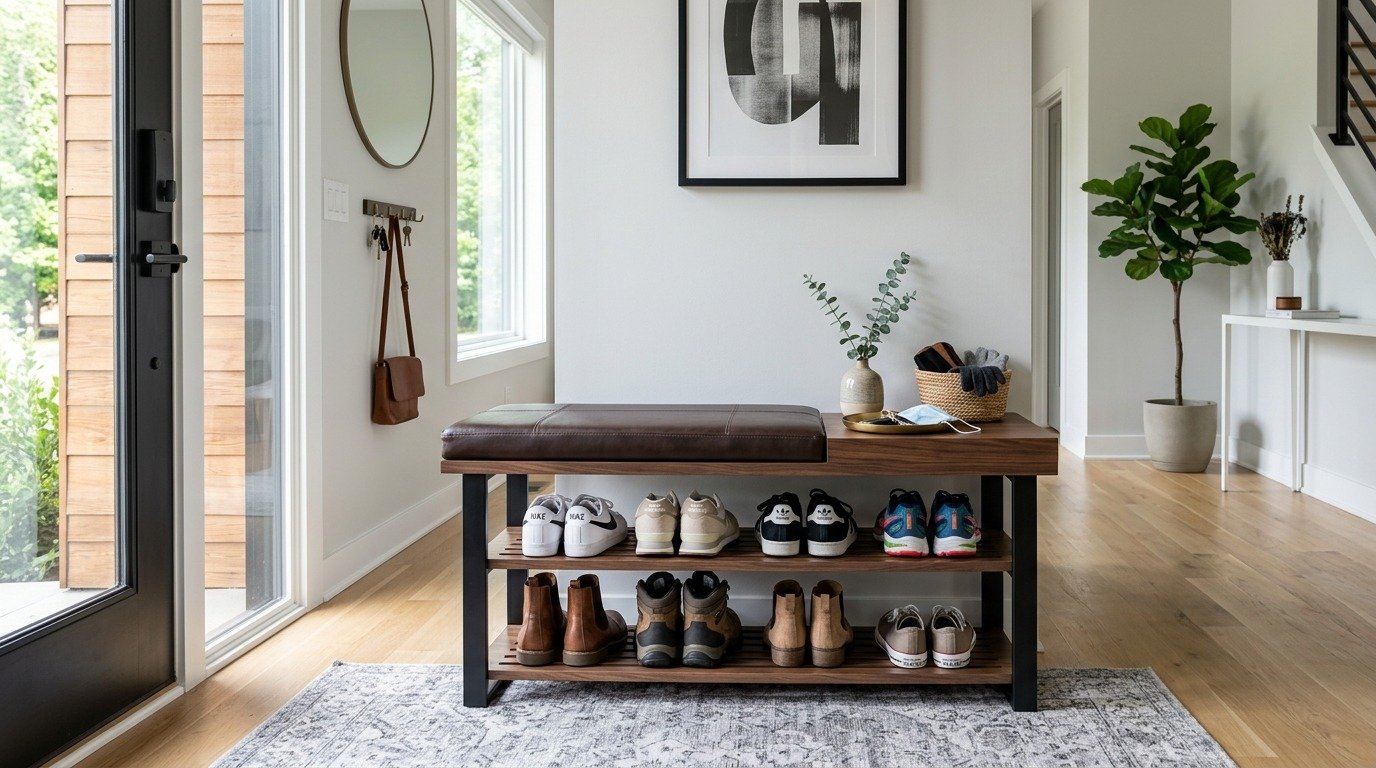
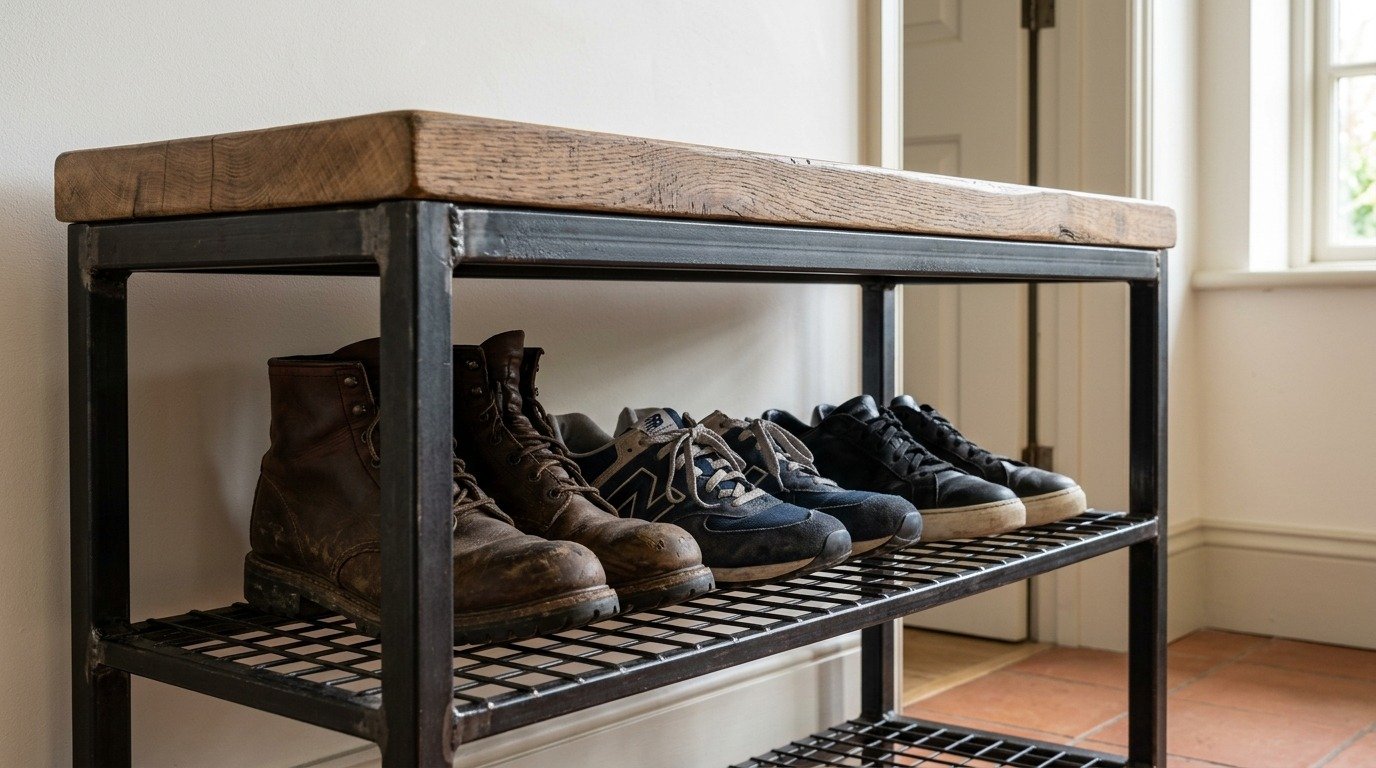
Shoe benches combine lower footwear shelving with a sturdy horizontal seating platform. Built with welded carbon steel frames and solid hardwood or padded faux-leather seats, these units create a comfortable spot to sit down while tying laces or pulling off stubborn winter boots.
The primary advantage of a bench is functional ergonomics, particularly for young children or older adults. However, because human seating requires adequate bench depth, these units measure 12 to 15 inches deep. They fit best in dedicated foyer alcoves, mudrooms, or wide entry halls with at least 50 inches of walking clearance. Compare bench weight ratings in our shoe rack bench guide.
3. Integrated All-in-One Hall Trees
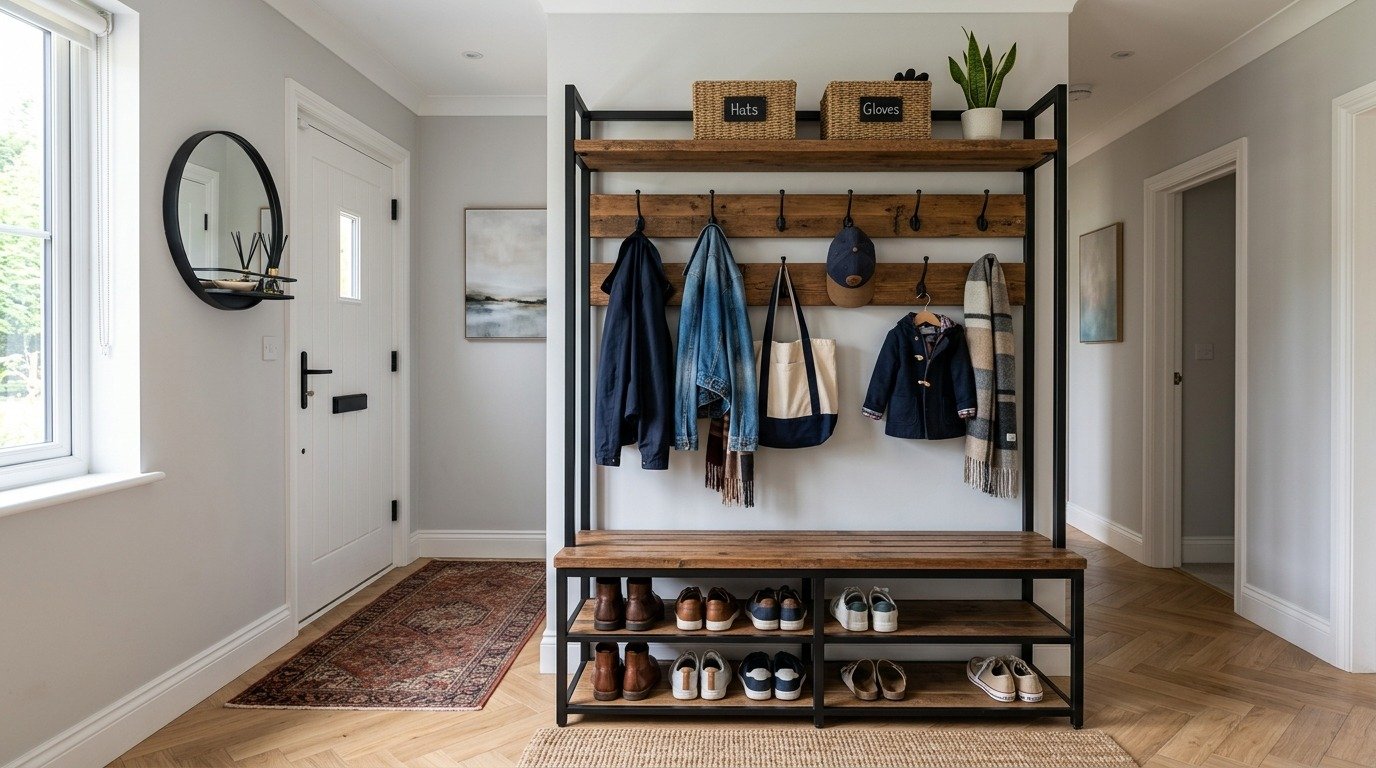
Hall trees integrate vertical coat hanging, top shelving, and bottom shoe racks into a single freestanding piece of furniture. A typical unit stands 70 to 74 inches tall, featuring upper steel coat hooks, an open top shelf for hat baskets, and two to three lower metal shoe tiers beneath a solid bench seat.
Hall trees deliver complete drop-zone organization for coats, backpacks, dog leashes, and shoes. They serve as an entire mudroom station in homes that lack a dedicated entryway closet. Because they are tall and top-heavy when loaded with heavy winter parkas, they must always be anchored firmly into wall framing.
4. Enclosed Tip-Out & Louvered Door Cabinets
Enclosed shoe cabinets hide footwear behind slatted wood louvered doors or slim mechanical tip-out drawers. When closed, they look like stylish entry consoles rather than shoe storage. Tip-out mechanisms store footwear vertically inside pivoting compartments, keeping cabinet depth down to a slender 7 to 9 inches.
Enclosed cabinets protect footwear from dust and keep pet dogs from chewing on leather shoe tongues. However, closed cabinets restrict airflow, requiring internal ventilation slots or rear cutout panels to prevent odor buildup. To explore enclosed cabinet designs, check our shoe rack with doors buying guide.
Comparison of Entryway Shoe Rack Formats
Review this side-by-side technical breakdown to compare dimensions, capacities, and hallway clearance requirements:
| Rack Format | Typical Depth | Pair Capacity | Primary Strength | Hallway Width Needed |
|---|---|---|---|---|
| Slim Angled Metal Tower | 9″ to 11″ | 16 to 24 Pairs | Maximum vertical shoe density | 36″ Minimum |
| Shoe Storage Bench | 12″ to 15″ | 6 to 10 Pairs | 250 to 300 lb seating support | 44″ Minimum |
| All-in-One Hall Tree | 14″ to 16″ | 8 to 12 Pairs | Combined coats, bags & shoes | 48″ Minimum |
| Slim Tip-Out Cabinet | 7″ to 9″ | 12 to 18 Pairs | Conceals clutter completely | 34″ Minimum |
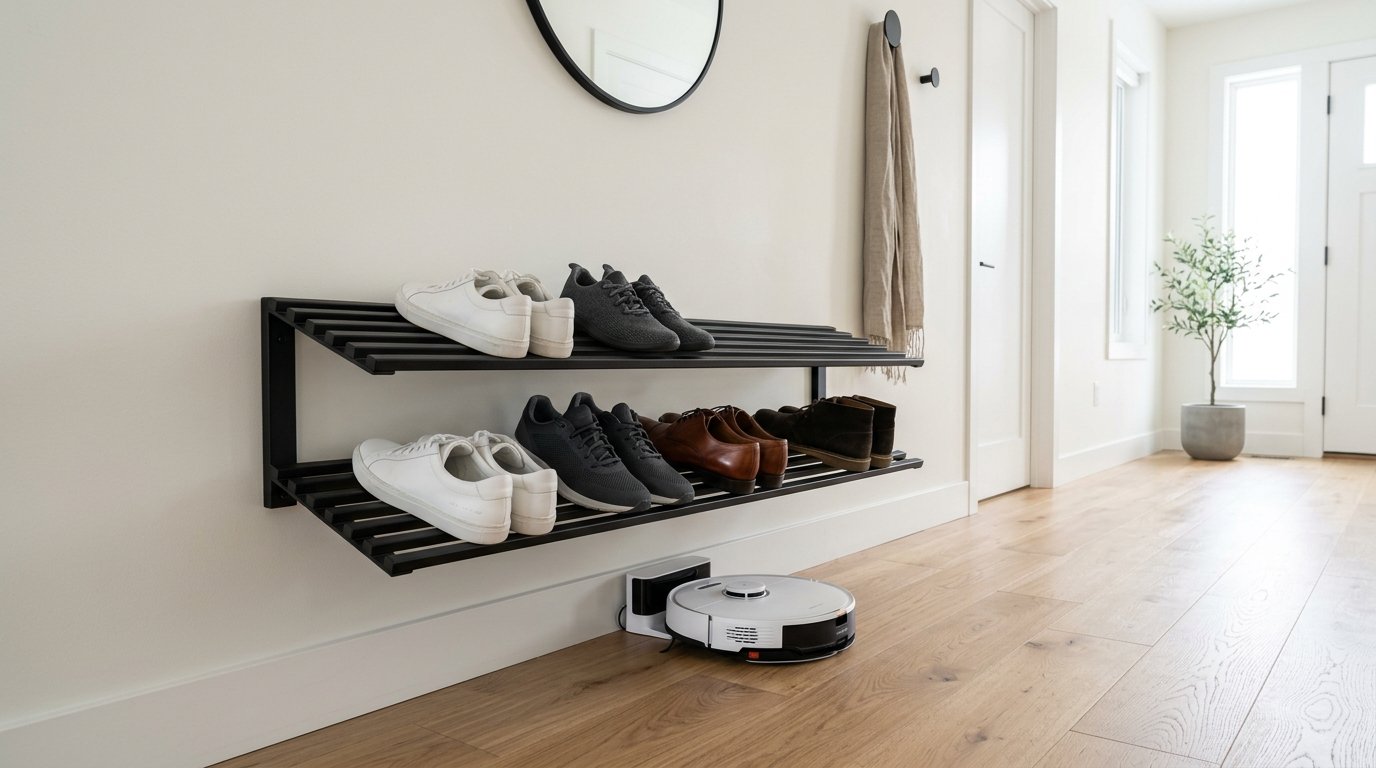
| Floating Wall Rack | 6″ to 8″ | 8 to 16 Pairs | Zero floor footprint for cleaning | 32″ Minimum |
Hallway Clearance & Door Swing Ergonomics
The single most frequent mistake homeowners make is ignoring door swing physics. An entryway must provide unhindered egress under the safety guidelines established by the Americans with Disabilities Act (ADA) accessible route standards and international residential building codes.
Residential code requires primary entry corridors to maintain at least 32 inches (and preferably 36 inches) of clear, unobstructed width. If your entryway hallway measures 42 inches wide from wall to wall, placing a 14-inch deep bench leaves only 28 inches of passage space. Family members carrying groceries will constantly scrape against the furniture corner.
In addition, check your front door’s interior swing radius. A standard 36-inch front entry door sweeps an arc extending 36 inches into the foyer. Positioning a shoe rack inside this swing arc prevents the door from opening fully to 90 degrees, damaging both the door knob and the rack finish. Always place your rack on the latch-side wall at least six inches past the fully open door edge, or mount an elevated wall rack like those in our wall shoe rack floating mounting guide.
Footwear Sizing Formulas: Width and Vertical Clearance
Calculating how many pairs will fit on a given rack requires understanding physical footwear dimensions. Shoe sizes directly determine linear shelf width requirements:
Linear Width Calculations
- Women’s Casual Shoes & Flats: Measure roughly 3.5 to 4.0 inches wide per shoe (7.5 to 8.0 inches per pair). A 32-inch wide shelf comfortably accommodates four pairs.
- Men’s Sneakers & Athletic Trainers: Measure 4.5 to 5.0 inches wide per shoe (9.0 to 10.0 inches per pair). A 32-inch shelf fits three pairs cleanly with minimal squeezing.
- Heavy Winter Boots & Work Footwear: Measure 5.5 to 6.0 inches wide per boot (11.0 to 12.0 inches per pair). A 32-inch shelf fits only two full pairs.
To calculate true capacity for a family of four, assume an average of 9 inches of shelf width per pair. Storing 16 pairs requires approximately 144 inches of total linear shelf space, achievable across four 36-inch wide tiers.
Vertical Tier Spacing
Standard flat shoe racks provide 6 to 7 inches of vertical clearance between shelves. While this fits low-top sneakers and dress loafers, it causes ankle boots and high-top sneakers to crease against the shelf above. Look for racks featuring at least one tall bottom tier offering 11 to 14 inches of height for rain boots, or select units with removable center wire shelves. For muddy outdoor boot storage, see our shoe rack for garage guide.
Safety Engineering: Anti-Tip Wall Anchoring Protocols
Tall entryway furniture represents a recognized tipping hazard, particularly in households with small toddlers who may attempt to climb shelves like a ladder. Storage units must comply with the strict stability testing rules established by the Consumer Product Safety Commission (CPSC) STURDY Act.
Any shoe tower or hall tree exceeding 30 inches in height should be mechanically anchored to the wall. Follow these four safety fastening rules:
- Anchor into Solid Wood Studs: Discard lightweight plastic drywall plugs. Use an electronic stud finder to locate wall framing and drive a 2 to 1/2 inch screw directly through the steel anti-tip bracket into the stud center.
- Use Heavy Metal Cam Straps: Replace cheap plastic zip-tie tethers with steel aircraft cable kits or reinforced woven nylon straps with cast metal cam buckles.
- Adjust Threaded Leveling Feet: Most home entryways have slightly uneven wood or tile transitions. Adjust the threaded base glides so the rack leans slightly back toward the wall rather than tipping forward.
- Distribute Weight Low: Always store heavy steel-toe work boots, wet winter footwear, and heavy tool bags on the lowest shelf. This keeps the unit’s center of gravity close to the floor, minimizing rotational tip momentum.
Structural integrity standards follow guidelines published under ANSI/BIFMA X5.9 storage safety standards for residential durability.
Wet Weather Protection: Boot Trays and Floor Care
Entryway shoe racks face harsh environmental exposure during winter snowfalls and spring rainstorms. Melting slush containing road salt, chemical de-icers, and grit drips directly from shoe treads onto whatever sits beneath the rack.
To protect valuable hardwood or luxury vinyl tile floors, look for racks that incorporate raised rim boot trays. Heavy-duty vulcanized rubber or rigid polypropylene trays feature 1.2-inch raised perimeter walls that contain up to one gallon of runoff water. In multi-tier wire racks, look for units supplied with removable translucent PVC shelf liners. These plastic liners prevent muddy water dripping from upper athletic shoes onto clean dress leather below.
5 Costly Entryway Shoe Rack Mistakes to Avoid
Avoid these five common blunders when planning your entryway layout:
- 1. Buying Deep 16-Inch Cabinets for Narrow Hallways: Oversized furniture creates claustrophobic choke points. Keep depth under 12 inches in corridors narrower than 48 inches.
- 2. Choosing Solid Wood Shelves without Drainage: Storing soaked snow boots on raw, unsealed wood causes timber swelling, surface water rings, and mildew. Opt for ventilated metal wire grids or slatted bamboo.
- 3. Placing Racks in Direct Sun Exposure: Direct UV radiation from front door sidelight windows causes rubber sneaker midsoles to yellow and leather uppers to dry out. Position racks along shaded entryway walls.
- 4. Ignoring Baseboard Trim Gaps: Thick four-inch baseboards prevent flat-back cabinets from resting flush against drywall, creating an awkward two-inch gap that traps dust. Look for cabinets with cutout baseboard recesses.
- 5. Skipping Adjustable Leveling Glides: Entryways with uneven stone tile cause four-legged racks to wobble constantly every time a shoe is retrieved. Ensure the frame includes adjustable threaded leveling pads.
Frequently Asked Questions
What is the ideal depth for a shoe rack in a narrow entryway?
For narrow entryways measuring 36 to 42 inches wide, the ideal shoe rack depth is 9 to 11 inches. Angled forward shelves allow full-size adult footwear to rest comfortably without protruding into the main walking path. If your hallway is under 36 inches wide, choose a 7-inch deep tip-out shoe cabinet or wall-mounted floating brackets.
How many pairs of shoes can a standard 3-tier entryway rack hold?
A standard 3-tier entryway rack measuring 30 to 32 inches wide comfortably holds 9 to 12 pairs of adult shoes, assuming three to four pairs per tier. Wider 36-inch to 40-inch models hold 12 to 15 pairs. If your household requires storage for 20 or more pairs, choose a tall 5-tier or 6-tier vertical tower rather than a wide floor-hogging unit.
Do shoe rack benches support the weight of adults sitting down?
Quality shoe rack benches built with welded steel frames or solid hardwood tops typically carry certified weight capacities between 250 and 350 pounds, easily supporting an adult while putting on shoes. However, cheap knockdown benches made with hollow pressed cardboard or thin MDF often support less than 150 pounds and can crack under dynamic sitting loads.
How do you keep an entryway shoe rack from smelling bad?
Prevent footwear odors by choosing racks with open wire grids or slatted shelves that promote continuous air circulation. Never store wet, sweaty athletic shoes inside fully sealed cabinets without first letting them dry for several hours. Placing cedar wood shoe trees or activated charcoal deodorizing bags on lower shelves neutralizes odors naturally.

Callum Langham
Founder & Technical Storage Editor
Callum Langham is the founder and technical editor of Rack System. With over 12 years of hands-on field experience in warehouse logistics, garage organization, and industrial storage installations, Callum specializes in engineering safety standards, beam load calculations, and OSHA/RMI compliance. Every guide on Rack System is audited against verified steel gauge tolerances and municipal building codes.