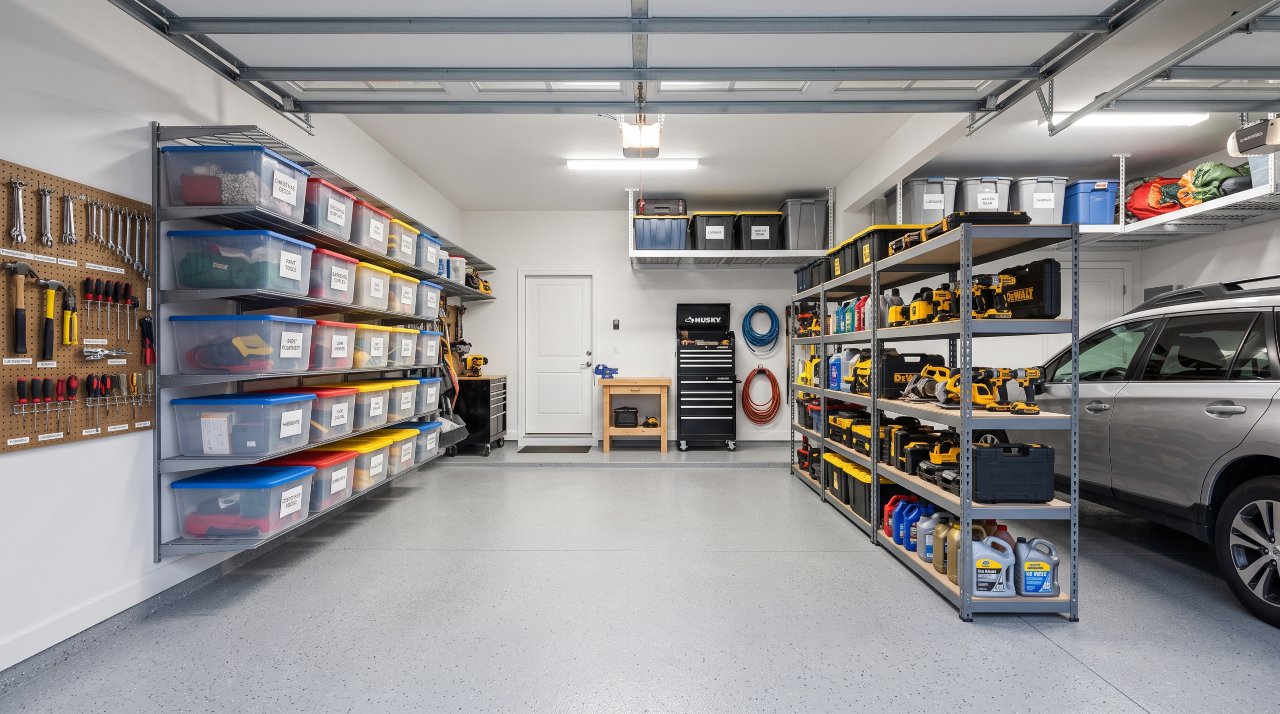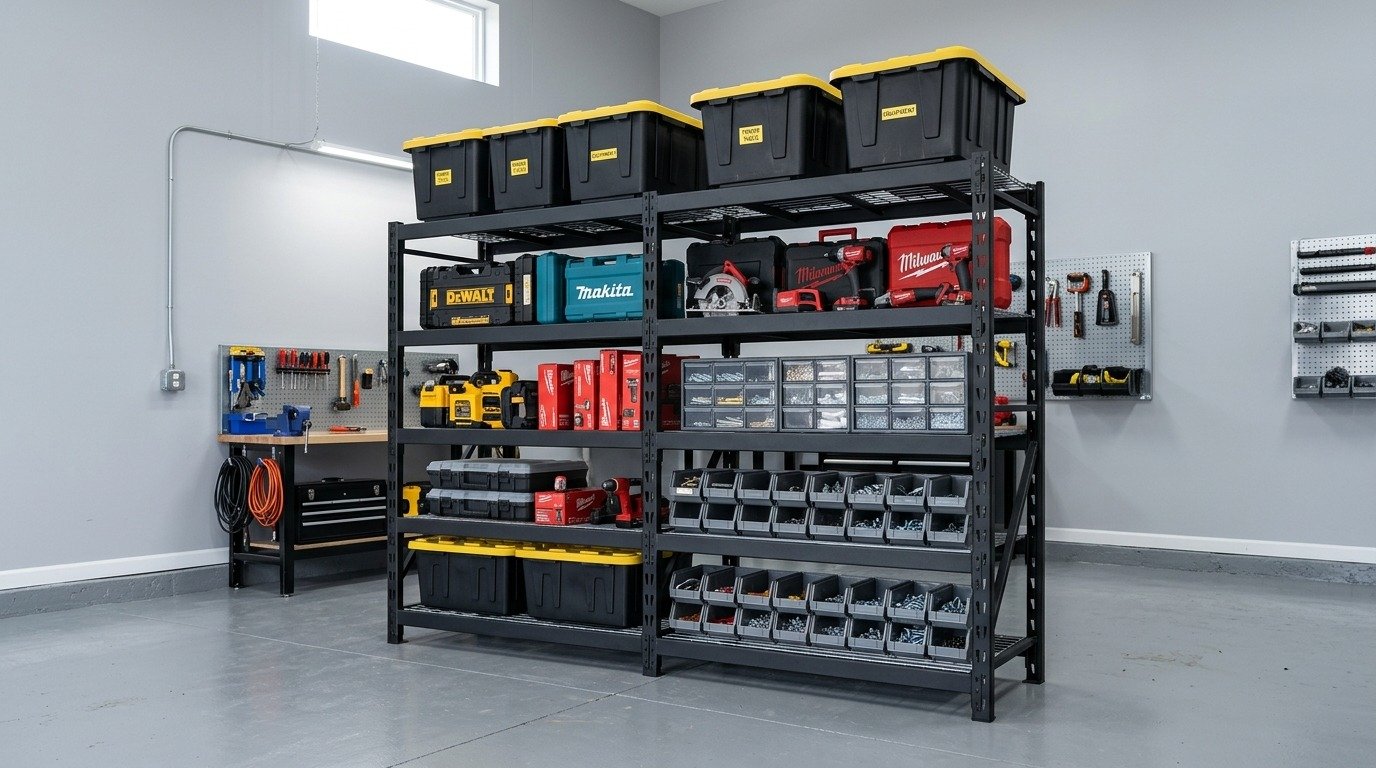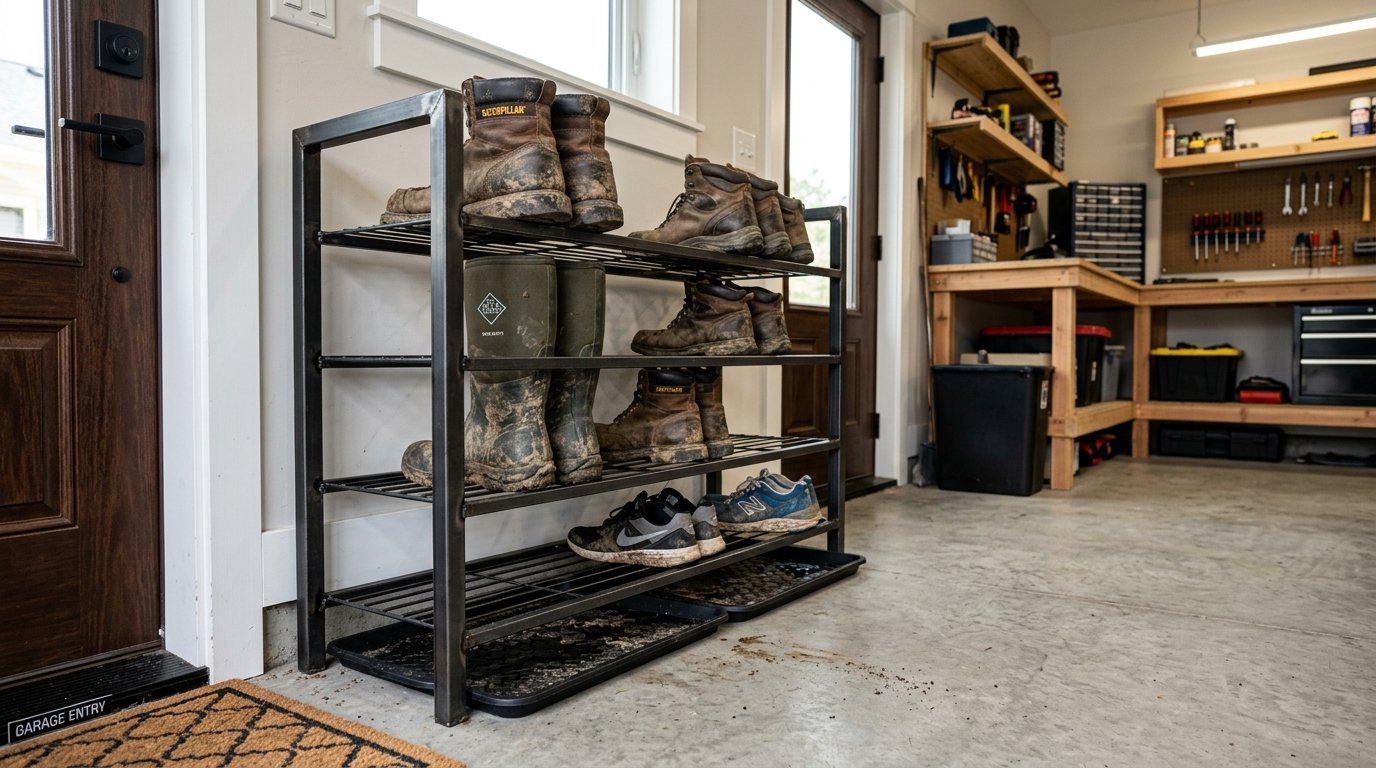
But capacity depends on more than a large number printed on a product page. Steel gauge, beam design, decking, shelf span, load placement, and anchoring all affect real-world performance.
Before you buy, measure the garage, list the items you’ll store, and estimate the weight of each group. A shelf rated for 2,000 pounds may carry that load only when weight is spread across the full shelf. A concentrated load in the middle can bend beams or damage decking much sooner.
Quick Answer: Heavy Duty Garage Shelving Specs
Heavy duty garage shelving is defined by 14-to-16 gauge structural steel frames holding 1,000 to 2,500 lb UDL (Uniformly Distributed Load) per shelf level, achieving 5,000 to 8,000 lb total rack capacity. Choose heavy-gauge wire mesh decking for moisture resistance and fire safety over particle board. Anchor frames to concrete floors using 3/8-inch wedge anchors or 1/4-inch lag screws into 2×4 wall studs to prevent tip-over accidents.
Key Takeaways
- Steel Gauge Rating: 14-gauge structural steel uprights support up to 2,500 lb per level; budget 20-gauge steel bends under heavy point loads.
- Decking Durability: Wire mesh decking prevents moisture warping in unconditioned garages and allows water flow from ceiling sprinklers.
- UDL vs Point Load Math: Ratings assume weight is evenly spread across the beams; heavy center point loads cut actual capacity in half.
- Safety Floor Anchoring: Anchor racks taller than 72 inches into concrete slabs with 3/8″ wedge anchors to eliminate tipping risks.
What Makes Shelving Heavy Duty?
Heavy duty garage shelving usually starts with structural steel uprights and horizontal beams. High-quality systems often use 14-gauge steel for the vertical posts and double-rivet box beams. Boltless systems may use 16-gauge steel and still provide strong performance when the frame and beam connections are properly designed.
Consumer utility racks often use 18-to-20 gauge steel. They can work well for light boxes. And household supplies, but thin steel may bend when you place dense items in one spot.
A shelf’s total rating also depends on its width, depth, beam length, connection points, and the number of levels.
Heavy duty ratings commonly range from 1,000 to 2,500 pounds per level. A four-level unit may carry 5,000 to 8,000 pounds in total, subject to the manufacturer’s load chart. Don’t add the ratings from separate shelves unless the complete rack has that total capacity.

Compare Garage Shelving Systems
| Shelving System Construction | Steel Gauge & Decking | UDL Shelf Rating | Best Garage Application |
|---|---|---|---|
| Welded Bulk Rack Heavy Span | 14-gauge steel with wire mesh deck | 1,500 to 2,500 lb per shelf | Car engines, transmissions, heavy tool chests, gym weights |
| Boltless Double-Rivet Rack | 16-gauge steel with drop-in wire deck | 800 to 1,200 lb per shelf | Storage totes, paint cans, seasonal tires, power tools |
| Consumer Standard Utility Rack | 18 to 20-gauge steel with particle board | 300 to 600 lb per shelf | Light storage boxes, garden supplies, household overflow |
A welded bulk rack suits dense, heavy items that stay in the garage for long periods. A boltless double-rivet rack is easier to assemble and usually costs less. It’s a practical choice for totes, tools, and medium-weight supplies.
Consumer utility racks fit light storage, but they shouldn’t be treated as industrial shelving.
Choose the Right Shelf Capacity
Use UDL ratings correctly
UDL means Uniformly Distributed Load. The listed weight assumes the load is spread across the shelf surface and supported by the front and rear beams. For example, four 250-pound boxes spread across a shelf create a.
Better load pattern than one 1,000-pound machine placed in the center.
Point loads create higher stress in a smaller area. A heavy engine sitting on narrow feet can press down on just a few wires. Or a short section of decking.
That pressure can cause local bending, even when the total weight stays below the UDL rating.
Plan for point loads
Place dense items over the shelf beams or use a steel plate, timber runners, or a suitable load-spreading panel. Runners should sit across several deck supports, not just one or two wires. Check the rack maker’s instructions before adding wood or steel, since extra material can affect clearances and sprinkler water flow.
As a practical safety margin, don’t load shelves right up to the advertised limit. Keep heavier items on lower levels, spread them across the shelf, and leave room for safe handling. If a load is concentrated, ask the rack supplier for a point-load rating instead of relying on the UDL figure.

Pick the Best Decking Material
Wire mesh decking
Wire mesh is a strong choice for an unconditioned garage. It allows air to move around stored goods and won’t swell when humidity changes. Water from a ceiling sprinkler can also pass through the deck, which helps maintain sprinkler coverage below the rack.
Mesh decking makes it easier to spot leaks, inspect the shelf, and clean dust from below. Heavy-gauge wire is better for dense items than light wire, since it resists bending at contact points. Use a load-spreading surface for small feet, casters, or sharp metal edges.
Particle board decking
Laminated particle board gives you a flat surface for small boxes and loose parts. It’s often quieter than wire and stops small items from falling through gaps. The problem is moisture.
A roof leak, wet tire, or damp floor can cause the board to swell, soften, and lose its shape.
If you choose particle board, keep it dry, seal exposed edges, and inspect it several times each year. Replace panels that show swelling, sagging, delamination, or water stains. Don’t place wet equipment on the shelf.
Solid steel decking
Solid steel is durable and handles abrasion well. It suits garages where shelves may hold sharp parts, heavy machinery, or leaking containers. It’s heavier and usually costs more than mesh, and it can restrict airflow and sprinkler water passage.
Confirm the rack’s fire protection requirements before selecting it.

Use the Correct Garage Rack Size
Common shelf widths are 48, 60, 72, 84, and 96 inches. Common depths are 18, 24, and 36 inches. Heights often range from 72 to 96 inches.
These sizes cover most residential garages, but the best choice depends on aisle space, door swing, vehicle clearance,. And the size of your stored items.
Measure the wall from floor to ceiling, then subtract clearance for lights, garage door tracks, openers, pipes, and sprinkler heads. Leave enough space to build the rack and place items without hitting the ceiling. A tall rack can provide more storage, but it also needs better anchoring and careful loading.
Choose shelf depth by item size
An 18-inch-deep shelf works well for hand tools, small totes, and boxes. A 24-inch shelf gives you more room for tires, paint cans, and medium storage containers. A 36-inch shelf suits large parts and bulky equipment, but it can make items harder to reach.
Don’t choose extra depth if you’ll place small items at the back and forget them.
Protect walkways and vehicles
Mark the planned rack footprint with tape before installation. Park the vehicle in its normal position and check door, hood, and hatch clearance. Keep walkways clear, especially near electrical panels, water shutoffs, furnaces, and exits.
Use a clear aisle wide enough to carry boxes without twisting. If the rack is beside a vehicle, protect exposed corners with guards or keep a sensible gap. A rack that technically fits may still be a poor choice if it makes daily garage use awkward.
Anchor Shelving to Stop Tip-Overs
Anchoring is a key part of safe heavy duty garage shelving. A tall, lightly loaded rack can tip if someone pulls a box from the top level. The risk increases when the rack is loaded high, the floor is uneven,.
Or a heavy item shifts during an earthquake or impact.
For concrete floors, use floor footplates with 3/8-inch concrete wedge anchors when the rack maker specifies them. Drill to the required depth, clean dust from the hole, and tighten the anchor to the maker’s torque guidance. Don’t install anchors close to a slab edge or over unknown pipes and cables.
For wall stability, use 1/4-inch lag screws driven into solid 2×4 wall studs. A drywall anchor alone isn’t suitable for a loaded industrial rack. Locate studs with a finder and confirm their position with a small pilot hole.
Use the supplied wall brackets or a rated restraint system.
Basic tipping risk check
Tip risk rises as the rack gets taller and the load’s center of gravity moves upward. A simple check is to compare the height of the loaded center of gravity with the rack’s base depth. If a 96-inch rack has heavy items stored above shoulder height.
And only an 18-inch base, it has a smaller tipping margin than a 72-inch rack with a 24-inch base.
This isn’t a replacement for an engineer’s calculation, but it gives you a useful warning. Anchor tall frames, load the bottom levels first, keep heavy items low, and don’t climb on the shelves. Inspect anchors after installation and again after any major impact.
Assemble and Inspect the Rack
Read the assembly instructions before opening the box. Sort uprights, beams, braces, connectors, and deck panels. Build on a flat surface and use a rubber mallet where the instructions allow it.
Boltless rivet racks still need each beam fully seated in its connector. A partly engaged rivet can fail under load.
Check that every upright is vertical and every beam is level. If the garage floor slopes, use approved shims or leveling feet. Don’t use loose scraps of wood that can shift.
Install all braces and back supports shown in the instructions.
After assembly, push the empty rack from several sides. It shouldn’t rock, twist, or separate at the connections. Check for bent steel, damaged welds, missing rivets, sharp edges, and cracked decking.
Fix defects before loading the unit.
Load Shelves for Long Service
- Put engines, transmissions, dumbbells, and dense metal parts on the lowest level.
- Spread loads across the front and rear beams instead of creating one center point.
- Keep shelf loads below the rated UDL and follow any lower rating for specific decking.
- Place small containers in bins so they can’t fall through mesh or roll off the shelf.
- Keep liquids in sealed containers and use trays to catch leaks.
- Store sharp tools with points protected and handles facing out for safe access.
- Label shelf capacity and use a simple inventory list for very heavy equipment.
- Keep the top level for light items, since high loads raise the center of gravity.
Inspect the rack at least twice a year. Look for sagging beams, bent uprights, loose anchors, damaged decking, corrosion, and overloaded shelves. Remove the load before repairing a shelf.
Replace damaged parts with approved components from the rack maker. Don’t weld or drill the frame without written engineering guidance.
Safety Rules for Garage Storage
Keep stored materials stable, dry, and arranged so they can’t slide into walkways. Stack boxes squarely and avoid leaning long boards or pipes against an unsupported rack. Secure tall objects separately, especially if children or pets use the garage.
Maintain access to fire extinguishers, electrical equipment, heating appliances, and exits. Don’t store flammable liquids beside ignition sources. Follow local fire rules for fuel, propane, paint, and other hazardous materials.
For broader technical guidance, review the Material Handling Institute technical standards. And the OSHA material storage safety standards. Residential garages may follow local rules that differ from workplace standards, so check your building department when storing commercial quantities.
Or very heavy equipment.
When to Choose Each Rack Type
Choose a welded bulk rack when you’ll store engines, transmissions, gym weights, steel parts, or large tool chests. Its welded construction and heavier steel suit high loads and frequent use. It’s also a good choice when you want a fixed installation that won’t be moved often.
Choose a boltless double-rivet rack when you want quick assembly and adjustable shelf heights. It works well for storage totes, seasonal tires, paint cans, and power tools. Check the beam rating and decking type before loading dense materials.
Choose a consumer utility rack for light boxes, garden supplies, and household overflow. It may be enough for a small storage area,. But don’t use it for car engines, large compressors, or concentrated loads.
If your needs may grow, starting with stronger 14- or 16-gauge shelving can prevent an early replacement.
For more planning help, read our guide to heavy duty storage racks for garage. You can also compare layouts and rack styles in our guide to the best racking system for garage.
Frequently Asked Questions
What is the weight capacity of heavy duty garage shelving?
Heavy duty garage shelving commonly carries 1,000 to 2,500 pounds per shelf under a UDL rating. Total rack capacity often reaches 5,000 to 8,000 pounds. Light and medium systems may carry 300 to 800 pounds per level.
Check the manufacturer’s rating for the exact frame, beam length, decking, and shelf spacing. A heavy point load can reduce usable capacity, so spread dense items across the beams.
Which decking material is best for garage storage shelving?
Heavy-gauge wire mesh is usually the best choice for an unconditioned garage because it resists moisture, supports airflow,. And lets sprinkler water pass through. Particle board gives you a smooth surface but can swell after water exposure.
Solid steel handles harsh use and sharp items, but it weighs more and may cost more. Match the deck to your garage conditions and the shape of your stored goods.
How do you anchor heavy duty garage shelving safely?
Use 3/8-inch wedge anchors through floor footplates when fastening to concrete, provided the rack instructions call for that size. Use 1/4-inch lag screws into solid 2×4 wall studs for wall restraint. Keep anchors away from slab edges and hidden services.
Tall racks, racks over 72 inches, and racks loaded high need special attention. Load heavy goods low after anchoring.
What dimensions should I choose for garage storage racks?
Common choices include 48-to-96-inch widths, 18-to-36-inch depths, and 72-to-96-inch heights. Select width based on wall space and shelf load. Select depth based on item size and reach.
Select height after checking the ceiling, garage door tracks, lights, and sprinkler heads. Tape out the footprint first and confirm vehicle clearance before ordering.
Final Buying Checklist
Before buying heavy duty garage shelving, confirm the steel gauge, shelf rating,. Total rack rating, decking material, shelf dimensions, connection type, and anchor hardware. Ask how the rating was tested and if it applies to your planned shelf spacing.
Make sure replacement beams and deck panels are available.
For most demanding garages, 14-gauge or 16-gauge steel with wire mesh decking is a strong starting point. Spread weight evenly, keep dense items low, anchor tall frames, and inspect the rack on a regular schedule. Those steps will give you safer storage and better service from your shelving system.

Callum Langham
Founder & Technical Storage Editor
Callum Langham is the founder and technical editor of Rack System. With over 12 years of hands-on field experience in warehouse logistics, garage organization, and industrial storage installations, Callum specializes in engineering safety standards, beam load calculations, and OSHA/RMI compliance. Every guide on Rack System is audited against verified steel gauge tolerances and municipal building codes.