You’ve got lumber, pipes, steel bar stock, or furniture to store — and every standard pallet rack you’ve looked at has the same problem: a vertical front column right where your long material needs to go. That’s the exact problem a cantilever racking system solves.
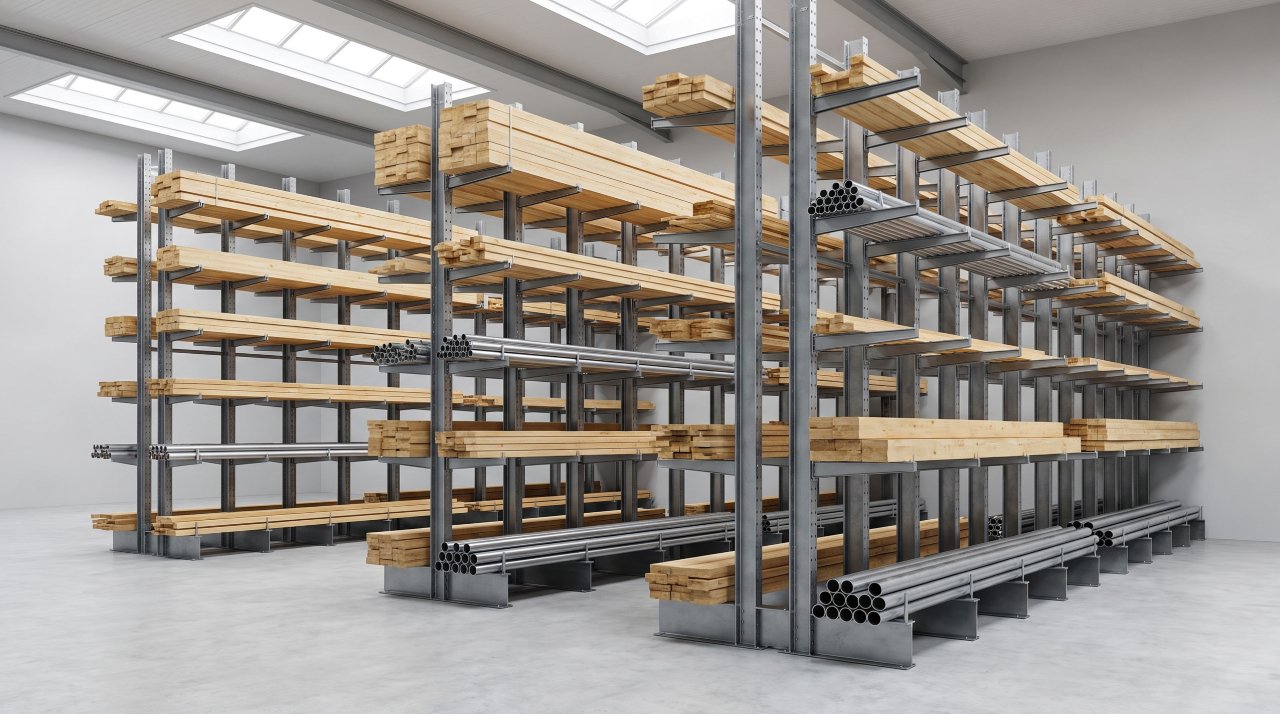
Cantilever racks have no front uprights. Arms extend outward from a central column, leaving the face of the rack completely open. You can load 20-foot boards from the side with a forklift or grab 10-foot lengths of pipe by hand. No column in the way, no awkward angling, no damage to the product.
Here’s what most buying guides don’t tell you: arm capacity and column capacity are two separate limits, and confusing them is the most common way people overload a cantilever rack without realizing it. This guide covers every type of cantilever racking system, the specs that matter, how to choose between them, and the mistakes to know before you spend anything.
What a Cantilever Rack System Is Made Of
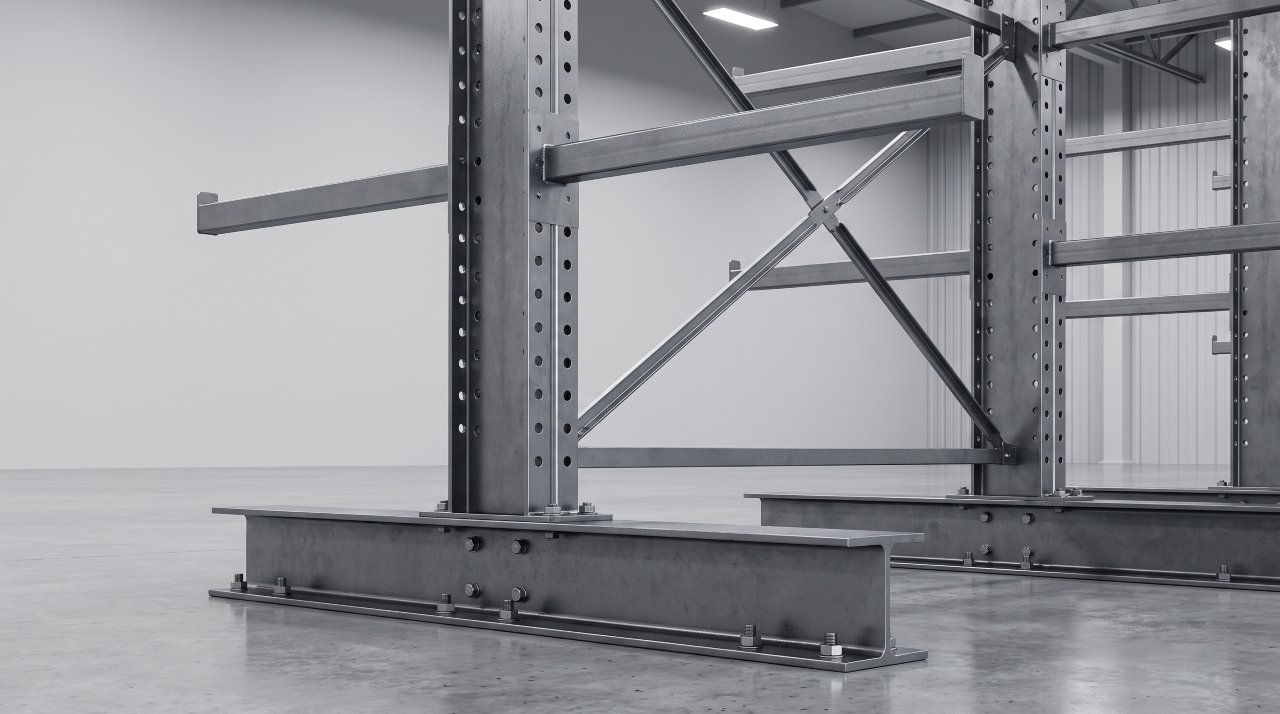
Before getting into types, you need to know the four parts — because the spec on each one determines what the whole system can actually hold.
Upright (column): The vertical backbone. It sits on the base and connects to the bracing. Arm height adjustments are made here, typically in 3-inch or 4-inch increments via pre-punched holes. Uprights range from 8 feet to 20 feet for standard industrial use, with heavy-duty structural systems going up to 48 feet.
Arms: The horizontal brackets that actually hold your product. Arm length, arm angle (straight vs. inclined), and the steel profile all determine how much weight a single arm can carry. A standard 48-inch arm is typically rated around 2,000 lbs — but only if the load is evenly distributed across the full arm length.
Base: Bolted to the floor and attached to the upright. The base resists the rotational force (moment) created when arms are loaded. Under-engineered bases are a failure point in budget systems.
Bracing: Connects uprights front-to-back (for double-sided systems) or upright-to-upright down the row. Bracing keeps the system from racking (twisting) under load.
The Two Capacity Numbers You Cannot Confuse
Most buyers look at one number: arm capacity. That’s the max weight a single arm holds. But the column capacity — the total cumulative weight all arms on one upright can carry simultaneously — is a separate and lower limit.
Here’s how that plays out: say you have a column with 6 arms, each rated at 2,000 lbs. Your gut says the column holds 12,000 lbs total. It doesn’t. The column has its own structural limit based on steel gauge, height, and base design. Per ANSI MH16.3 (the industry standard for cantilever rack design, published by the Rack Manufacturers Institute), you must verify arm capacity, column capacity, and base/anchor capacity as three distinct limits — not one.
Always check all three in the manufacturer’s load tables before buying. If a supplier only gives you one number, ask for the rest.
1. Single-Sided Cantilever Rack
Arms extend from one side of the central column only. These are placed against a wall and use the wall space that double-sided systems can’t access.
Single-sided racks are common in smaller warehouses, lumber yards that run along building walls, and shops where aisle space is tight. Because arms only load from one side, the base must be sized to handle the full offset moment — it’s working harder than a double-sided base with equal loads on both sides.
Typical specs: Arms from 18 to 72 inches long. Uprights 8 to 16 feet. Arm capacity 300 to 3,000+ lbs depending on arm length and steel type.
Best for: Lumber, paneling, drywall, and any material stored against a wall. Works with hand loading or forklift.
Where buyers go wrong: Treating a single-sided system as a wall-mounted shelf and skipping floor anchor bolts. The base must be anchored to concrete. Without anchors, any lateral bump from a forklift or uneven loading tips the whole column.
2. Double-Sided Cantilever Rack
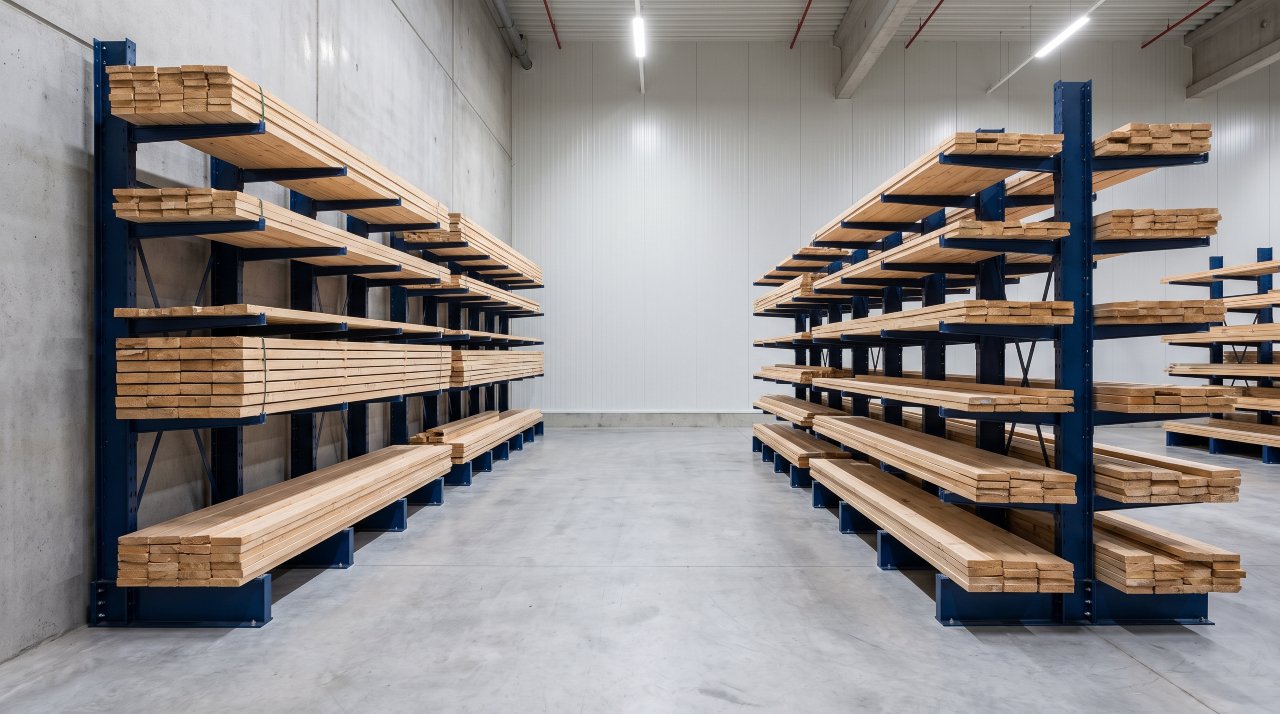
Arms extend from both sides of the column, creating a free-standing unit that you can access from two aisles. This is the most common configuration in open warehouse floors and lumber yards with forklift traffic.
Because load on both sides creates opposing moments at the base, a balanced double-sided system is more stable than a single-sided one under equal loading. The efficiency gain is real: you get twice the storage on the same floor footprint compared to two back-to-back single-sided units.
Typical specs: Arm lengths 24 to 60 inches per side. Uprights 10 to 20 feet. Some structural systems go higher.
Best for: Steel bars, pipe stock, timber, furniture — any long goods that need forklift access from two sides.
Where buyers go wrong: Loading one side heavily and leaving the other side empty for extended periods. Asymmetric loading puts the full offset moment on the base just like a single-sided unit — except the base wasn’t designed for that. Load both sides as evenly as you can, and check the manufacturer’s specs for maximum allowable load imbalance.
3. Roll-Formed Cantilever Racking
Roll-formed means the steel components are shaped by running flat sheet steel through a series of forming rollers. This produces lighter, thinner components. Roll-formed systems cost less and are easier to reconfigure — arms and uprights connect with simple clips or bolts that don’t require special tools.
Roll-formed cantilever racks are common in retail lumber yards, furniture showrooms, and light-industrial storage. Some residential garage setups use roll-formed cantilever systems for surfboards, lumber, or long pipe.
Typical specs: Arm capacity 300 to 1,500 lbs. Steel typically 12 to 16 gauge (higher gauge = thinner). Heights up to 14 feet in most product lines.
Best for: Light to medium loads, low forklift traffic, applications where reconfiguration happens frequently.
Where buyers go wrong: Buying roll-formed for an application that qualifies as industrial. If you’re storing steel bar, full lumber packs, or anything routinely moved by forklift in a warehouse, you’re past what roll-formed is designed for. The savings disappear the first time you bend an arm.
4. Structural Cantilever Racking
Structural racks are built from hot-rolled steel — the same material used in building construction. Uprights, arms, and bases are heavier, thicker sections. Connections are typically bolted with high-strength fasteners, not snap-in clips. Structural systems require more planning to install and cost more upfront, but they’re the appropriate choice for true industrial loads.
Heavy-duty structural cantilever systems can support over 36,000 lbs per column. Arms rated at 5,000 to 20,000 lbs per arm exist for specialized applications. This is the system you’re looking for if you’re storing full-length structural steel, heavy plumbing runs, or timber packs moved with counterbalance forklifts.
Typical specs: Structural steel with minimum 50,000 psi yield strength. Uprights 12 to 48 feet. PE-stamped engineering drawings required for many industrial applications.
Best for: Steel service centers, heavy lumber operations, industrial pipe storage, any application with loads over 2,000 lbs per arm.
Where buyers go wrong: Assuming “heavy duty” in a product name means structural. Many suppliers use “heavy duty” to describe a roll-formed product with thicker gauge than their basic line. Ask for the steel type (roll-formed or structural hot-rolled), not just the weight rating.
5. Outdoor Cantilever Racking
Not a separate structural type, but a configuration category worth covering on its own. Options include powder coating, hot-dip galvanization (the more durable of the two for wet environments), and stainless steel for corrosive environments.
Some outdoor systems include canopy attachments to protect the stored material from rain and UV without fully enclosing the rack. This is common in lumber yards, pipe yards, and precast concrete storage.
Key difference from indoor: The floor anchoring requirements change. Outdoor concrete pads may have different slab specs than interior warehouse floors, and wind loading becomes a factor the engineer needs to account for — especially on taller uprights.
Best for: Any material stored outside: lumber, pipe, bar stock, landscaping supplies, precast components.
Where buyers go wrong: Buying an indoor powder-coated system and placing it outside. Powder coat chips, and once the steel is exposed, rust starts at the most structurally critical points (base, arm-to-column connections). Specify galvanized for anything that will see weather, even occasionally.
6. Mobile Cantilever Racking
Mobile cantilever systems mount on motorized or manual rail bases that move along tracks set into the floor. Rows compact together when not in use, and you open only the aisle you need. This gives you the storage density of a static system with 40–60% less floor space.
Mobile systems work where floor space is expensive and product turnover is low to moderate. FIFO (first in, first out) inventory management is harder with mobile systems because access to any given row requires moving adjacent rows first.
Best for: Architectural materials, steel extrusions, special lumber grades, or any long material where you need density over speed of access.
Where buyers go wrong: Installing a mobile system without verifying the floor flatness and slab reinforcement. Mobile bases amplify point loads on the slab. You need a structural engineer to confirm the floor can handle it before you commit to the system.
Comparison Table: Cantilever Rack System Types
| Type | Steel | Arm Capacity Range | Best Load Type | Typical Cost Level | Reconfigurable? |
|---|---|---|---|---|---|
| Single-Sided | Roll-formed or structural | 300–3,000+ lbs | Wall-stored long goods | Low–High | Yes |
| Double-Sided | Roll-formed or structural | 300–3,000+ lbs per side | Open aisle long goods | Low–High | Yes |
| Roll-Formed | Roll-formed sheet | 300–1,500 lbs | Light/medium indoor | Low | Yes |
| Structural | Hot-rolled steel | 2,000–20,000+ lbs | Heavy industrial | High | Limited |
| Outdoor | Either + galvanized | Varies by steel type | Exposed material storage | Medium–High | Yes |
| Mobile | Structural (typically) | Varies | Dense, lower-turnover stock | Very High | Limited |
Arm Style: Straight vs. Inclined
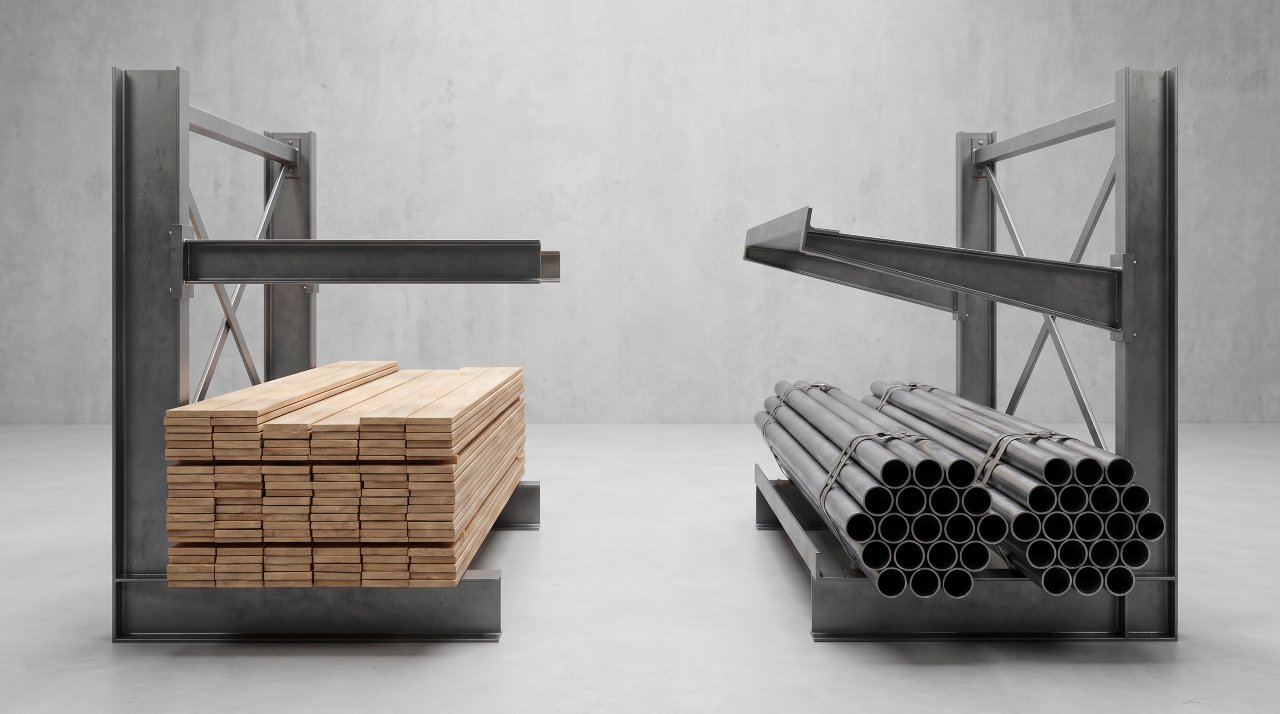
One detail most buyers don’t consider until it’s too late: arm angle.
Straight arms are flat and horizontal. They work for anything that sits stable on its own — lumber, panels, flat bar, sheet metal.
Inclined (lipped) arms pitch upward at a slight angle (typically 5 degrees) and have a raised lip at the end. They’re designed for cylindrical material — pipes, tubes, conduit, rods — that would roll off a straight arm. If you’re storing pipe and you spec straight arms, your product will roll off the first time someone grabs something at the end of the row.
Here’s Where Most People Get This Wrong
The biggest mistake in buying a cantilever rack system isn’t picking the wrong type. It’s calculating load by multiplying arm capacity by the number of arms and thinking that’s the safe total.
It isn’t. Arm capacity is the limit per arm. Column capacity is the separate limit for the entire upright under cumulative load.
A 20-foot upright with 10 arm levels, each arm rated at 1,500 lbs, does not safely hold 15,000 lbs. The column’s compressive strength and the base’s moment resistance determine the real ceiling. Always ask your supplier for the column load table and the base anchor specification — not just the per-arm rating.
Frequently Asked Questions
What is a cantilever racking system used for?
Cantilever racking systems are used to store long, bulky, or irregularly shaped materials that can’t sit safely on standard pallet racking. Common uses include lumber, steel bars, pipes, conduit, furniture, and drywall. The open-front design — no vertical columns blocking the face of the rack — makes loading and unloading long items fast and straightforward, whether by hand or forklift.
What’s the difference between cantilever rack systems and pallet racking?
Pallet racking uses horizontal beams between two vertical upright frames, creating bays for standard pallets. It handles short, stackable unit loads well but blocks access to anything longer than the bay width. Cantilever rack systems use arms extending from a single central column with nothing in front. That open face is what makes cantilever the correct system for long or oversized material.
How much weight can a cantilever storage rack system hold?
It depends on the system — there’s no single answer. A light-duty roll-formed cantilever rack arm may hold 300 to 500 lbs per arm. A heavy-duty structural arm can hold 5,000 lbs or more per arm. Column capacity adds a second limit on top of per-arm ratings. For any real application, pull the manufacturer’s full load table and verify arm capacity, column capacity, and base anchor requirements as separate numbers.
What is the difference between roll-formed and structural cantilever racking?
Roll-formed cantilever rack is made by shaping steel sheet through forming rollers. It’s lighter, less expensive, easier to reconfigure, and suited for light to medium loads up to around 1,500 lbs per arm. Structural cantilever racking is built from hot-rolled steel sections with higher yield strength (minimum 50,000 psi in most industrial specs). It handles heavy industrial loads, can exceed 20,000 lbs per arm in engineered configurations, and is the correct choice for steel service centers, heavy lumber yards, and industrial pipe storage.
How to Size a Cantilever Racking System: The Short Version
- Measure your longest product. The arm length needs to support the product without overhang past the tip.
- Weigh your heaviest load per arm level. Not the whole pile — just what sits on one pair (or set) of arms at one level.
- Count your arm levels per column. Multiply weight per level by the number of levels to get cumulative column load. Cross-check against the column capacity in the load table.
- Choose arm style. Straight for flat/stable material. Inclined for cylindrical or rolling material.
- Specify finish. Powder coat for indoor. Galvanized for outdoor or high-humidity environments.
- Confirm anchor requirements. Get the base plate spec and anchor bolt spec from the manufacturer and check your slab thickness before ordering.
For any installation exceeding 15,000 lbs total per column or heights above 16 feet, consult a licensed rack engineer. ANSI MH16.3 recommends PE-stamped calculations for engineered systems — many municipalities require it.
Conclusion
The right cantilever racking system depends on three things: what you’re storing, how heavy it is, and how you’re moving it. Single-sided for wall placements. Double-sided for open aisles. Roll-formed for lighter duty. Structural for genuine industrial loads. Outdoor-rated galvanized for any weather exposure.
The two-number rule is the most useful thing to take away from this guide: arm capacity and column capacity are separate limits. Check both before you buy. If you want to go deeper on how cantilever systems fit into a broader racking setup, read our full heavy duty racking guide for the complete picture. For options that combine open-face access with shelving-style storage, our industrial shelving options guide is worth your time.
Bookmark this page before your next storage project. Cantilever rack specs are worth double-checking every time you reconfigure.

Callum Langham
Founder & Technical Storage Editor
Callum Langham is the founder and technical editor of Rack System. With over 12 years of hands-on field experience in warehouse logistics, garage organization, and industrial storage installations, Callum specializes in engineering safety standards, beam load calculations, and OSHA/RMI compliance. Every guide on Rack System is audited against verified steel gauge tolerances and municipal building codes.