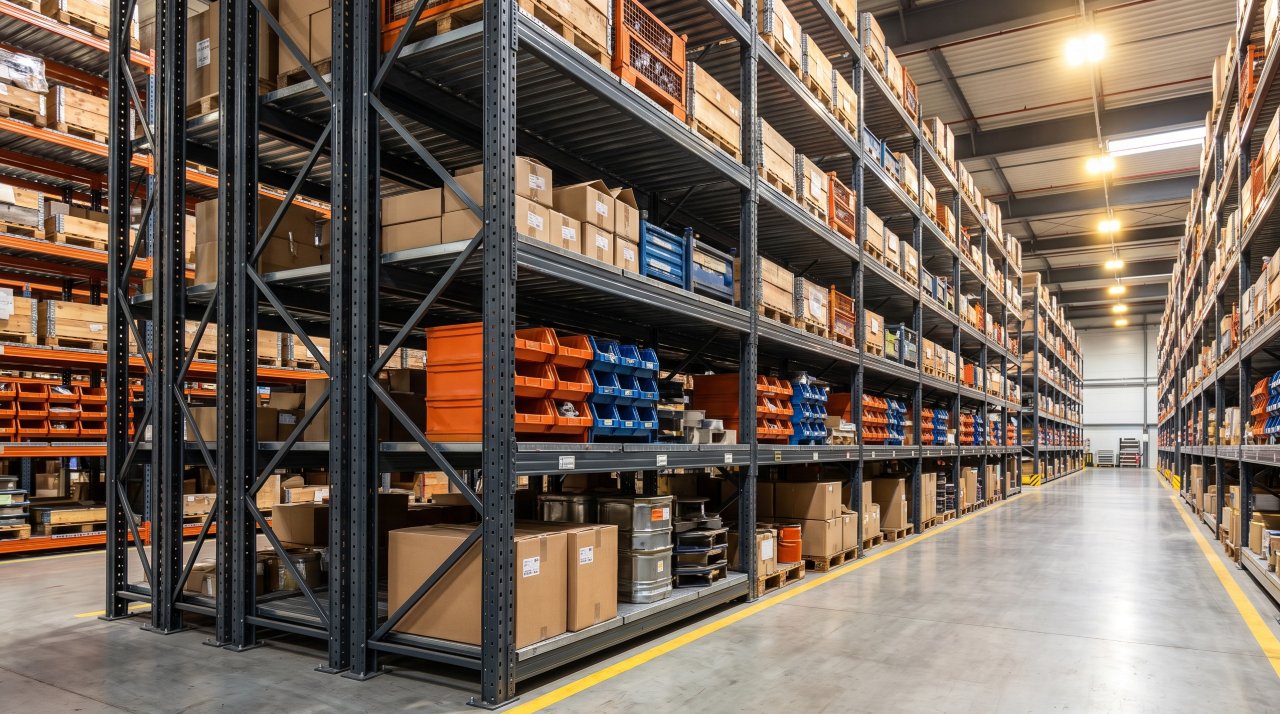
You’ve hit a point that most warehouse managers hit eventually. The floor is full, the inventory is growing, and you’ve got two realistic paths forward: add more static shelving by expanding into unused space, or convert to mobile racking and squeeze more storage out of what you already have.
Both work. Both have a real cost and a real trade-off. The problem is that most comparisons stop at a vague “mobile saves space, static saves money” and leave you with no actual framework for making the call.
Here’s a more useful way to look at it. In a typical static shelving layout, fixed aisles eat between 45 and 50 percent of your total floor area. That means if you have a 5,000 sq ft storage room, roughly 2,250 sq ft of it is walkway — not storage. Mobile racking reclaims most of that by collapsing to a single working aisle. That number is the real starting point for any comparison between these two systems.
This guide covers what static shelving is, what mobile racking storage systems actually are, the specs that matter for each, and a direct head-to-head across every factor that changes the decision.
What Static Shelving Is
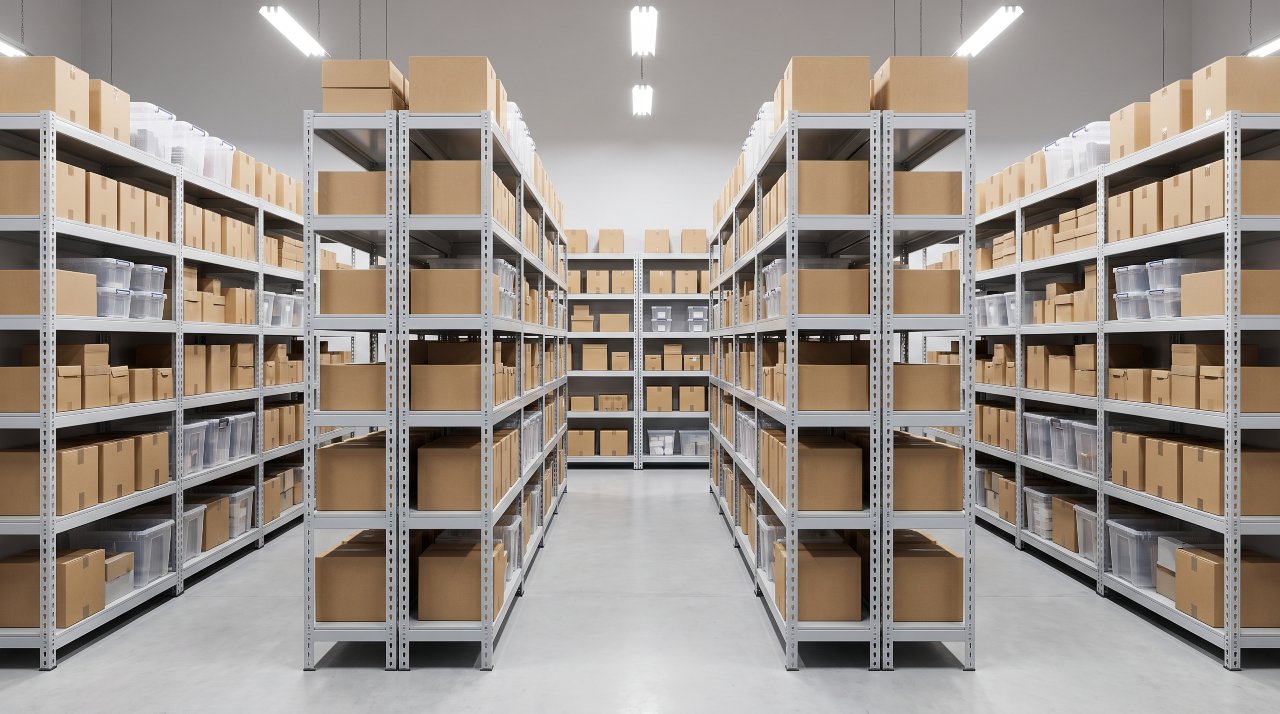
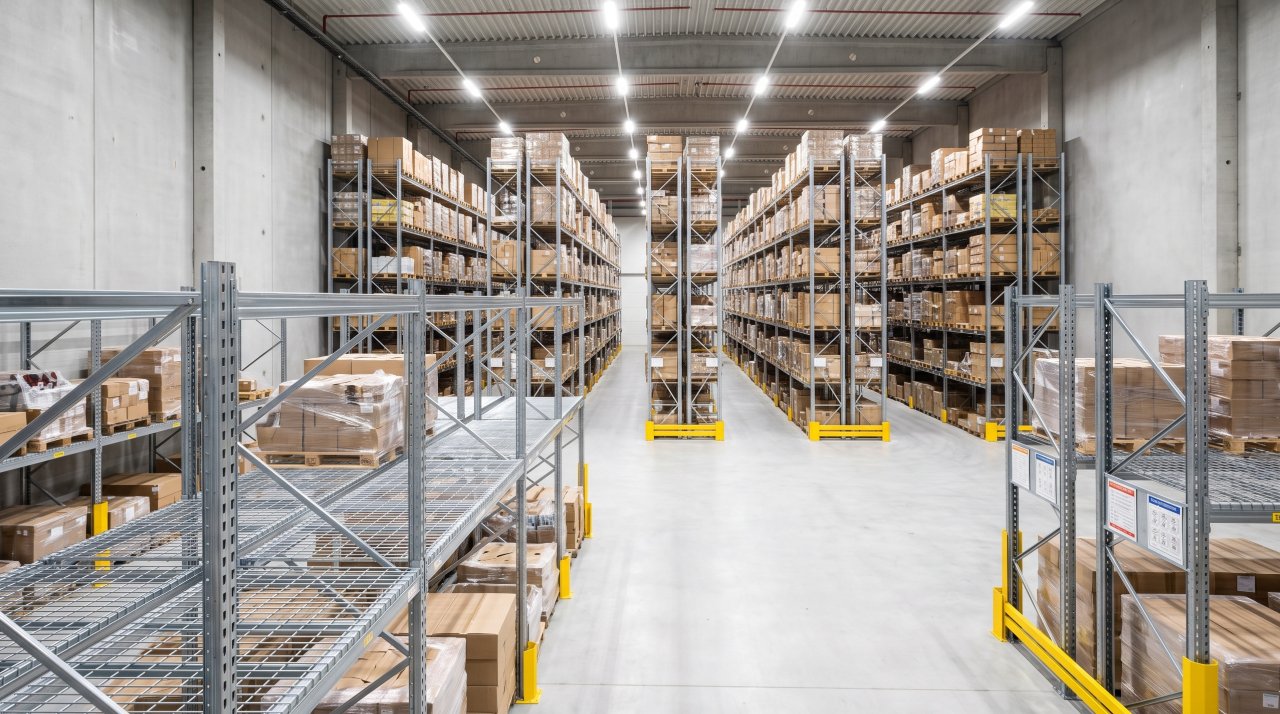
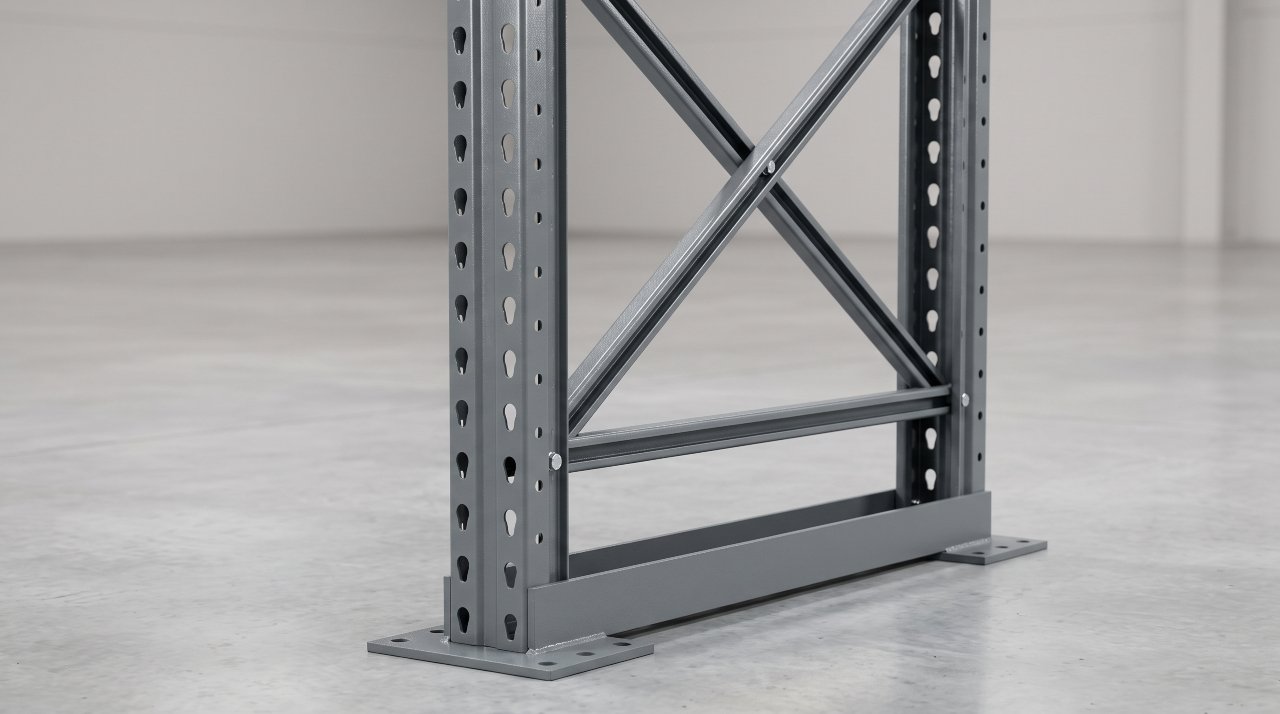
Static shelving is any shelving system that stays fixed in place. Uprights bolt to the floor, horizontal shelves sit at set heights, and every aisle between rows stays open all the time. You walk in, pull what you need, and walk out. Nothing moves.
That simplicity is the main argument for static. There are no motors, no tracks, no mechanical components to maintain. When a shelf gets damaged, you replace that shelf. When you need to reconfigure the layout, you unbolt and re-bolt. Static shelving handles hand-loaded inventory from floor to picking height — boxes, bins, parts, documents, smaller equipment.
Common types of static shelving:
- Steel shelving: The standard for industrial use. Adjustable shelf heights, open or closed back panels, load ratings from 275 lbs to over 2,200 lbs per shelf level in heavy-duty configurations.
- Boltless (rivet) shelving: Tool-free assembly, easy reconfiguration. Usually particle board or wire deck surfaces. Best for light to medium loads up to around 1,500 lbs per level.
- Long-span shelving: Wider bays (up to 13 feet) for bulky non-palletized items that don’t fit standard shelving bay widths.
- Wire shelving: Open grid design for cold storage, pharmaceutical, or food-grade environments where airflow and hygiene matter.
Typical specs: Shelf depths 12 to 30 inches. Heights 3 feet to 12+ feet depending on ceiling clearance. Shelf capacity 100 lbs (light-duty) to 1,000+ lbs (heavy-duty industrial) per level.
What Mobile Racking Storage Systems Are
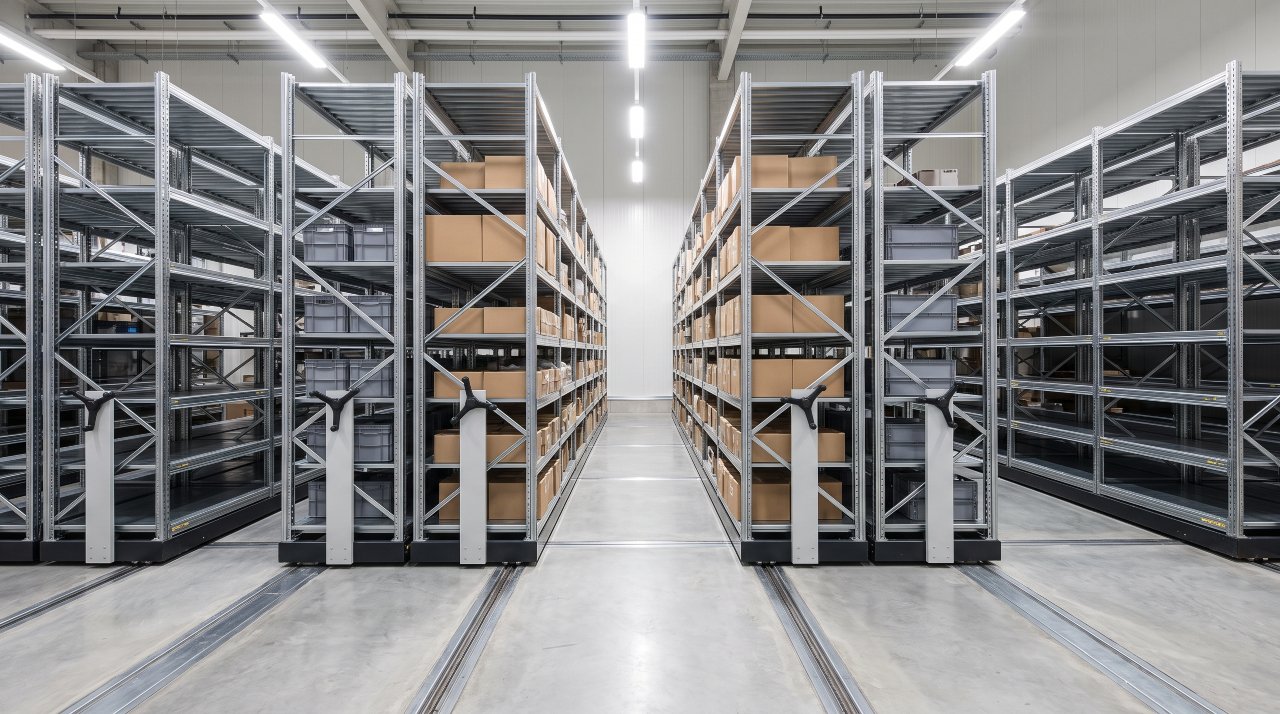
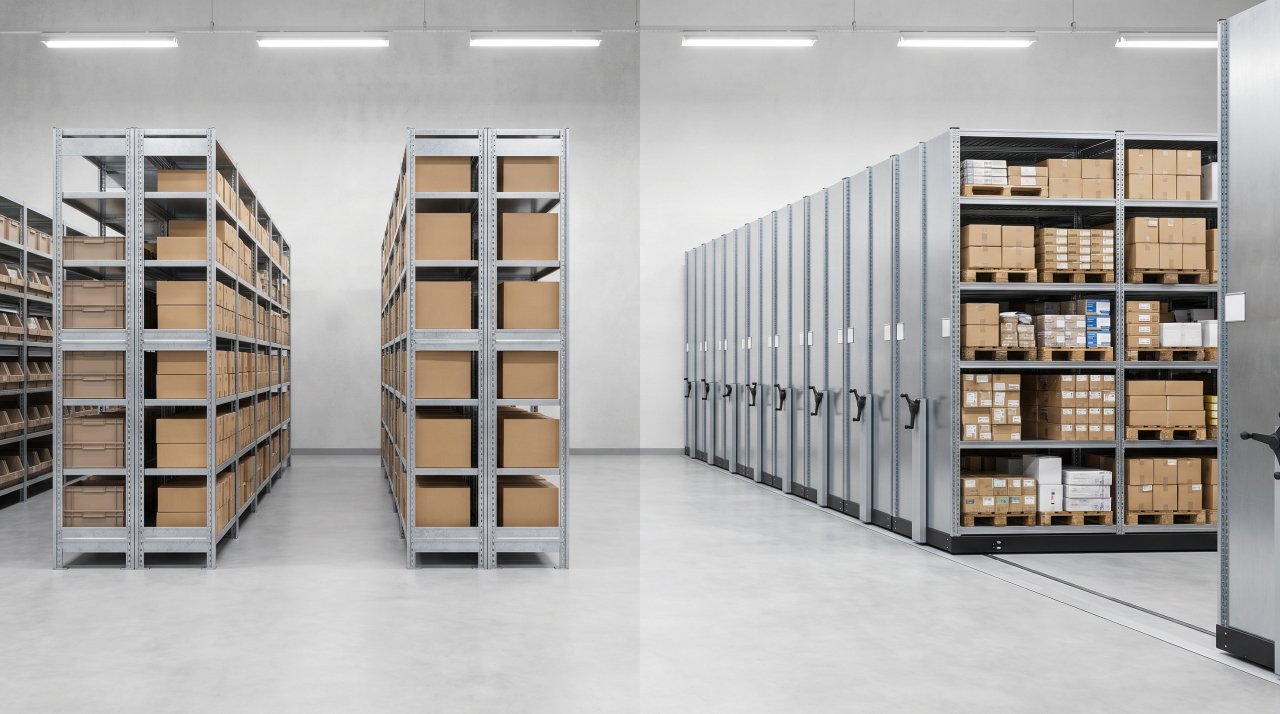
Mobile racking mounts the entire shelving or racking structure onto motorized or manual carriages that roll along tracks set into or bolted onto the floor. The rows sit compacted together. You open only the aisle you need, at the time you need it. When you’re done, the rows close back.
The result: instead of 8 fixed aisles between 9 rows of shelving, you have 1 working aisle that moves to whichever row you’re accessing. Mobile racking typically reduces aisle floor space from 45–50% of floor area down to around 10%. In practical terms, that means a 5,000 sq ft room can go from fitting, say, 9 rows of shelving to fitting 15 or more — all within the same footprint.
Drive types for mobile racking:
- Manual (hand-crank): Lower cost, no power required. Suitable for lighter loads and infrequent access.
- Semi-electric (powered assist): Electric motors move the carriages but a person still selects the aisle. Common in libraries, archives, and healthcare storage.
- Fully electric/automated: Remote or app-controlled aisle opening. Found in large warehouses and cold stores where labor time matters significantly.
What mobile racking stores: The shelving or racking that sits on the carriage is standard — pallet racking bays, steel shelving, cantilever arms. Mobile racking is a delivery mechanism, not a storage format on its own.
The Aisle Math: The Number Most Buyers Skip
Before comparing anything else, run this calculation for your facility.
Take your total floor area. Measure what percentage of it is currently aisle space (count the aisle widths, multiply by aisle length, divide by total floor area). In most standard static shelving layouts, that number lands between 45 and 50 percent.
Now the question becomes: what is that floor space worth to you?
If you’re paying 15 per sqft per year in rent and your static layout wastes 2,000 sqft in aisles, that′s 30,000 per year in rent for empty walkways. Mobile racking that reclaims 1,600 sq ft of that space pays for itself differently depending on your rent, your inventory growth, and whether you’d otherwise need to expand or relocate.
This is why mobile racking is the standard solution in cold storage (where every cubic foot costs significantly more to maintain), urban distribution centers with high rents, and archive facilities where expansion is not an option.
If your rent is low, your space isn’t full, and your picking frequency is high — the math probably favors staying static and adding shelving units.
Head-to-Head Comparison
| Factor | Static Shelving | Mobile Racking |
|---|---|---|
| Floor space used by aisles | 45–50% | ~10% |
| Storage density gain vs. static | Baseline | +50% to +100% |
| Access speed | Instant — all aisles always open | Slower — aisle must open first |
| Upfront cost | Low | High (200–500+ per pallet position) |
| Installation complexity | Low — bolt together | High — tracks, floor survey, electrical |
| Maintenance requirements | Minimal — no moving parts | Regular — motors, tracks, carriages |
| Load capacity ceiling | High — depends on shelving type | Matches the shelving type used |
| Suitable for forklift access | Yes (with adequate aisle width) | Yes (one working aisle at a time) |
| Simultaneous multi-aisle access | Yes | No — one open aisle at a time |
| Suitable for cold storage | Yes | Yes — often preferred (denser = less cooled volume) |
| Reconfiguration ease | High | Low — tracks are permanent |
| Floor requirement | Standard concrete slab | Level, reinforced slab for carriage loads |
When Static Shelving Is the Right Call
Static wins in specific, well-defined situations.
High picking frequency. If your team pulls from multiple rows simultaneously, or if the same aisle gets accessed more than once every few minutes, mobile racking creates a bottleneck. You can only have one aisle open at a time. In a fast-moving pick-and-pack operation, that wait compounds across a shift and kills throughput.
Heavy loads. Static heavy-duty shelving and pallet racking handles the full weight of your inventory without adding a carriage mechanism underneath. The engineering is cleaner and the structural limits are higher per unit.
Limited budget. A static shelving setup costs a fraction of a mobile racking installation. If capital is the constraint, static shelving is the practical answer — and you can always add mobile racking later for your slower-moving inventory sections.
Space isn’t the problem. If you have room to expand your shelving footprint without hitting walls or paying for more floor space, static is simpler. No tracks in the floor, no installation downtime, no service contracts.
When Mobile Racking and Shelving Is the Right Call
Mobile wins when one of these conditions is true.
You’ve run out of usable floor space. When the shelving rows are full and there’s no room to add more without building out or relocating, mobile racking doubles your storage density without changing the building footprint. That’s often cheaper than moving or building.
Floor space is expensive. Cold storage at $40 per sq ft annually makes the payback math work fast. High-rent urban fulfillment centers face the same math at lower per-sq-ft rates. Run the numbers specific to your facility.
Your inventory turns slowly. Archives, seasonal stock, spare parts, legal documents, pharmaceutical inventory — anything where you access a row once a day or less — is a good fit for mobile. The slower the access rate, the less the aisle delay matters.
Security matters. Mobile units are compact and lock together. For controlled-access storage (medical supplies, classified documents, high-value components), a lockable mobile system is more secure than open static shelving aisles.
The Hybrid Approach: Static for Fast, Mobile for Slow
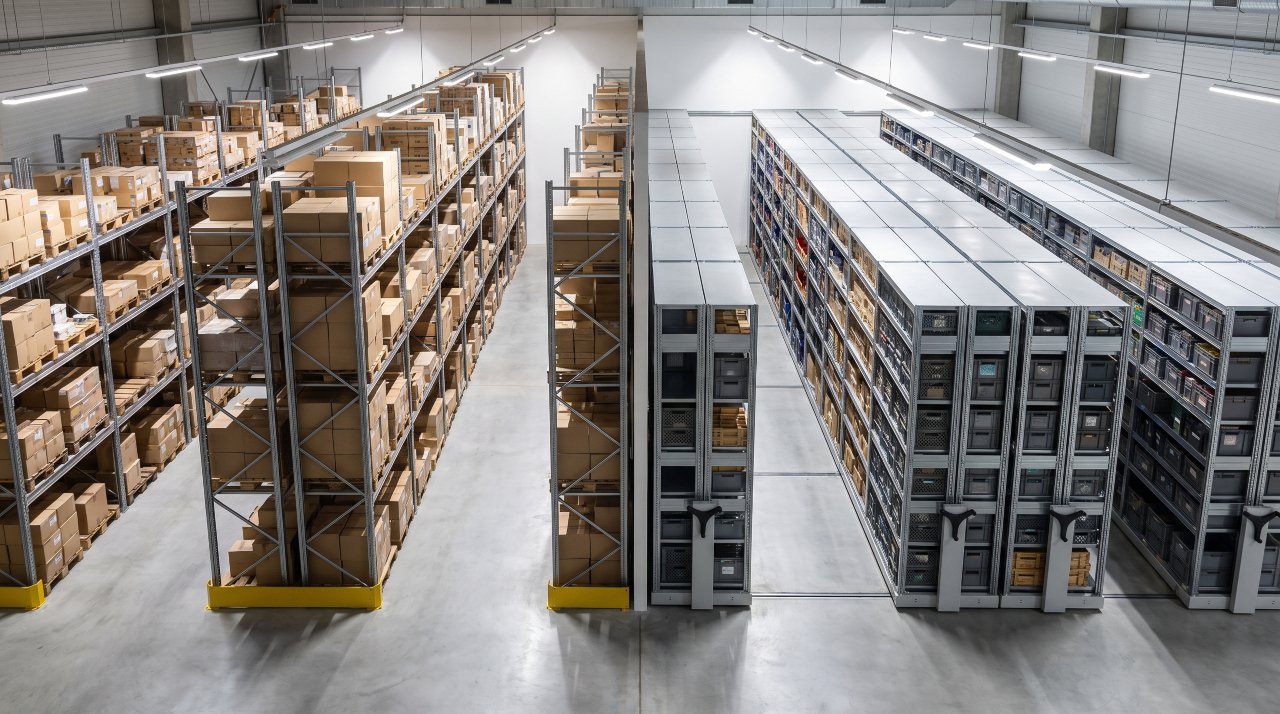
Here’s where most people get this wrong: they treat it as a binary choice when the better answer is usually a zone-based layout.
Fast-moving SKUs go on static shelving near the pick-and-pack area. Pickers get to them instantly, no waiting, no bottleneck. Slow-moving bulk inventory, archives, or seasonal stock goes on mobile racking in the back of the facility. You recover the floor space there without affecting the throughput in the active picking zone.
This split is how large distribution centers and warehouse operations actually manage storage. The static-vs-mobile decision becomes a zone-by-zone question, not a facility-wide one. Map your inventory by access frequency first, then assign storage type by zone.
Here’s Where Most People Get This Wrong
The most common mistake is evaluating mobile racking on upfront cost alone and deciding it’s too expensive.
The correct evaluation is: what does it cost to stay static? If staying static means leasing additional warehouse space, moving to a bigger facility, or building out, the comparison number changes completely. A mobile racking installation at 200,000 that replaces a 150,000-per-year lease expansion pays for itself in 16 months. The same 200,000installationthatreplacesa30,000-per-year expansion takes six-plus years. Both numbers are real — the right answer depends on your numbers, not a general rule.
Get the floor survey done. Run the aisle space percentage calculation. Price out your alternative (expansion, relocation, additional lease). Then make the call with the real cost of each option in front of you.
Frequently Asked Questions
What is the difference between static shelving and mobile racking?
Static shelving stays fixed in place with a permanent aisle between every row. Mobile racking mounts shelving units on carriages that move along floor tracks, compacting rows together and opening only the aisle that’s in use. Static offers instant access to everything and lower cost. Mobile offers significantly higher storage density in the same footprint, at higher installation cost and slower access speed.
What is mobile racking storage?
Mobile racking storage is a high-density system where shelving or racking rows sit on motorized or manual wheeled carriages running on floor-mounted tracks. You open a single working aisle wherever you need it, then close it when done. The rows compact together at all other times, eliminating the fixed aisles that consume 45–50% of floor area in a standard static layout. Common applications include cold storage, archives, hospital supplies, and warehouse operations where floor space is the primary constraint.
What are mobile racking and shelving systems best used for?
Mobile racking and shelving systems work best in operations where storage density is more important than access speed. That means archives and record storage, pharmaceutical and medical supply rooms, cold stores (where reducing cooled volume cuts operating costs), slow-moving inventory in distribution centers, and any facility that has maxed out its floor space and cannot expand. They’re not the right fit for high-frequency picking environments where simultaneous multi-aisle access matters.
How much space can mobile racking storage systems save?
Mobile racking systems typically reduce aisle space from 45–50% of floor area down to approximately 10%, leaving one movable working aisle. In practice, this means storage capacity increases by 50% to 100% within the same facility footprint. A 5,000 sq ft storage room running static shelving might fit 9 rows. The same room with mobile racking can accommodate 15+ rows, depending on row depth and carriage sizing.
Is mobile shelving worth the extra cost over static shelving?
It depends on what it costs you to not use mobile shelving. If your alternative is leasing more space, expanding the building, or relocating, mobile racking often pays for itself within 12 to 18 months. If you have ample floor space to expand with static shelving at low cost, the payback timeline stretches significantly. Run the aisle space calculation for your facility, price out both paths, then compare the 3-year total cost of each option.
Can static shelving and mobile racking be used in the same facility?
Yes — and in most large operations, a hybrid layout is the most practical approach. Fast-moving inventory goes on static shelving for instant, simultaneous access. Slow-moving stock, archives, or bulk inventory goes on mobile racking to recover floor space. The split keeps picking throughput high in the active zone while maximizing density in the lower-turnover areas.
How to Choose: A Quick Decision Framework
Answer these four questions before committing to either system:
- What percentage of your floor area is currently aisle space? If it’s under 30%, mobile racking delivers less gain than typical. If it’s 45%+, you’re losing significant usable space to walkways.
- How frequently do you access each row? More than once every 15–20 minutes = static. Once a day or less = mobile is a strong fit.
- What does your next-best alternative cost? Price out facility expansion, additional lease, or relocation. That’s the real competition for mobile racking’s upfront cost.
- Can multiple people need simultaneous aisle access? If yes, static shelving or a hybrid layout is the safer choice.
If your answers point in different directions across those four questions, the hybrid layout almost always resolves the conflict.
Conclusion
Static shelving wins on cost, simplicity, and access speed. Mobile racking wins on density, space recovery, and long-term ROI when floor space is your actual constraint. Neither is universally better — the right answer sits in your aisle math and your inventory access patterns.
Start with the percentage of floor space your current aisles consume. If that number is near 50%, you’ve got a strong case for mobile racking in at least part of your facility. For an overview of the broader racking landscape these systems fit into, our heavy duty racking overview covers the full picture. If you’re storing long or irregular materials and need a fixed open-face option, read our guide on cantilever as another fixed option before deciding on your layout.
Bookmark this page and share it with anyone helping plan your storage layout — it’s the starting framework, not the end of the conversation.

Callum Langham
Founder & Technical Storage Editor
Callum Langham is the founder and technical editor of Rack System. With over 12 years of hands-on field experience in warehouse logistics, garage organization, and industrial storage installations, Callum specializes in engineering safety standards, beam load calculations, and OSHA/RMI compliance. Every guide on Rack System is audited against verified steel gauge tolerances and municipal building codes.