Quick Answer: How to Choose a Heavy-Duty Rolling Rack
When choosing a heavy-duty rolling rack, always evaluate dynamic rolling capacity rather than static stationary limits. While stationary wire racks carry up to 2,000 pounds on leveling feet, mobile rolling racks are limited to 600 to 1,000 pounds by their caster wheels and stem mountings. For industrial and commercial use, choose 5-inch polyurethane-tread swivel casters with total-locking foot brakes and 4-bolt plate mounts rather than threaded friction stems. Ensure dynamic load capacity is calculated across three casters to account for uneven concrete expansion joints and threshold shock loads.
Key Takeaways
- The “3-of-4” Caster Rule: On uneven shop floors, expansion joints lift one wheel momentarily; always calculate safe rolling capacity by multiplying a single caster rating by 3, not 4.
- Static vs. Dynamic Load Gap: Adding casters to a 2,000-lb rated stationary wire shelving unit immediately de-rates safe transport capacity to 600–800 lbs to prevent stem shear and tip-over.
- Wheel Material Selection: Polyurethane-on-polyolefin wheels deliver the best balance of high load capacity (300+ lbs/wheel), floor protection, and chemical resistance; cheap hard nylon cracks on rough concrete.
- Total-Lock Brake Mechanisms: Choose dual-locking casters that simultaneously lock both wheel rotation and directional swivel rotation to eliminate dangerous rack drift on sloped ramps.
The Mechanics of Mobile Commercial Storage
In high-throughput stockrooms, automotive garages, commercial kitchens, and manufacturing assembly lines, fixed shelving restricts workflow. A heavy-duty rolling rack provides mobile flexibility, allowing inventory, raw materials, and tooling to travel directly between receiving docks, processing stations, and storage bays. However, introducing mobility fundamentally alters the structural physics of storage equipment.
When a stationary storage unit sits on concrete, weight transfers downward as pure vertical compression through level footplates. The moment you mount casters and push that rack across a floor slab, dynamic kinetic forces take over. Floor vibrations, threshold bumps, rotational torque, and centrifugal turning forces place severe lateral stress on caster stems and rack frame joints. Selecting the right rolling rack requires looking past catalog shelf capacities and understanding caster mechanics, frame geometry, and wheel dynamics.
The 4 Primary Types of Rolling Racks
Different commercial operating environments demand specific structural frame architectures. The four most common industrial rolling rack types each serve distinct workflow requirements.
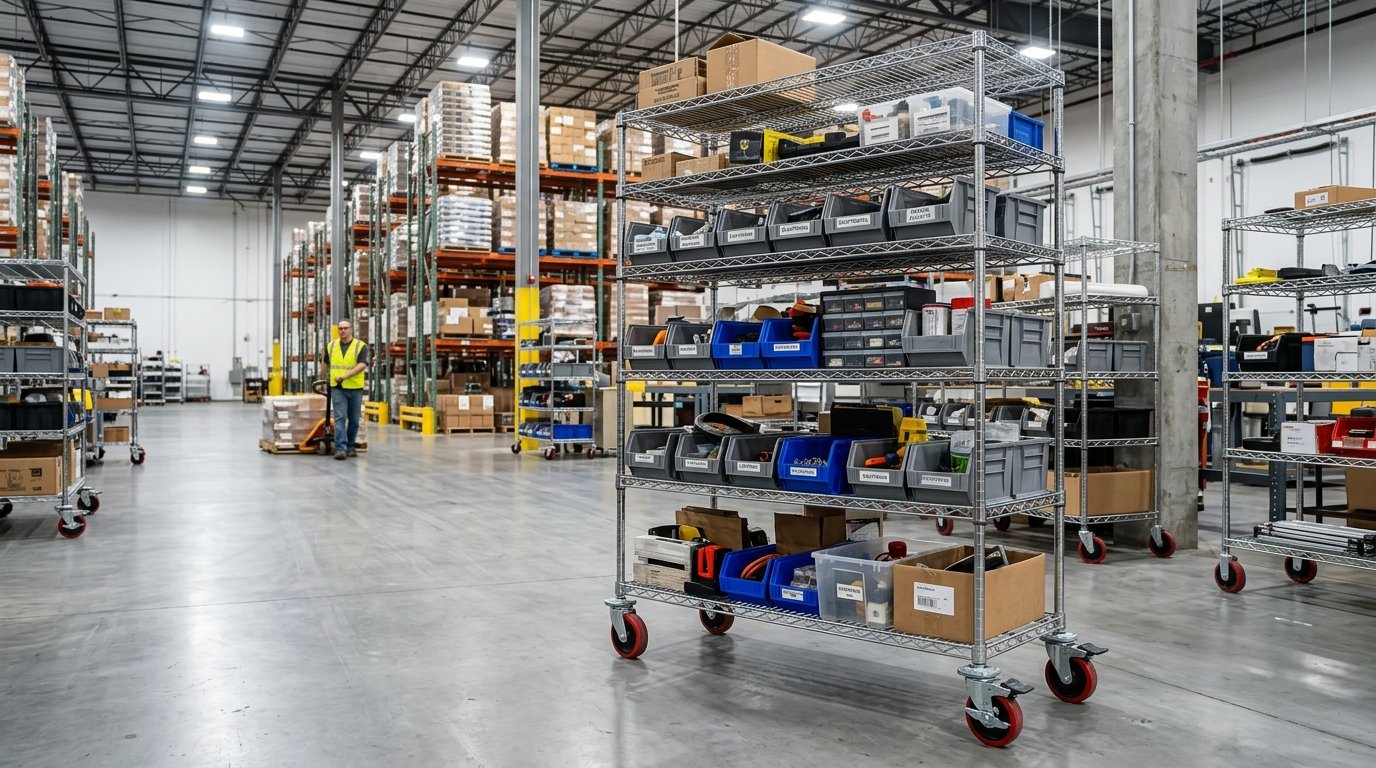
1. Industrial Wire Shelving Rolling Racks
Wire rolling racks are the most common mobile shelving units across commercial warehousing, cleanrooms, and food service. For detailed wire capacity comparisons, review our wire rack shelving weight limits guide.
- Frame Construction: Tubular 1-inch diameter steel corner posts with continuous annular groove rings spaced every inch. Heavy-gauge welded wire shelf decks lock onto split-sleeve tapered plastic collars.
- Standard Dimensions: Shelf widths range from 36 to 72 inches, with depths of 18, 24, and 30 inches, standing 64 to 72 inches tall.
- Mobile Capacity: Typically rated for 600 to 1,000 pounds dynamic weight when mounted on 5-inch commercial casters, compared to 2,000+ pounds on leveling feet.
- Finishes: Bright chrome plating for dry ambient storage, electro-polished stainless steel for laboratory sanitation, and epoxy green/gray antimicrobial coatings for walk-in coolers.
2. Commercial Nesting Z-Racks
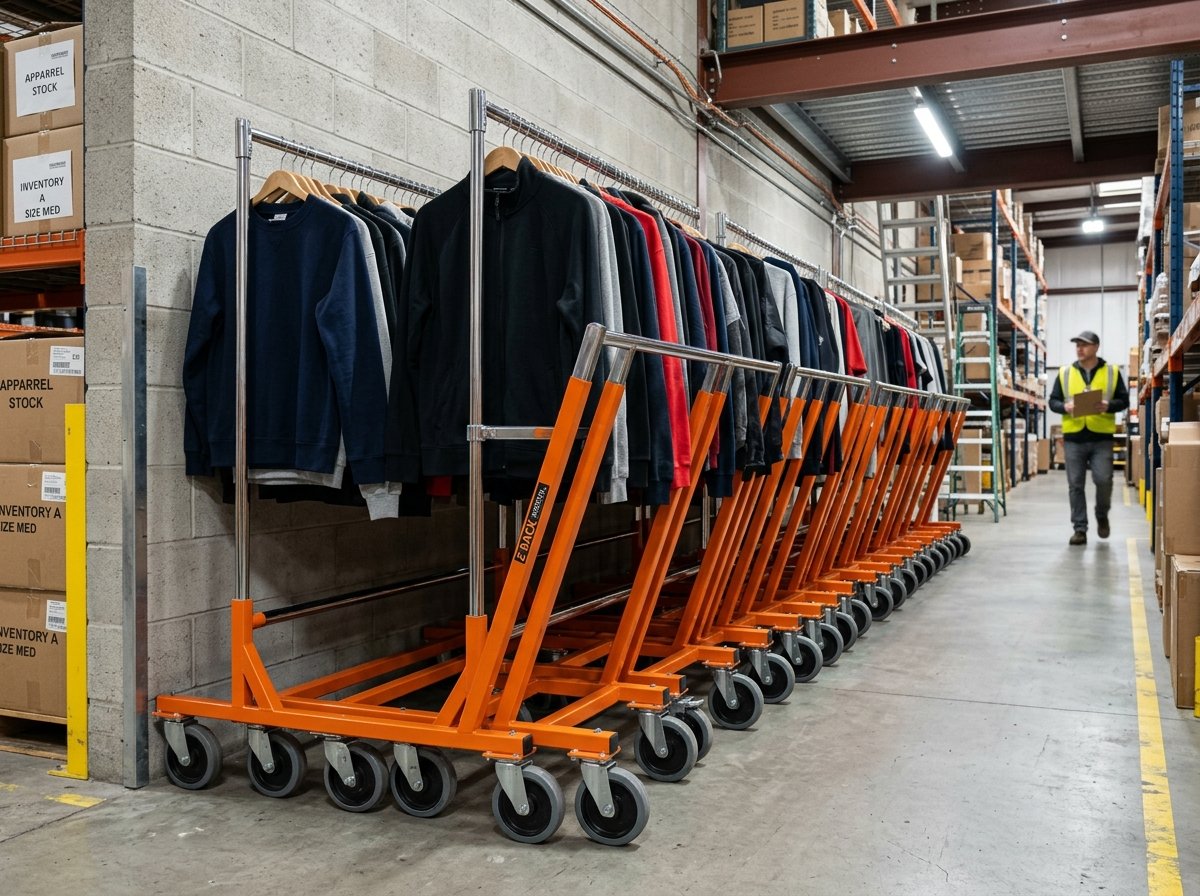
Engineered primarily for high-density apparel stockrooms, theatrical costume storage, and retail replenishment, Z-racks feature an innovative interlocking base. For apparel-specific configurations, see our guide on commercial rolling clothing racks.
- Base Geometry: The base is fabricated from heavy tubular steel welded into an offset “Z” configuration. When unloaded, multiple Z-racks nest tightly together, taking up minimal floor space when staging inventory.
- Load Capacity: Heavy-duty commercial Z-racks carry 400 to 500 pounds of hanging garments without center bar deflection, utilizing 14-gauge rectangular base steel and 16-gauge upright uprights.
- Stability: The low center of gravity created by the heavy steel Z-base prevents tall top-heavy rolling racks from tipping during rapid transit over door sills.
3. Mobile Sheet Goods and Pipe Cantilever Racks
Specialized mobile A-frame and cantilever carts are engineered to transport awkward, heavy sheet materials like plywood, drywall, steel plate, and PVC piping.
- Frame Construction: Fully welded heavy channel iron with angled vertical uprights that lean materials toward the center spine to prevent tip-over.
- Mobile Capacity: Heavy industrial models carry 1,500 to 3,000 pounds, supported by 6-inch or 8-inch forged steel or polyurethane wheels mounted to 4-bolt top plates.
- Safety Restraints: Features retaining lips, tie-down anchor rings, and removable vertical separator posts to compartmentalize sheet materials during transport.
4. Enclosed Rolling Security Cages and Tool Cabinets
For mobile storage of high-value tools, hazardous solvents, or sensitive inventory, enclosed rolling cabinets feature heavy-gauge wire mesh or solid steel side panels with lockable latching doors. To inspect secure locking mechanisms, refer to our metal storage cabinets guide and mobile workshop setups in our tool box on wheels buyer guide.
- Security: All-welded 14-gauge steel shells or 2×2-inch wire security mesh with padlockable cremone door bolts that lock at both top and bottom frame rails.
- Mobile Capacity: Typically rated for 1,200 to 2,000 pounds dynamic load on structural plate-mount casters.
Caster Engineering: Wheel Sizing, Materials & Mounting
A rolling rack is only as dependable as its caster wheels. The point where wheel meets concrete is where dynamic mechanical failures occur.
The “3-of-4” Caster Capacity Formula
When calculating the required caster capacity for a four-wheeled rolling rack, never simply divide the total cart weight by four. In the real world, concrete warehouse floors are rarely perfectly flat. When a rolling cart passes over expansion joints, floor cracks, drainage slopes, or door saddles, one wheel frequently loses contact with the floor or carries virtually zero load.
During that moment, the entire weight of the loaded rack is supported by only three casters. Structural safety standards dictate the following engineering calculation:
Minimum Required Caster Capacity = (Total Weight of Rack + Maximum Intended Cargo Load) / 3
For example, if an empty steel wire rack weighs 80 pounds and carries 800 pounds of stock (total 880 lbs), each caster must be rated for at least 880 / 3 = 293 pounds. Equipping that rack with 200-lb rated consumer casters guarantees bearing failure and wheel deformation.
Wheel Material Comparison
- Polyurethane on Polyolefin (PU): The gold standard for commercial warehouses, stockrooms, and retail. Polyurethane treads are quiet, non-marking, resist shop chemicals and oil, and absorb floor vibration while carrying 300 to 800 pounds per wheel.
- Thermoplastic Rubber (TPR): Softer tread that provides ultra-quiet, shock-absorbing transport over tile and smooth concrete. Best for hospitals, schools, and offices, but de-rates to 150–250 pounds per wheel.
- Phenolic Resin: Molded from macerated canvas and phenolic resin. Extremely hard, rolling easily under massive loads (1,000+ lbs/caster), but loud on concrete and prone to chipping if dragged over rough expansion joints.
- Cast Iron / Forged Steel: Indestructible under extreme foundry and fabrication loads (2,000+ lbs/wheel), but unyielding, loud, and damaging to epoxy coatings and polished concrete.
Stem Mounting vs. 4-Bolt Top Plate Mounts
How the caster connects to the rack leg dictates its failure threshold under lateral shock:
- Threaded Stem / Grip-Ring Friction Stems: The caster uses a single 1/2-inch threaded steel bolt or expanding rubber sleeve inserted into the round hollow post leg. Adequate for light-to-medium utility carts under 500 pounds, but highly susceptible to bending or stripping if the cart strikes a threshold at speed.
- 4-Bolt Rigid Top Plates: Heavy-duty rolling racks use welded corner gussets with flat steel mounting plates (typically 2.5×3.6 inches or 4×4.5 inches) secured by four Grade 5 bolts. The plate distributes lateral momentum across the entire corner frame, preventing leg tube ovalization.
Static vs. Dynamic Load: Preventing Frame Deflection and Tip-Over
The most dangerous misunderstanding in commercial storage is conflating static capacity with dynamic rolling capacity. Industrial equipment standards governed by the Material Handling Industry mobile equipment standards, OSHA walking-working surface and rolling cart regulations, and NSF International commercial sanitation guidelines enforce strict operational distinctions.
Understanding Dynamic Kinetic Energy
When 800 pounds of steel parts sits motionless on a rack, the load is static. When a warehouse worker pushes that loaded rack at a walking speed of 3 miles per hour and hits a 1/2-inch floor expansion joint, the sudden deceleration converts kinetic energy into an intense lateral shock wave. The momentum tries to fold the upright posts forward over the front casters. If the rack has high center-of-gravity loading, the entire unit will pitch forward into an uncontrolled tip-over.
Best Practices for Loading Rolling Racks
- Follow the “60/40” Rule: Place at least 60% of total cargo weight on the bottom two shelves. Never place dense, heavy machinery components or fluid drums on the top shelf of a mobile rack.
- Install Dual Directional Brakes: Standard rolling racks should feature two rigid (fixed) casters at the rear and two swivel-locking casters at the front for straight-line tracking down narrow warehouse aisles. For tight stockrooms requiring sideways maneuvering, use four swivel casters equipped with positive foot brakes on all four corners.
- Engage Brakes Before Loading: Never load or unload a rolling rack without stepping down firmly on the wheel brakes. A shifting cart during pallet transfer can roll away, pinching workers or tipping inventory.
Rolling Rack Styles & Caster Specifications
| Rack Style | Recommended Caster Size | Safe Dynamic Rolling Load | Ideal Working Environment |
|---|---|---|---|
| Industrial Chrome Wire Rack | 5″ Polyurethane Swivel w/ Brakes | 600 to 1,000 lbs | Warehouse order picking, dry stockrooms, electronics assembly |
| Commercial Nesting Z-Rack | 4″ to 5″ Non-Marking Rubber | 400 to 500 lbs | Apparel fulfillment, retail merchandising, backstage costume staging |
| Heavy-Duty Sheet / Bar Stock Cart | 6″ to 8″ Forged Steel or Phenolic Plate | 1,500 to 3,000 lbs | Metal fabrication shops, lumber yards, glass and stone handling |
| Enclosed Mobile Security Cage | 5″ to 6″ Total-Lock Polyurethane Plate | 1,200 to 2,000 lbs | High-value tool containment, pharmaceutical distribution, transit cages |
| Foodservice Speed Pan Rack | 5″ High-Temp Polyurethane / Nylon Stem | 350 to 500 lbs | Commercial bakeries, restaurant walk-in proofers, banquet catering |
Frequently Asked Questions
How much weight can a commercial rolling rack hold?
Most commercial 4-tier and 5-tier wire rolling racks safely support 600 to 1,000 pounds of dynamic distributed weight when fitted with heavy-duty 5-inch polyurethane casters. While identical stationary wire shelving units can carry 2,000 to 4,000 pounds on solid leveling feet, mobile units must be de-rated because caster wheel bearings, stem mountings, and floor shock loads become the primary structural limiting factors.
What is the difference between swivel-lock and total-lock casters?
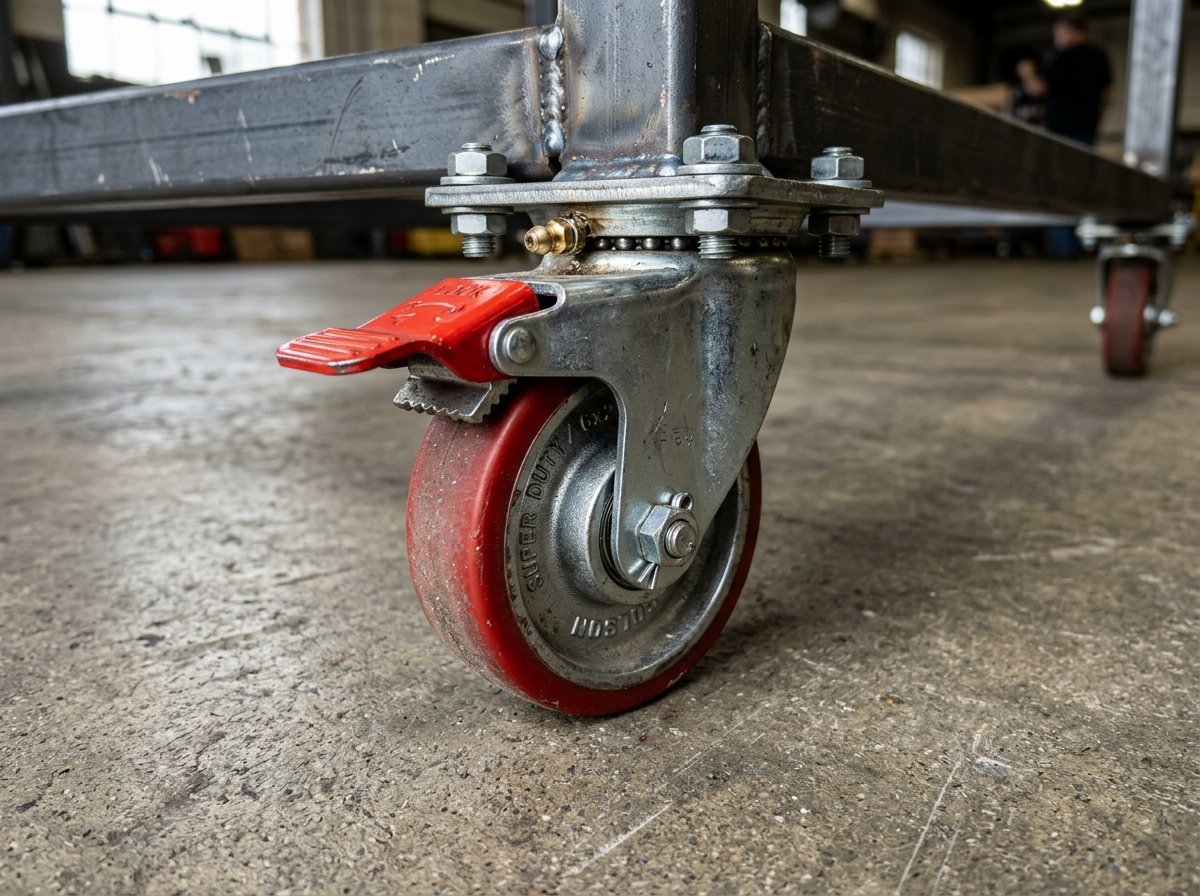
A standard wheel brake only prevents the wheel from rotating forward and backward, leaving the caster horn free to swivel 360 degrees. This allows a locked cart to pivot or drift sideways on uneven floors. In contrast, a total-lock caster features an internal dual-locking mechanism: pressing the foot pedal simultaneously clamps down on the wheel tread to stop rotation and engages a toothed ring to lock the swivel head rigidly in place, immobilizing the cart completely.
Can you add caster wheels to any wire shelving unit?
Most commercial wire shelving units with round 1-inch diameter tubular steel posts accept standard 1/2-inch threaded stem or friction-ring casters. However, consumer-grade shelving with thin 18-gauge to 20-gauge tubular posts should not be converted to heavy rolling racks, as lateral rolling force will cause the thin tube walls to flare and split at the caster stem socket. Look for NSF-certified commercial posts designed with reinforced threaded bottom inserts.
Why do rolling rack wheels get hard to push over time?
Rolling racks become difficult to steer when caster swivel raceways and wheel axles collect debris such as stretch wrap plastic, thread fibers, and warehouse dust. In industrial environments, unsealed ball bearings lose lubrication and seize up. To restore effortless rolling, choose casters equipped with integrated metal thread guards to prevent debris wrapping, and select caster swivel heads with grease zerk fittings that allow regular re-lubrication with synthetic grease.

Callum Langham
Founder & Technical Storage Editor
Callum Langham is the founder and technical editor of Rack System. With over 12 years of hands-on field experience in warehouse logistics, garage organization, and industrial storage installations, Callum specializes in engineering safety standards, beam load calculations, and OSHA/RMI compliance. Every guide on Rack System is audited against verified steel gauge tolerances and municipal building codes.