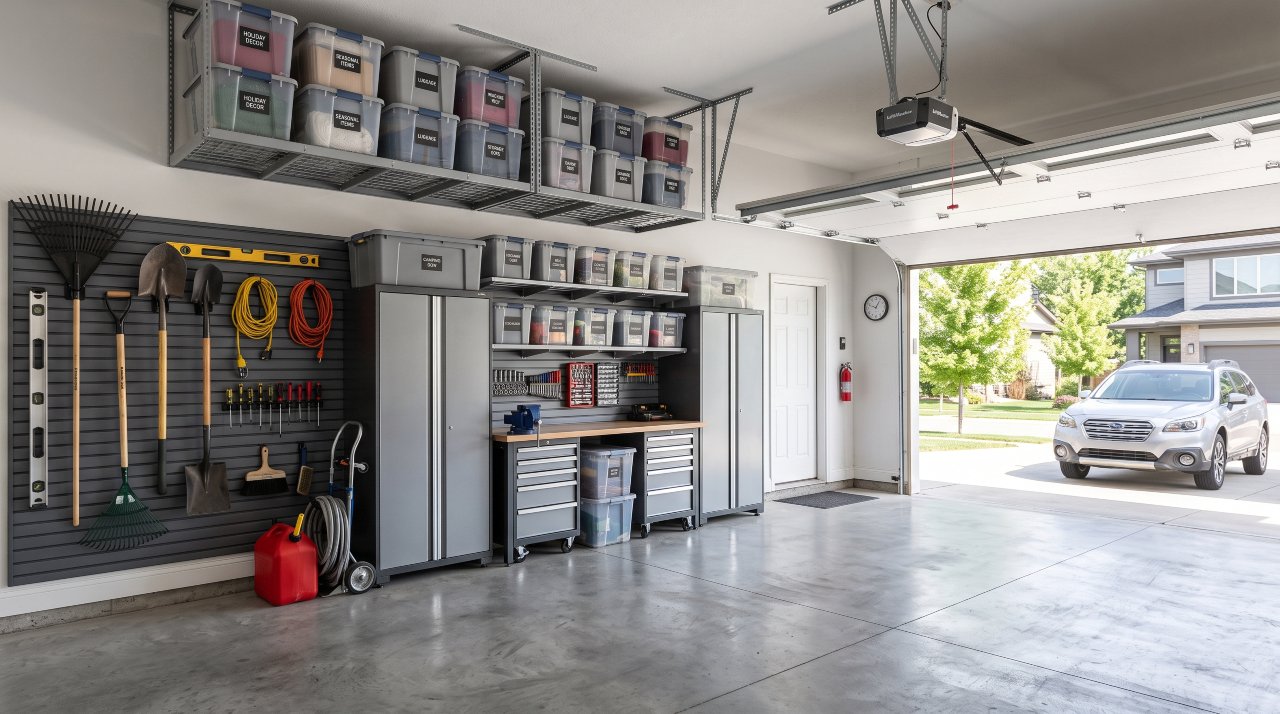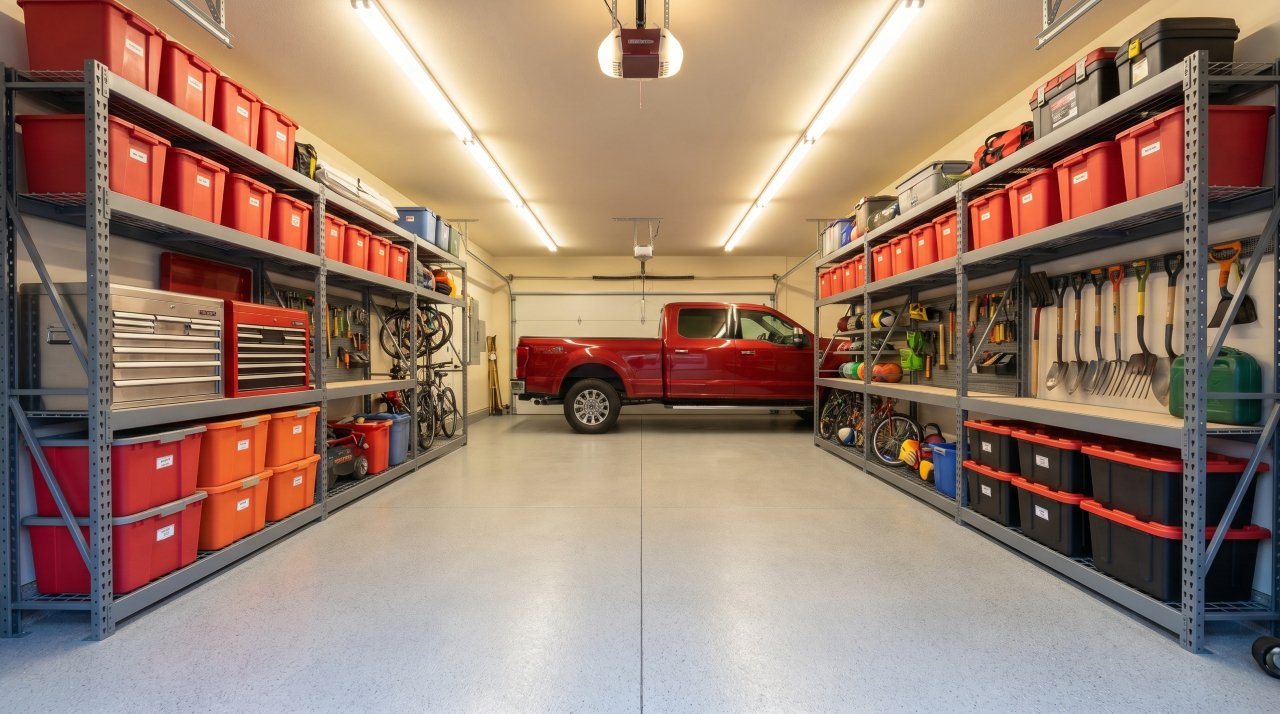
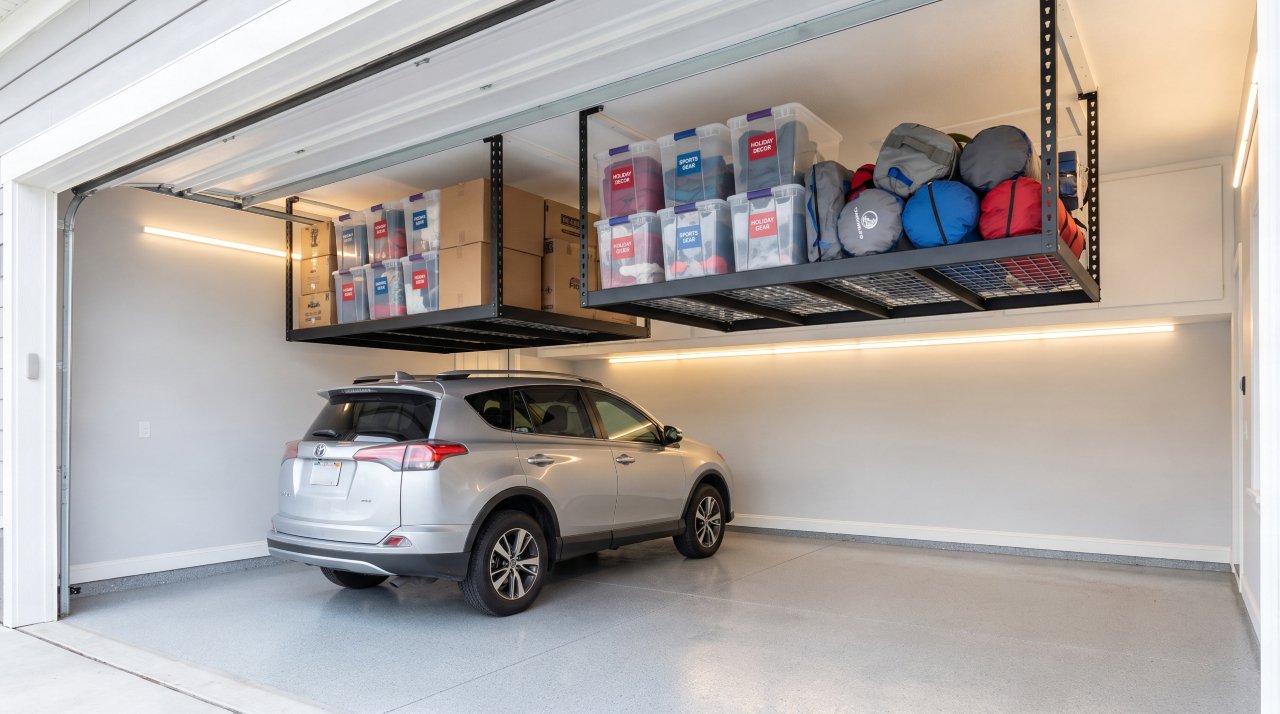
The average American garage holds 2.3 times more stuff than it was designed to store. Yet most people use less than 40% of their available garage space, because nearly all of that unused space is directly above their heads.
Overhead racks for garage storage systems turn that wasted ceiling zone into a fully functional storage area. They mount to your ceiling joists or walls and hold everything from holiday bins to kayaks, completely off the floor. If you’ve ever wanted your garage back, this is where you start.
This guide breaks down exactly how overhead rack garage storage systems work, what types exist, what you must check before buying, and what the brands won’t tell you. By the end, you’ll know whether an overhead rack is right for your garage and which features actually matter.
What Is an Overhead Rack Garage Storage System?
An overhead rack is a ceiling-mounted platform made of steel or aluminum that hangs from your garage ceiling joists. You store bins, boxes, and large items on top of the platform rather than on your floor or walls.
Most systems consist of four vertical drop rods, a welded steel grid platform, and mounting hardware that screws directly into ceiling joists. You can adjust the height of the platform anywhere from about 22 inches to 45 inches below the ceiling, depending on the model.
The core purpose is simple: free up your floor. According to the National Association of Home Builders, garages rank as the second most desired home feature for US buyers, yet over 25% of Americans can’t fit their car inside because of clutter. Overhead storage is the most direct fix for that problem.
How Much Weight Can Overhead Racks Hold?
Weight capacity is the first number most people look at, and it’s also the most misunderstood. Manufacturers list a total rack capacity, but that number means nothing if your ceiling joists can’t handle the load.
A standard 4×8-foot overhead rack typically carries between 400 and 600 pounds. Premium steel systems push that to 1,500 pounds. But the real question isn’t the rack’s rating, it’s whether your ceiling structure can bear the distributed weight of four mounting points under load.
The key rule: your ceiling joists must be rated for at least 10 pounds per square foot of live load beyond the ceiling material itself. Most residential garages in the US use 2×6 joists at 16-inch spacing, which comfortably supports standard racks when you mount directly into the joist, not just into drywall.
The 3 Main Types of Overhead Garage Rack Systems
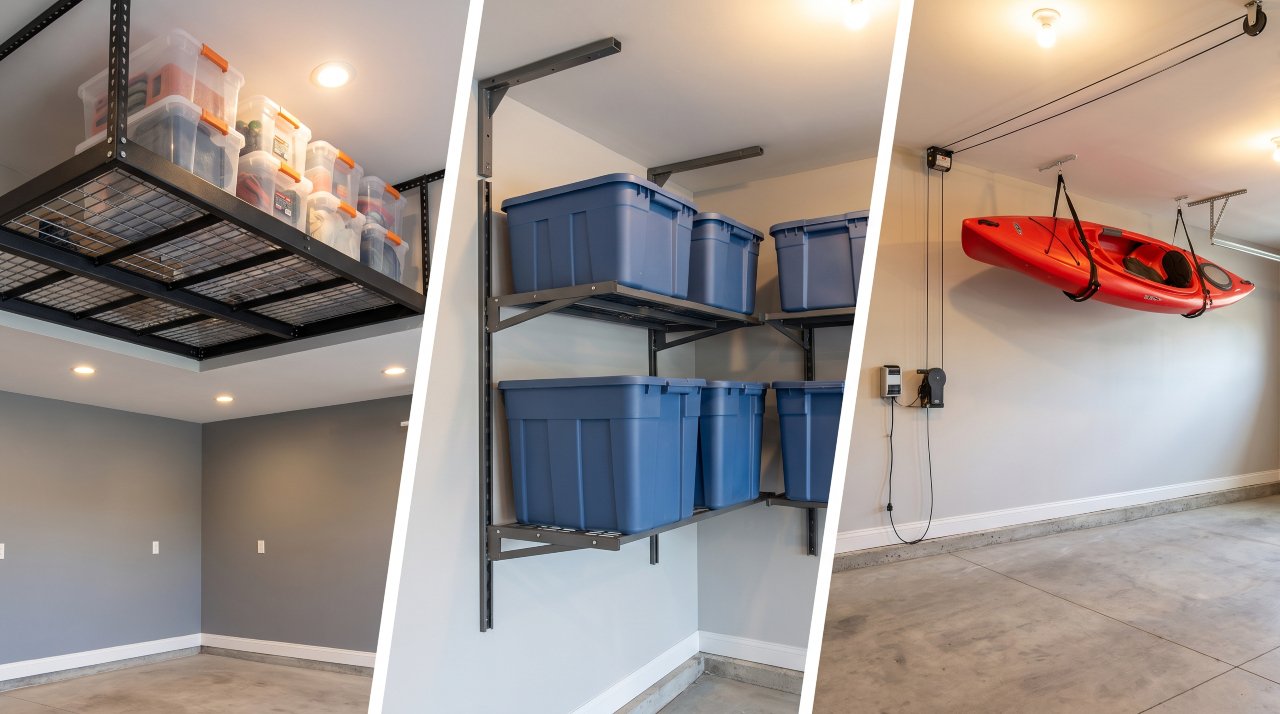
Not every overhead rack works the same way. The type you choose depends on your ceiling height, what you’re storing, and how your garage is built.
1. Fixed Ceiling-Mount Racks
These bolt directly into ceiling joists at a fixed drop height. They’re the most common, most affordable (typically $80 to $250), and the most stable. Brands like Fleximounts and Husky dominate this category. They’re ideal for most standard garages with 8 to 10 foot ceilings.
2. Wall-to-Ceiling Racks
These systems anchor to both the wall and ceiling joists for maximum structural support. They cost more ($150 to $400) but can handle heavier loads and work well in garages with irregular ceiling structures. They’re a smarter pick if you plan to store heavy bins of tools or sports equipment.
3. Motorized Overhead Lift Systems
Instead of a fixed platform, motorized lifts lower your storage down to you using a pulley or electric motor. Systems like the Garage Gator or Racor Pro handle specific items like bikes, kayaks, or platforms of bins. Prices range from $100 for manual pulley systems to $400+ for electric versions.
For a broader look at all storage options, check out this full garage storage guide that covers rack types beyond overhead systems.
What to Check Before You Buy Anything
This section is what most buyers skip, and it’s the one that causes the most expensive mistakes.
Check your ceiling height first. Overhead racks need at least 8 feet of ceiling clearance to be practical. Below that, you’ll find yourself ducking constantly or unable to park your car. If you have a 7-foot ceiling, a wall-mounted system or floor rack will serve you better.
Find your joist spacing. Standard joist spacing is 16 or 24 inches on center. You need to know this before you buy any rack, because the mounting hardware must align with actual joists, not just ceiling drywall. Use a stud finder, or tap across the ceiling listening for the solid thud that indicates a joist.
Measure your clear span. This is the open distance between walls above your car. A rack that’s too wide will hang over your car doors and become a hazard. Most 4×8-foot racks fit comfortably in a standard two-car garage bay, but measure before assuming.
Check for obstructions. HVAC ducts, light fixtures, garage door tracks, and opener rails all limit where you can mount a rack. Map your ceiling before you buy. Garage door opener rails typically sit 12 to 18 inches below the ceiling and run down the center, plan your rack position around them.
The Weight Distribution Rule Nobody Talks About
You can own a rack rated for 600 pounds and still damage it, or your ceiling, by loading it wrong. This is the mistake most first-time buyers make.
Weight distribution matters as much as total weight capacity. Loading 400 pounds all on one side of a 4×8 platform creates uneven stress on two mounting points instead of four. Over time, this warps the frame and fatigues the mounting hardware.
The correct approach: spread heavy items toward the center of the platform and place lighter bins toward the edges. Keep the heaviest single items (water heaters, engine parts) off overhead racks entirely, those belong on heavy duty garage rack options on the floor.
Installation: What’s Actually Involved
Installing a standard fixed overhead rack takes most people 2 to 4 hours with basic tools. You’ll need a drill, a stud finder, a socket set, and a second person for the lift-and-hold portion.
The process goes: locate joists, mark positions, install ceiling brackets into joists, hang vertical drop rods, attach horizontal frame, then set the grid platform on top. The most common mistake is under-torquing the lag screws into the joists. Manufacturers specify torque values for a reason, follow them.
You don’t need to be a contractor. But if your garage has a living space above it (not just attic space), you’ll want a structural engineer to confirm joist capacity before loading any heavy rack system. The American Society of Civil Engineers provides guidelines on residential structural load ratings that your local building department can also reference.
Downsides of Overhead Rack Systems
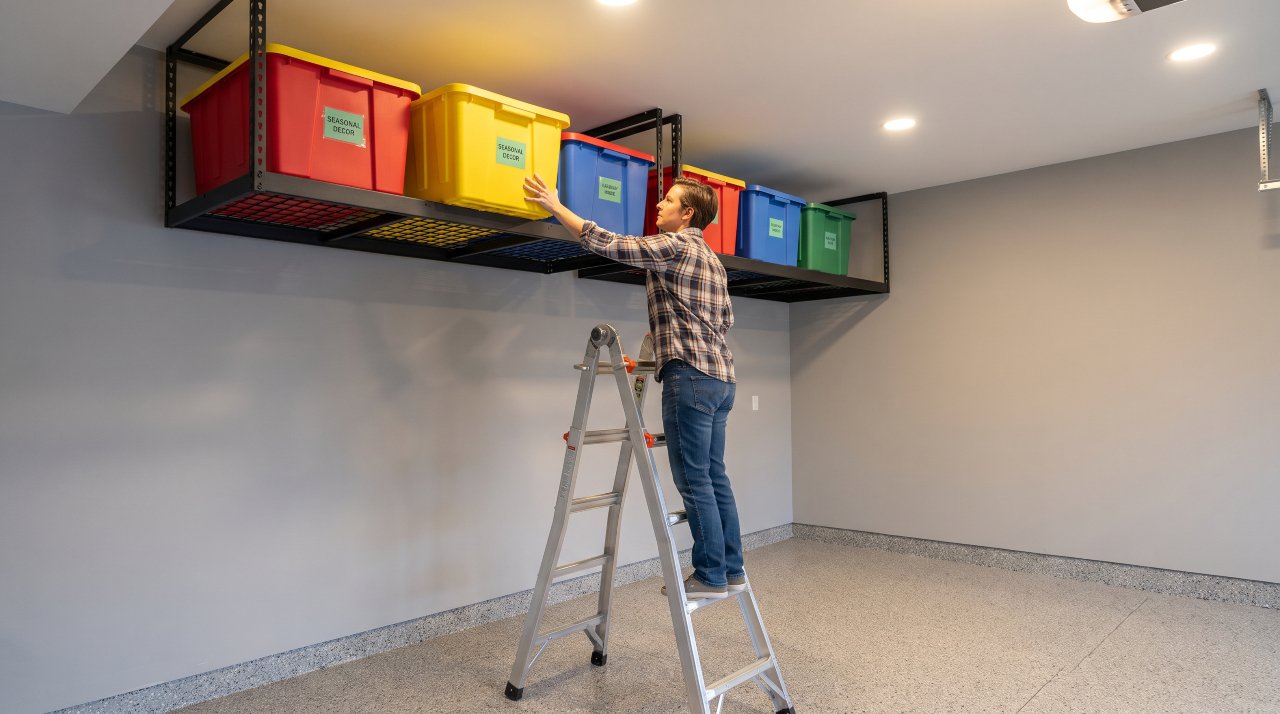
Every product has tradeoffs, and overhead racks are no exception. You need to know these before you spend money.
Access is slower. You can’t just grab something off an overhead rack the way you’d reach into a shelf. You need a ladder or step stool every time. If you need frequent access to an item, put it somewhere else.
Height limits matter. Taller vehicles, trucks with camper shells, cargo vans, SUVs with roof racks, may not clear an overhead rack platform. Measure your vehicle’s highest point and compare it to your planned rack drop height. Leave at least 12 inches of clearance above your roof.
Moisture and dust accumulate. Anything stored on an open-grid overhead platform collects dust and, in humid climates, moisture. Use sealed bins, not open cardboard boxes. In coastal US regions or humid Southern states, consider bins with locking lids and moisture-absorbing desiccant packets inside.
Installation is permanent-ish. You can remove them, but doing so leaves lag screw holes in your ceiling joists. If you’re renting, check your lease. If you’re buying a home to sell, overhead racks can actually add appeal, but only if they’re installed cleanly.
What Overhead Racks Work Best For (and What They Don’t)
| Great For | Not Ideal For |
|---|---|
| Seasonal bins (holiday decor, camping gear) | Items you access weekly or more |
| Large awkward items (kayaks, skis, ladders) | Fragile or breakable items |
| Sports equipment you use seasonally | Liquids, paints, or chemicals |
| Bulk pantry overflow in sealed bins | Items too heavy for your joist rating |
| Freeing floor space for parking | Tall vehicle garages under 9 ft ceiling |
This single decision framework will save you from buying the wrong system. If most of your items fall in the left column, an overhead rack is your best investment. If they fall on the right, you need a different storage approach.
Top Features to Look for in 2026
The overhead rack market has matured significantly. Here’s what actually separates a quality system from a cheap one.
Cold-rolled steel frame. Look for 14-gauge or heavier steel in the main platform frame. Thinner steel flexes under load and can bow over time. Fleximounts, Husky, and Racor all use 14-gauge or heavier on their mid-range and premium models.
Adjustable drop rods. Your ceiling-to-shelf height needs flexibility. Fixed-length rods limit you. Adjustable drop rods (typically 22 to 45 inches) let you fine-tune clearance for your vehicle and storage needs.
Powder-coat finish. Bare steel rusts in humid garages. Powder-coat resists moisture and handles the temperature swings that unheated garages experience between seasons. This is a non-negotiable feature for any garage in the Southern US, Pacific Northwest, or coastal regions.
Wire grid vs. solid platform. Wire grids are lighter, allow you to see what’s stored, and won’t trap debris. Solid platforms offer a cleaner look and hold smaller items that would fall through wire gaps. Both work, choose based on what you’re storing.
For a full comparison of systems at every price point, see the best overall systems guide covering 2026’s top picks across all garage storage categories.
The Consumer Product Safety Commission (CPSC) also maintains product recall databases, always check whether a specific rack model has any open safety notices before purchasing.
How to Choose the Right Size for Your Garage
Sizing an overhead rack isn’t complicated, but you do need three measurements before you shop.
First, measure the floor footprint of the area directly below the ceiling space you want to use. This tells you the maximum rack dimensions. Second, measure from the floor to the lowest obstruction (garage door rail, duct, or light fixture). Subtract 6 to 8 inches for loading clearance, this gives you your available drop height. Third, measure your tallest vehicle’s highest point and compare it to your planned rack drop height.
The most common size for a standard two-car garage is 4×8 feet. You can also pair two 4×4-foot racks side by side if you have an obstruction in the center. Many brands sell 2×8 or 4×6 configurations for garages with unusual layouts.
Don’t over-buy on capacity. A 600-pound rated rack costs less than a 1,500-pound rated rack and handles almost everything most households actually store overhead. Save the premium spend for floor-level heavy-duty shelving where the structural demands are actually higher.
FAQ, Overhead Racks Garage Storage Systems
How high should overhead garage storage racks be?
Most experts recommend leaving at least 12 inches of clearance between your vehicle roof and the bottom of the rack platform. For a standard sedan, this means setting the rack platform at 84 to 90 inches from the floor. For trucks or SUVs, measure your specific vehicle’s roof height and add 12 inches minimum.
Are overhead garage storage racks safe?
Yes, when installed correctly into ceiling joists with properly torqued hardware. The most common safety failures come from mounting into drywall only (not joists), overloading one side of the platform, or using racks rated below actual load weight. Follow manufacturer torque specs and spread weight evenly across the platform.
How much weight can an overhead garage rack hold?
Most standard 4×8-foot overhead racks hold 400 to 600 pounds. Heavy-duty systems reach 1,000 to 1,500 pounds. The limiting factor is often your ceiling joists, not the rack itself. Always confirm your joist rating before loading a rack beyond 400 pounds.
Can I install an overhead garage rack myself?
Most homeowners can install a standard fixed overhead rack in 2 to 4 hours with basic tools and one helper. Wall-to-ceiling hybrid systems and motorized lift systems are also DIY-friendly with clear instructions. If your garage has a living space above (not an attic), consult a structural professional first.
What’s the best brand for overhead garage storage?
Fleximounts, Husky, and Racor Pro consistently rank highest for build quality and installation experience in 2025 to 2026. Fleximounts offers the widest size range. Husky has strong warranty support through Home Depot. Racor Pro specializes in specialty lift systems for bikes and kayaks.
Do overhead garage racks work with low ceilings?
Overhead racks work best with ceilings of 8 feet or higher. At 7.5 feet, you can still install some models, but storage access becomes awkward and vehicle clearance becomes very tight. Below 7 feet, skip overhead racks entirely and focus on wall-mounted shelving or floor rack systems instead.
The One Thing That Changes Everything
The most important takeaway from this guide is this: measure before you buy anything.
Most buyers pick a rack based on price or brand name, then discover their ceiling is the wrong height, their joists are in the wrong place, or their car doesn’t clear the drop height. Fifteen minutes of ceiling measurements and joist mapping before you order saves you a return trip to the hardware store and hours of frustrated reinstallation.
Overhead rack garage storage systems genuinely work. They reclaim space you didn’t know you had and can double your effective garage storage capacity without touching your walls or floor. You just need to pick the right one for your specific garage, not the most popular one online.
Your next step: Grab a stud finder, a tape measure, and write down three numbers, your ceiling height, your joist spacing, and your tallest vehicle’s roof height. Those three numbers narrow your choices to exactly what will work in your garage.

Callum Langham
Founder & Technical Storage Editor
Callum Langham is the founder and technical editor of Rack System. With over 12 years of hands-on field experience in warehouse logistics, garage organization, and industrial storage installations, Callum specializes in engineering safety standards, beam load calculations, and OSHA/RMI compliance. Every guide on Rack System is audited against verified steel gauge tolerances and municipal building codes.