A five-tier stainless steel shelving unit can cost $150 at a big-box store or more than $1,100 from a commercial supplier. Both look nearly identical in the product photo. The difference shows up a year later, when one unit has rust spots at every weld and the other still wipes clean.
Most buyers compare width, height and price. What actually decides how long stainless steel shelving lasts is the grade of steel, the shelf style and how honestly the weight rating was written. This guide covers all three, plus sizing, NSF listings, casters and care, so you can match the unit to the room it’s going into.
Quick Answer
Stainless steel shelving is corrosion-resistant metal shelving built for wet, cold or washdown areas such as commercial kitchens, walk-in coolers, labs and damp garages. Most kitchens and garages do fine with Type 304. Type 316 adds molybdenum for better resistance to salt and chlorides, so it fits coastal homes, labs and areas cleaned with harsh chemicals. Wire shelves allow airflow and drainage, while solid shelves hold small items and wipe down easily. Commercial units commonly carry ratings of 800 to 1,000 lb per shelf, evenly distributed, but casters can cap the whole unit far lower. For dry storage, chrome or epoxy wire costs less and does the same job. Pay for stainless only where moisture, cleaning chemicals or food contact will be a daily fact of life.
Key Takeaways
- Grade matters more than gauge: 304 for general use, 316 for salt, chlorides and harsh cleaners, 430 for dry indoor areas only.
- Per-shelf ratings assume evenly distributed loads. A unit rated 2,000 lb on feet may be limited to 450 to 900 lb on stem casters.
- Wire shelves suit coolers and washdown areas. Solid shelves suit small parts, spills and anything that could fall through.
- Stainless still stains. Regular washing with mild detergent and warm water keeps it looking new.
What Stainless Steel Shelving Is (and Isn’t)
Stainless steel is an iron alloy with at least 10.5% chromium. That chromium forms a thin, self-repairing oxide layer on the surface, which is why it resists rust far better than plain or painted steel.
Here’s where most people get this wrong: “stainless” doesn’t mean “rustproof.” The British Stainless Steel Association puts it plainly, noting that stainless steels can stain and discolour from surface deposits and “cannot be assumed to be completely maintenance-free.” A cheap grade in a salty or chlorine-heavy room will still pit and spot.
You’ll find stainless shelving in three common forms. Freestanding post-and-shelf units are the most popular, followed by wall-mounted shelves and table-mounted overshelves. Each one carries different load limits and mounting needs, so pick the form first and the size second.
Stainless Steel Grades: 304 vs 316 vs 430
The grade is the single spec that decides how a stainless steel shelving unit ages. Retail listings often skip it, which is a red flag in itself. If a product page says only “stainless steel” with no grade, assume it’s a lower-cost ferritic grade until the seller confirms otherwise.
One useful yardstick is the Pitting Resistance Equivalent Number (PREN), calculated as Cr + 3.3Mo + 16N. A higher number means better resistance to the small pits that chlorides from salt, bleach and some sanitizers cause. The figures below come from British Stainless Steel Association data.
| Grade | Chromium | Molybdenum | PREN | Best fit |
|---|---|---|---|---|
| 304 | 17.5 to 19.5% | None specified | 17.5 to 20.8 | Kitchens, coolers, garages, general labs |
| 316 / 316L | 16.5 to 18.5% | 2.0 to 2.5% | 23.1 to 28.5 | Coastal sites, pharma, chemical washdown |
| 430 | 16.0 to 18.0% | None specified | Not listed in the BSSA table | Dry indoor storage, light duty |
Type 304
Metro, one of the largest commercial shelving makers, calls Type 304 its most popular option, citing excellent corrosion resistance in foodservice, healthcare and general lab settings. For a restaurant walk-in or a garage that gets wet from snowmelt, 304 is the sensible default.
Type 316
The molybdenum in 316 is what lifts its PREN. Metro recommends it for labs and pharmaceutical rooms with frequent exposure to caustic chemicals and salts. It’s also worth the premium if your garage sits within a few miles of the ocean or your floor gets road salt every winter.
Type 430
Grade 430 is a ferritic stainless steel. It’s magnetic, cheaper and lower in corrosion resistance than 304 because it lacks nickel. A quick magnet test in the store is a useful hint, though cold-worked 304 can show slight magnetism too, so confirm the grade on the spec sheet.
Wire vs Solid Stainless Shelves
The shelf surface is the second big decision. Most commercial lines offer both, and many let you mix wire and solid shelves on the same posts.
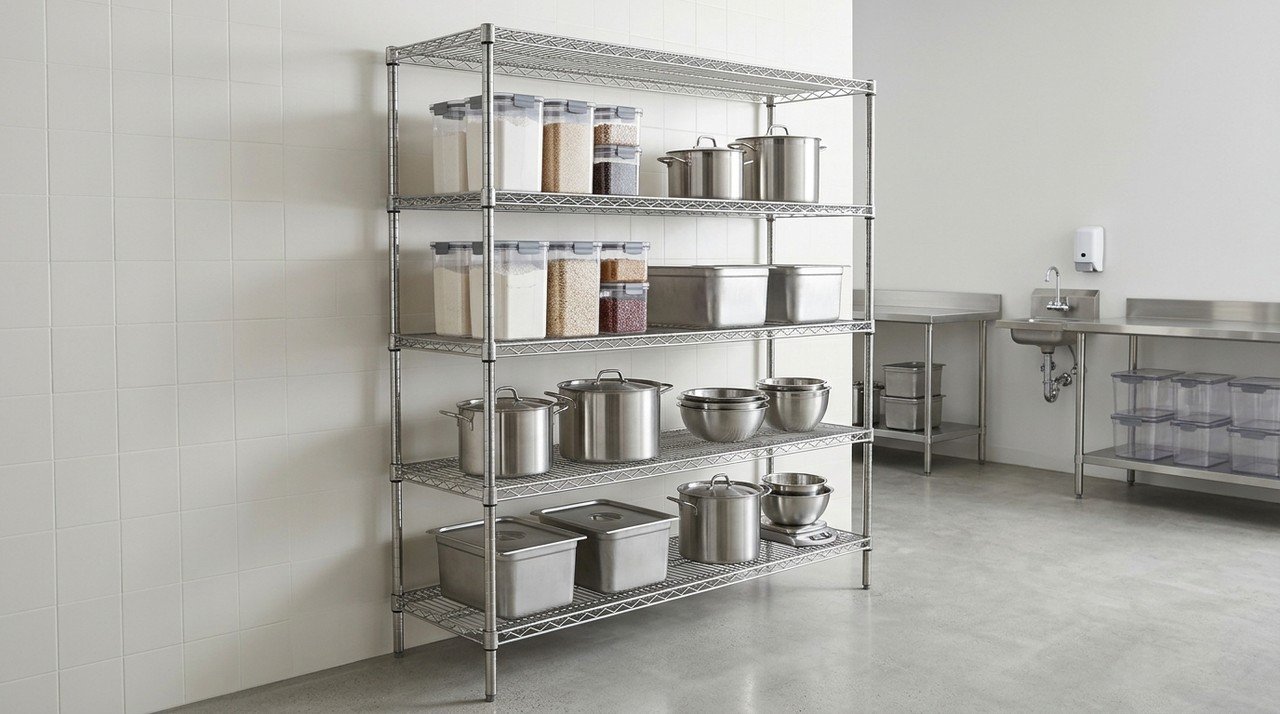
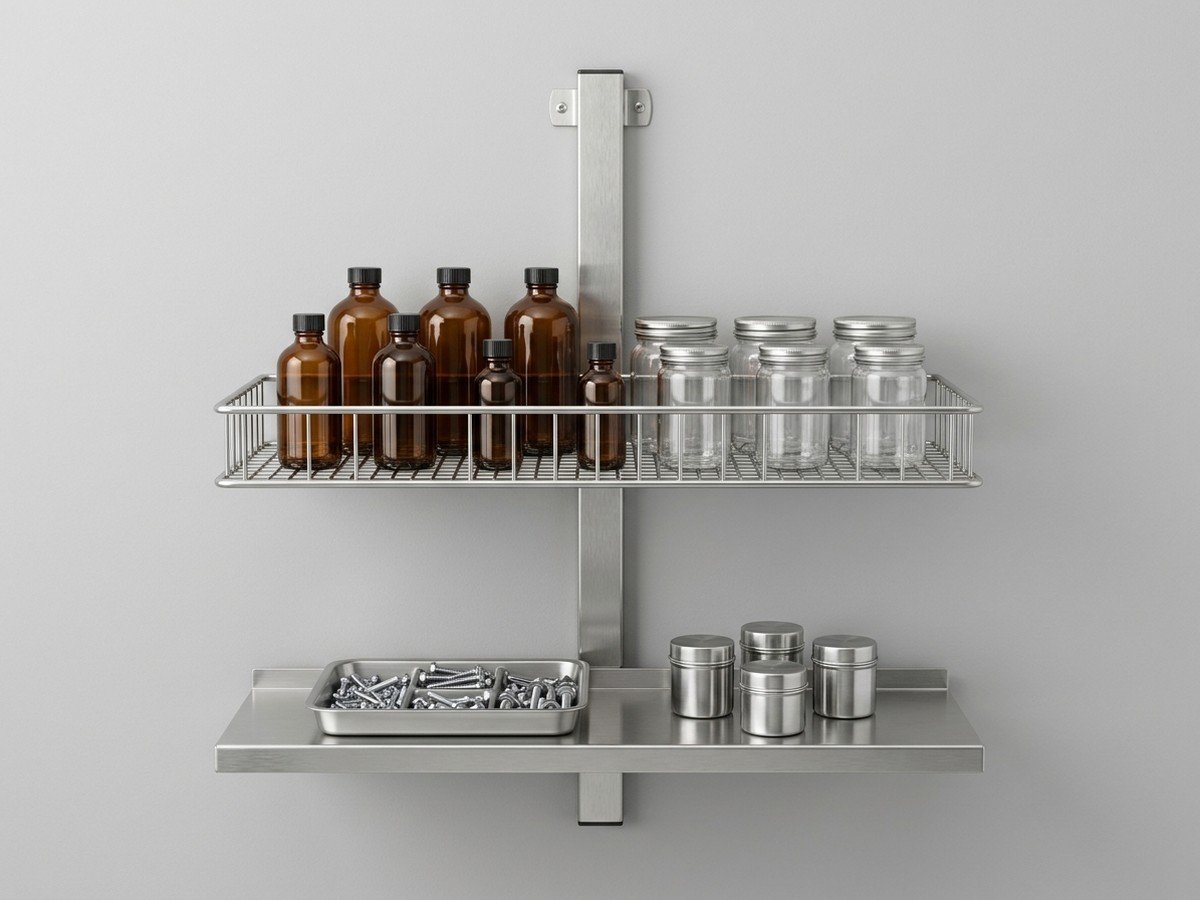
- Wire shelves: open surface for airflow, drainage and washdown. They’re the standard choice in walk-in coolers and freezers because cold air reaches every item and condensation drips through instead of pooling.
- Solid shelves: a flat surface for small items, liquids and wipe-down cleaning. They stop spills from dripping onto lower shelves and keep small parts, like screws or spice jars, from slipping through.
- Mixed units: a solid top shelf as a dust cover and a solid bottom shelf to catch drips, with wire shelves between. This setup works well in garages and home pantries.
One trade-off to know: solid shelves trap moisture underneath stored containers. In a humid space, wipe them dry now and then, or the chlorides in spilled food and cleaners will start working on the surface.
Freestanding Units vs Wall-Mounted Shelves
Freestanding stainless steel shelving uses four posts with shelves locked in at set heights. It carries far more weight and moves when you rearrange a room. Typical commercial heights are 54, 63, 74 and 86 inches.
Wall-mounted shelves free up floor space for mopping, which is why health inspectors and restaurant owners like them over prep tables. Small units run as shallow as 6 inches deep, and simple 6 by 24 inch wall shelves start under $50 from restaurant suppliers.
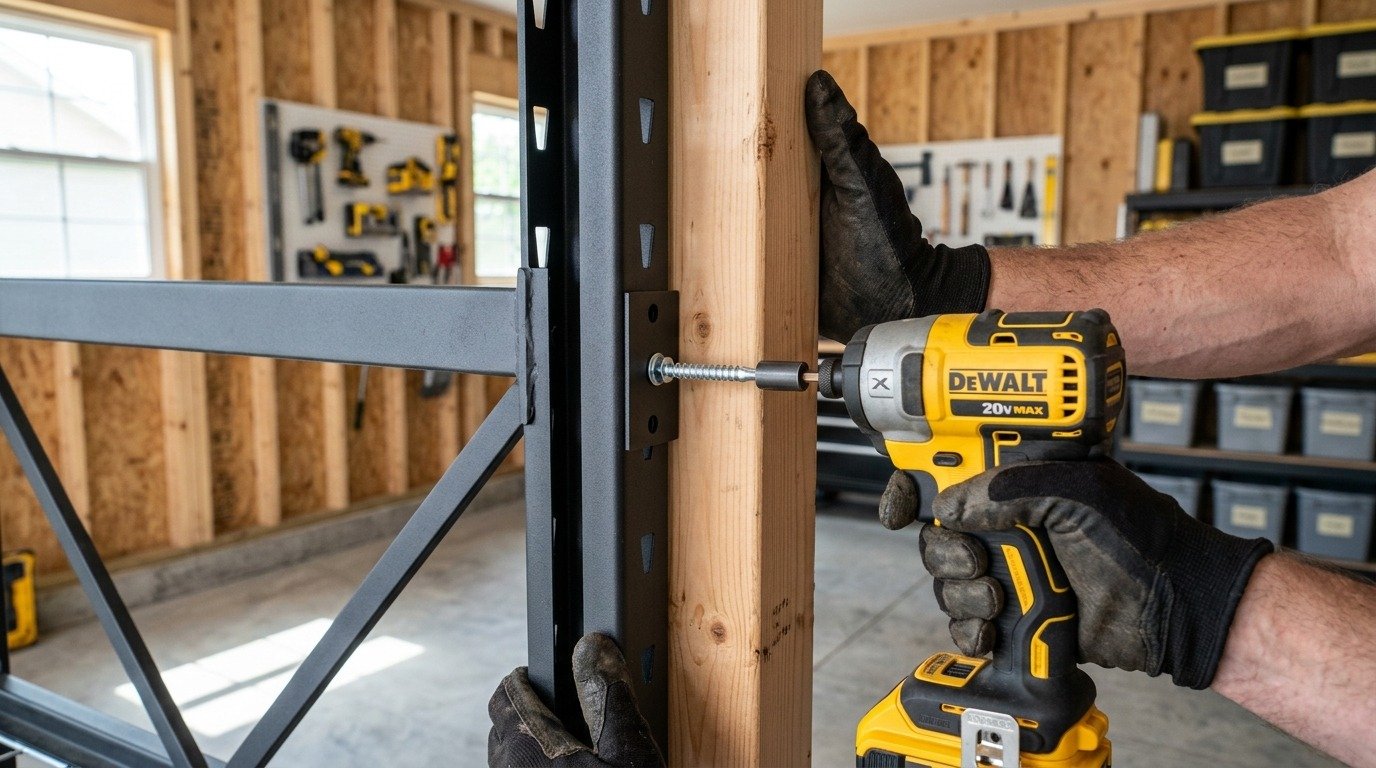
The weak point on a wall shelf is never the steel. It’s the fastener and the wall behind it. Stainless Supply, a US maker of commercial wall shelving, tells installers to mount uprights over studs or use a cleat hanger, and that’s the rule to follow on any brand.
Sizes and How to Measure
Commercial stainless shelving comes in a standard grid of depths and widths. One supplier stocks 43 sizes, with depths from 12 to 36 inches and widths from 24 to 72 inches.
| Shelf depth | Common use | Watch out for |
|---|---|---|
| 12 to 14 in | Spices, cans, bottles, narrow hallways | Tall narrow units tip more easily; anchor them |
| 18 in | Food boxes, small totes, garage bins | The most popular size; easy to find spare shelves |
| 21 to 24 in | Food service lugs, sheet pans, heavy stock | Deep shelves hide items at the back |
| 30 to 36 in | Bulk sacks, kegs, large equipment | Needs aisle space for loading from one side |
Measure three things before you order. Take the wall length, the clearance to the ceiling or sprinkler heads, and the depth of the biggest container you’ll store. Then add 2 to 3 inches of side clearance for assembly, because posts and shelf collars need room to tap into place.
In a walk-in cooler, also measure the door opening and the evaporator fan position. Shelves stacked tight against the fan block airflow and create warm spots.
Weight Capacity: What the Rating Really Means
Weight ratings are where marketing gets creative. Big numbers on the box rarely tell the whole story.
Commercial units commonly list 800 to 1,000 lb per shelf. Metro’s wire shelving specs state up to 800 lb per shelf, evenly distributed, and up to 2,000 lb per unit. Notice both limits: four shelves loaded to 800 lb each would be 3,200 lb, well past the unit rating.
“Evenly distributed” is the part buyers overlook. A single 200 lb engine block sitting in the middle of a 48 inch wire shelf puts far more stress on that span than 200 lb of boxes spread edge to edge. Budget big-box units often list around 300 lb per shelf, which is plenty for a pantry but not for a garage full of paint cans and power tools.
Casters Lower the Ceiling
Adding wheels changes the math completely. Metro rates its stem casters at 450 to 900 lb per cart, depending on the caster. That means a unit rated 2,000 lb on fixed feet may only be good for half that or less once it’s mobile.
Always use the lowest number in the chain. Shelf rating, unit rating and the caster set’s combined rating each set a limit, and the smallest one wins. Our guide to caster ratings for rolling racks covers how to size casters for a loaded unit.
Wall Shelves
A wall shelf’s capacity depends on stud spacing, fastener type and bracket count as much as the steel. Long shelves with only two brackets sag in the middle long before the steel fails. Follow the maker’s bracket count, and never hang a shelf from drywall anchors alone if it will carry stock pots or tools.
Stainless vs Chrome, Epoxy and Galvanized
Stainless steel shelving often costs several times as much as a chrome wire unit of the same size. That premium only pays off in the right room.
| Finish | Wet areas | Cost | Where it fits |
|---|---|---|---|
| Stainless steel | Yes, including washdown | Highest | Coolers, prep rooms, labs, coastal garages |
| Epoxy-coated wire | Yes, until the coating chips | Mid | Coolers and humid storage on a budget |
| Chrome wire | No, NSF listed for dry use only | Low | Dry pantries, offices, retail backrooms |
| Galvanized | No, per Metro’s guidance | Low | Dry warehouses, general garage storage |
Metro notes that its chrome shelving is NSF listed for dry environments only, and that galvanized shelving should not be used in wet areas or around aggressive chemicals. If your space stays dry, skip stainless and put the savings toward more shelves.
NSF Certification and When It Matters
NSF certification means a shelving product has been tested to sanitation standards for commercial food equipment. Many health inspectors expect it in restaurant kitchens, walk-ins and food storage rooms.
In a home garage or workshop, NSF adds nothing you need. Anyone running a food truck, bakery, café or home-based commercial kitchen should buy NSF-listed shelving and keep the paperwork. Check the listing covers the finish too, since a chrome unit’s dry-only listing won’t satisfy an inspector in a walk-in cooler.
What Stainless Steel Shelving Costs
Prices below come from current US retail and commercial supplier listings for four-shelf units. Expect them to shift with steel prices and sales.
- Budget big-box units: roughly $65 to $350 for 4 to 5 tiers. Grades are often unlisted and per-shelf ratings sit around 300 lb.
- Commercial NSF units: about $456 for a 14 by 36 inch unit, $630 for 18 by 48 inches and $1,107 for 24 by 72 inches from one supplier’s current grid.
- Wall shelves: roughly $40 to $110 for single shelves from 16 to 72 inches long, more for multi-tier or guarded models.
The jump from budget to commercial pricing mostly buys a confirmed grade, a real load rating and NSF listing. If the listing can’t tell you which grade you’re getting, you’re paying stainless prices for an unknown alloy.
Assembly, Leveling and Care
Assembly
Most freestanding units use split plastic sleeves that clip onto grooved posts, with shelf collars sliding down over them. Start with all four posts in the bottom shelf and the top shelf, then add the middle shelves. A rubber mallet seats each corner without denting the steel.
Leveling and Anchoring
Adjust the leveling feet so the unit sits flat and every post carries load. A rocking unit concentrates weight on three posts, which cuts real capacity. Tall, narrow units over 72 inches should be anchored to the wall, especially in garages where kids and vehicles move around them. For more on safe loading, see our storage rack weight capacity guide.
Cleaning
Stainless is easy to keep clean if you stay ahead of it. According to the British Stainless Steel Association, washing with soap or mild detergent and warm water, followed by a clear-water rinse, is usually enough.
Skip steel wool and carbon-steel brushes. They leave iron particles behind that rust and look like the shelf itself is corroding. Rinse off chlorine bleach and salty spills quickly, then dry the surface.
Common Buying Mistakes
- Buying “stainless” with no grade listed: ask the seller, or assume a ferritic grade best kept indoors and dry.
- Adding up shelf ratings: the unit rating is the true ceiling, not the sum of the shelves.
- Ignoring casters: wheels can halve the usable capacity of a heavy unit.
- Paying for stainless in a dry room: chrome or epoxy wire does the same job for far less.
- Choosing wire for small parts: screws, pens and spice jars fall through; add solid shelves or shelf liners.
Frequently Asked Questions
Is stainless steel shelving worth the money?
Yes, in wet, cold, salty or food-handling areas where coated finishes chip and rust out first. In a dry room, chrome or epoxy-coated wire shelving does the same job for a fraction of the cost.
What is the difference between 304 and 316 stainless shelving?
Type 316 contains about 2.0 to 2.5% molybdenum, which raises its resistance to pitting from chlorides. Choose 316 for coastal locations, labs and chemical washdown, and 304 for most kitchens, coolers and garages.
Can stainless steel shelving rust?
Yes. Low-grade stainless, salt, chlorine bleach and iron particles from steel wool can all cause rust spots and staining. Regular washing and quick rinsing of spills prevent most of it.
How much weight can stainless steel shelving hold?
Commercial units commonly list 800 to 1,000 lb per shelf, evenly distributed, with a separate per-unit limit such as 2,000 lb. Budget units often list around 300 lb per shelf. Check both numbers before loading.
Is stainless steel shelving good for a garage?
It’s a strong choice for garages that get wet from snowmelt, road salt or a nearby coastline. In a dry, climate-controlled garage, standard steel or wire shelving offers better value per pound of capacity.
Can I put wheels on stainless steel shelving?
Most commercial units accept stem casters in place of leveling feet. Stem casters on Metro carts are rated 450 to 900 lb per cart, so the casters, not the shelves, often become the weight limit.
Picking the Right Unit for Your Space
Start with the room, not the price tag. Wet, cold or salty spaces justify stainless, and the grade should follow the exposure: 304 for most, 316 where chlorides are constant. Then choose wire or solid shelves for what you store, size the unit to the room’s clearances and use the lowest weight rating in the chain.
Do those four things and stainless steel shelving will outlast almost anything else in the room. Bookmark this guide for your next storage upgrade, and read our wire shelving racks sizing guide if you’re comparing finishes for a dry space.