Search “locker cabinet” and you’ll see a $72 steel box, a $369 designer locker and an $1,100 garage unit on the same page. They share a name and almost nothing else. The cheap one has a hasp and a shelf, while the garage unit is rated to carry 1,000 pounds.
That mix-up is the real problem behind most bad locker cabinet purchases. People buy a gym-style locker for garage gear, or a garage locker for a mudroom, then wonder why it dents, sags or looks wrong.
This guide splits locker cabinets into the three types you’ll actually find. It covers the sizes, steel gauges, tier layouts and load ratings for each, so you can match the cabinet to the job before you buy.
Quick Answer
A locker cabinet is a tall, narrow steel storage unit with a lockable door, used in workplaces, schools, gyms, garages and homes. Commercial personnel lockers come in standard widths and depths of 12, 15 or 18 inches and a nominal height of 72 inches. They typically use 16-gauge steel doors with 24-gauge body panels, in single-, double-, triple-tier or box-style layouts. Garage locker cabinets are a heavier class. NewAge Bold lockers are rated for 800 lb total and 150 lb per shelf, and NewAge Pro lockers carry up to 1,000 lb. Home and decor lockers are lighter still and built for clothing, bags and shoes. Choose by what goes inside: personal items, heavy gear or everyday household storage.
Key Takeaways
- Three different products: Personnel lockers, garage locker cabinets and home lockers share a name but not a spec sheet.
- Doors and bodies differ: Standard commercial lockers pair 16-gauge doors with thinner 24-gauge bodies.
- Personnel locker shelves are light: One UK locker maker rates its standard shelves at just 15 kg (about 33 lb) each.
- Garage lockers carry far more: Welded garage lockers are rated from 800 to 1,000 lb per cabinet.
- Tall lockers need anchoring: A 72-inch steel locker can tip when the door is open and the top is loaded.
What Is a Locker Cabinet?
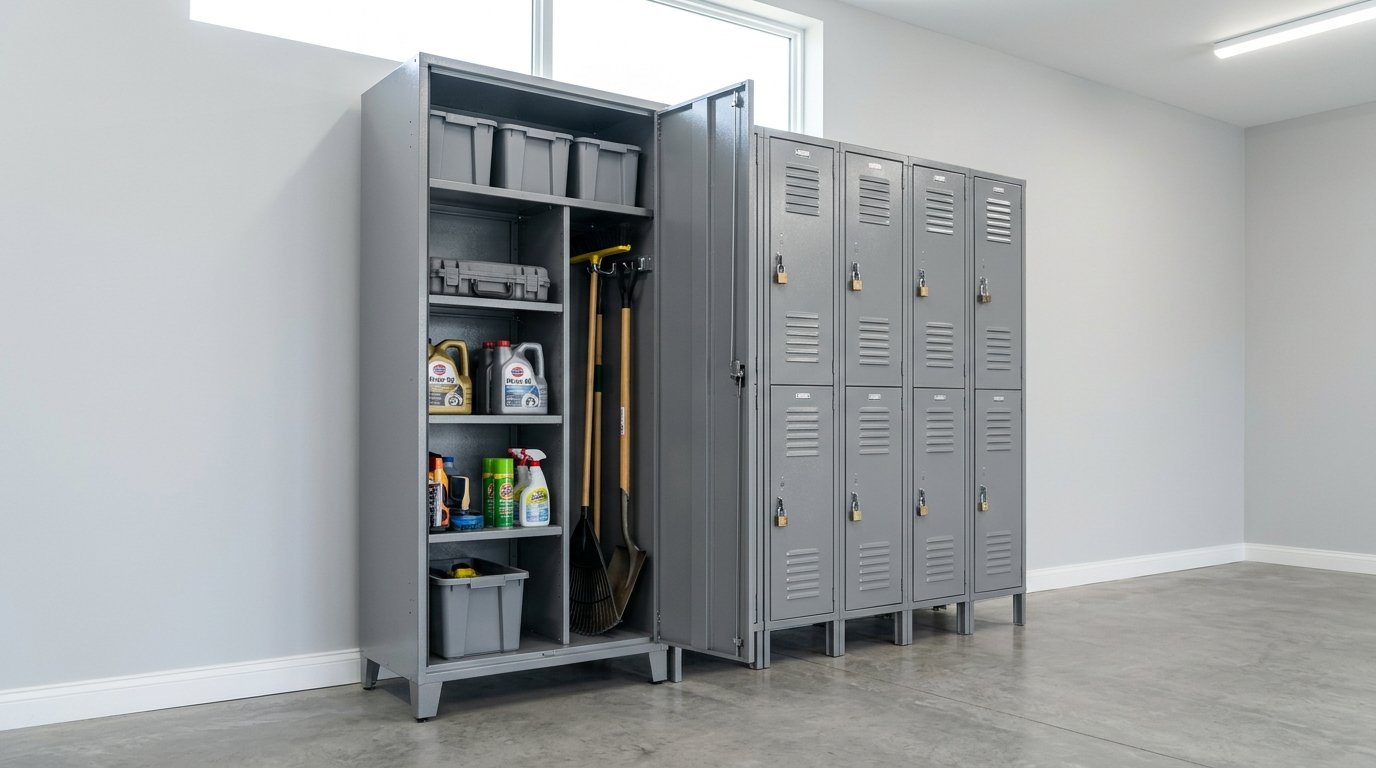
A locker cabinet is a vertical storage unit with one or more lockable compartments. Most are steel, between 5 and 6.5 feet tall, and narrow enough to line up in banks along a wall.
The difference from a regular storage cabinet is the layout. Lockers usually give each person or purpose its own compartment, with a hasp or built-in lock on every door. A cabinet tends to be one wide space behind a pair of doors.
If you mainly need wide shelving behind a lock, a cabinet is likely the better fit. Our lockable storage cabinet guide covers that side of the market.
The 3 Types of Locker Cabinets
Here’s where most people get this wrong. They compare prices across all three types, as though they were the same product at different quality levels. They’re built for different loads entirely.
| Type | Typical Build | Load Class | Best For |
|---|---|---|---|
| Personnel locker | 16-ga doors, 24-ga body, spot-welded or knock-down | Light: clothing, bags, personal items | Workplaces, schools, gyms |
| Garage locker cabinet | Fully welded steel, 24- to 18-ga | Heavy: 800 to 1,000 lb per cabinet | Garages, workshops |
| Home / decor locker | Powder-coated steel, furniture finish | Light: everyday household items | Mudrooms, bedrooms, offices |
1. Personnel Lockers
These are the lockers you’d find in a break room or school hallway. Makers like Lyon, Salsbury and Hertz build them with 16-gauge steel doors and 24-gauge body parts. The thicker door resists prying and dents, while the thinner body keeps weight and cost down.
Shelf ratings are modest because the job is light. One UK locker maker lists a maximum safe shelf load of 15 kg (about 33 lb), evenly distributed, for its standard shelves. Personnel lockers are designed for coats and lunch bags, not tool cases.
Pricing runs from about $100 for a single knock-down unit to $700 or more for an assembled multi-wide bank.
2. Garage Locker Cabinets
Garage lockers are wider, deeper and much stronger. NewAge’s Bold Series locker is fully welded 24-gauge steel, rated for 800 lb total with three adjustable shelves at 150 lb each. The Pro Series moves to 18-gauge steel and up to 1,000 lb per locker.
Prices reflect that build. NewAge lists its locker cabinets from about $350 to $1,360, with a 48-inch Bold locker around $670. Seville Classics’ UltraHD locker sits lower, around $230 to $290 depending on the retailer.
These suit long-handled tools, cases of fluids, sporting gear and bulk supplies. For a deeper look at gauge and load limits, see our metal garage cabinet load guide.
3. Home and Decor Lockers
Brands like Mustard Made build lockers as furniture. Expect powder-coated steel in bright colors, smaller footprints and prices around $369 to $499. Budget versions from Garvee and similar brands start under $100.
These work well for kids’ rooms, entryways and home offices. They aren’t intended for garage-level loads, so keep heavy tools out.
Standard Locker Sizes and Tier Layouts
Commercial lockers follow a fairly standard sizing grid. Salsbury, for example, offers its standard metal lockers in 12, 15 and 18-inch widths.
- Width: 12, 15 or 18 inches per compartment.
- Depth: 12, 15 or 18 inches. Deeper lockers fit coats on hangers and bulky gear bags.
- Height: 72 inches is the common nominal body height. Some double-tier units run 66 inches.
- Legs: Many lockers come with or without legs, so check the total height against your ceiling and any sloped top.
Tier layout decides how that height gets split up. A single-tier locker gives one full-height compartment. Double, triple and four-tier lockers stack two, three or four doors in the same footprint, and box lockers stack five or more small compartments.
More tiers means more users per foot of wall, but less room per person. A single tier holds a long coat and boots, while a triple tier fits a backpack and little else.
Steel Gauge and Build Quality
Steel gauge runs backwards, so a lower number means thicker steel. A 16-gauge door is roughly 0.060 inch thick, while a 24-gauge panel is about 0.024 inch.
That’s why the door is the strongest part of most personnel lockers. It takes the knocks, the slams and any attempt to pry it open. The sides and back are protected by neighboring lockers and the wall, so makers use lighter steel there.
Garage lockers flip that logic. Every panel carries load, so welded bodies and thicker steel throughout matter more than a heavy door.
Check how the brand lists gauge. Some quote the frame only, and others quote doors and body separately.
Ventilation, Locks and Accessories
Gym and workplace lockers often store damp clothing. Louvered or perforated doors let air move through and cut down on odor and rust. Solid doors look cleaner and offer more privacy, but suit dry storage better.
Most lockers use one of three locking methods:
- Padlock hasp: Cheapest and simplest. Users bring their own padlock.
- Built-in key or combination lock: No loose padlocks, but you’ll need a master key or code list.
- Digital keypad or RFID: Common in newer gyms and offices. Costs more and needs batteries or power.
Useful add-ons include sloped tops, which stop people from piling clutter on top, plus number plates, end panels and closed bases. Sloped tops also help with cleaning in commercial spaces.
Placement, Anchoring and Accessibility
A 72-inch locker with an open door and a loaded top shelf can tip forward. That’s especially true for single units standing alone. Bolt lockers to each other in banks, and fix them to the wall or floor using the manufacturer’s anchor points.
The Consumer Product Safety Commission’s furniture tip-over prevention program applies the same thinking to any tall storage in a home. Its core advice is to anchor tall units and keep heavy items low.
Workplaces and public facilities have an extra rule. Under the 2010 ADA accessibility standards, at least 5 percent of lockers of each type, and no fewer than one, must be accessible. In practice, that means at least one locker within reach ranges for a wheelchair user, with usable hardware.
For full-wall layout planning, our garage organization layout guide walks through measuring, clearances and zoning.
Common Locker Cabinet Mistakes
- Buying a personnel locker for tools. Light shelves and 24-gauge sides aren’t built for dense, heavy gear.
- Ignoring depth. A 12-inch-deep locker won’t take a coat on a hanger without the door pressing on it.
- Forgetting the legs. Lockers with legs add height. Measure under beams, garage door tracks and soffits.
- Leaving tall units freestanding. Anchor lockers to the wall or to each other.
- Choosing solid doors for damp gear. Wet towels and sports kit need louvered or perforated doors.
Frequently Asked Questions
What is the difference between a locker and a cabinet?
A locker usually splits storage into individual, separately locked compartments. By contrast, a cabinet typically has one larger interior behind one or two doors. Garage “locker cabinets” blur the line by using a tall, single-compartment locker shape with cabinet-grade shelving.
What is the standard size of a metal locker?
Common commercial sizes are 12, 15 or 18 inches wide and deep, with a 72-inch nominal height. Some double-tier lockers run 66 inches tall.
What gauge steel are lockers made from?
Standard commercial lockers use 16-gauge doors and 24-gauge bodies. Garage locker cabinets range from 24-gauge welded steel up to 18-gauge in premium lines.
How much weight can a locker cabinet hold?
It depends entirely on the type. Personnel locker shelves may be rated as low as about 33 lb. Garage lockers like NewAge Bold carry 800 lb total and 150 lb per shelf, and NewAge Pro lockers reach 1,000 lb.
Are Mustard Made lockers worth it?
They’re well reviewed as furniture, with retail ratings around 4.8 to 4.9 stars across hundreds of reviews. Each one is built for household storage rather than heavy garage gear, so judge them as furniture, not as workshop storage.
Do metal lockers need to be anchored?
Tall lockers should be anchored to the wall, floor or neighboring lockers. A single freestanding locker can tip when its door is open and its upper shelf is loaded.
Choosing Your Locker Cabinet
Decide what goes inside first. Personal items in a shared space point to a personnel locker with the right tier layout and ventilation. Heavy tools and bulk supplies call for a welded garage locker rated in the hundreds of pounds.
Everyday household storage fits a home locker, as long as you keep heavy loads out of it. Then check depth, height with legs and how you’ll anchor it. Bookmark this guide for your next storage upgrade, and share it with anyone kitting out a garage, gym or break room.