You found a cheap set of used beams online, drove two hours to pick them up, and they won’t seat in your uprights. The holes look almost the same. Almost is the problem. Teardrop pallet rack is the most common style in North America, but “teardrop” covers more than one hole pattern, and mixing them is where most buyers lose money.
This guide covers how teardrop pallet rack works, how to identify what you already own, which upright and beam specs matter, and how teardrop compares with structural and other roll-formed styles. The angle here is compatibility: the hole spacing and beam connector details that decide if parts from two sellers will ever fit together.
Quick Answer
Teardrop pallet rack is a roll-formed, boltless racking style named for the teardrop-shaped slots punched up the face of each upright. Beam end connectors have rivets or pins that drop into those slots and lock under the load, so a beam goes in with a rubber mallet instead of bolts. Classic teardrop (Interlake old style) uses slots on 2-inch centers, which gives 2 inches of beam adjustment. Sammons-style uprights look similar but space holes 4 inches apart, so the two don’t always match. Common uprights use 3-inch by 3-inch columns in 14-gauge steel, in depths of 24, 36, 42 and 48 inches. Frame capacity depends on height, depth and beam spacing, so read the manufacturer’s chart. Every beam needs a safety lock clip so a forklift can’t knock it loose.
Key Takeaways
- Teardrop rack assembles without bolts: beam connectors drop into teardrop slots and lock under weight.
- Classic teardrop slots sit on 2-inch centers; Sammons-style uprights use 4-inch spacing.
- A typical upright has 3″ x 3″ columns in 14-gauge steel, with 42″ depth the common pick for 48″ x 40″ pallets.
- Upright capacity drops as the space between beam levels grows, so the same frame can carry very different loads.
- Structural rack bolts together from hot-rolled channel and suits forklift-heavy, high-impact aisles better.
What Is Teardrop Pallet Rack?
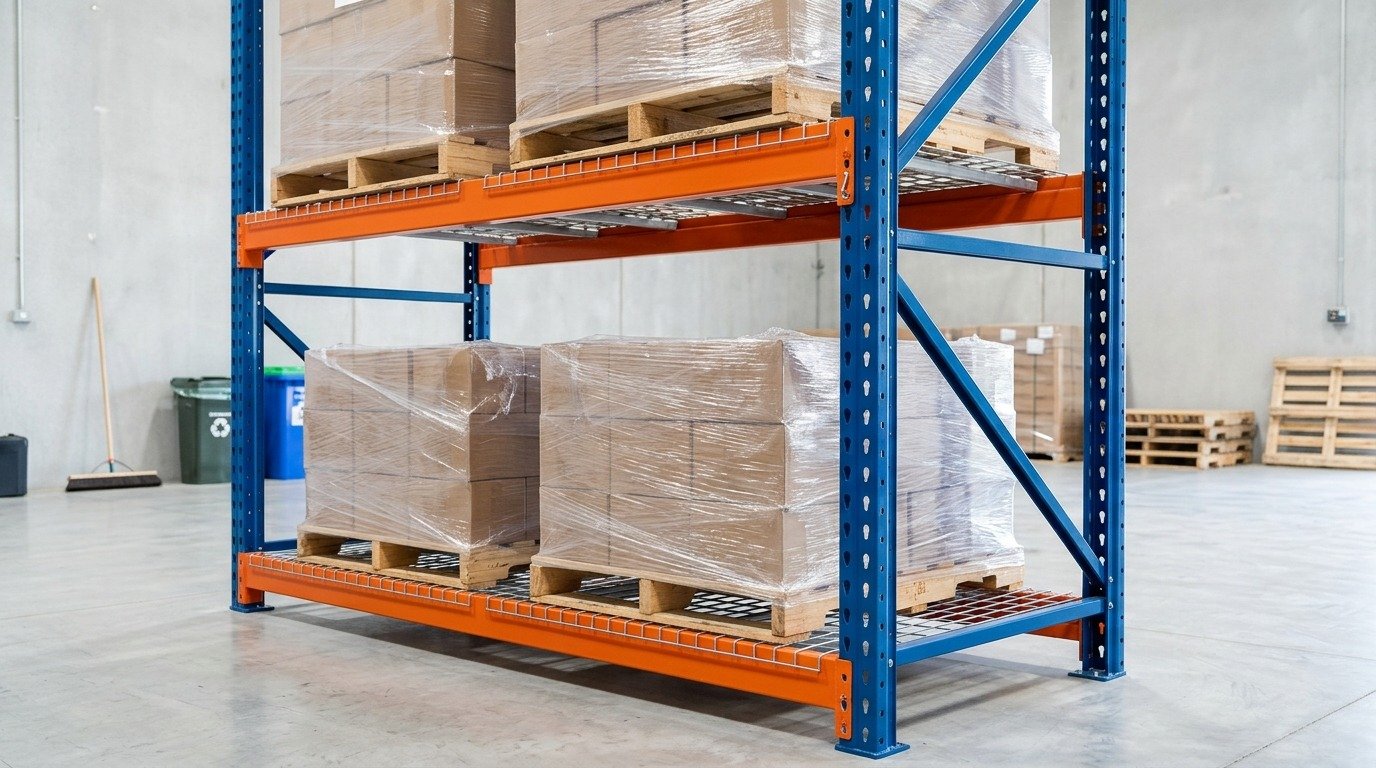
Teardrop pallet rack is selective racking built from two parts: upright frames and horizontal beams. The uprights are roll-formed steel columns joined by welded or bolted bracing. Their front faces carry a vertical row of teardrop-shaped slots, wide at the top and narrow at the bottom.
Each beam ends in a connector plate with two or three rivets. You line the rivets up with the wide part of the slots, push the beam in, and tap it down. Gravity and the narrow lower part of the slot pull the connection tight, and the load keeps it there.
That boltless design is the whole appeal. A two-person crew can set beam levels quickly, and moving a level later takes minutes rather than a socket set and an afternoon. If you’re new to selective racking in general, our guide to selective pallet racking layout covers aisle widths and bay planning first.
How to Identify Teardrop Uprights You Already Own
Here’s where most people get this wrong. They see teardrop-looking holes, buy “teardrop beams,” and assume they’ll fit. Several upright styles share a similar look, and beams from different systems often aren’t interchangeable.
Check these four things before you order a single beam:
- Hole shape. Rounded teardrops point to Interlake old style. Interlake new style has more angular slots, and those uprights usually accept old style beams too.
- Hole spacing. Measure center to center between two slots. Classic teardrop runs 2 inches; Sammons-style uprights run 4 inches.
- Column face width. Most teardrop uprights have a 3-inch face. Lighter-duty frames and some brands use different column sizes, so measure the face and the side.
- Brand stamp or label. Look for a manufacturer sticker or stamped mark near the base plate. Interlake, Husky, Steel King and others make teardrop-compatible parts with small differences.
Take photos of the slot, the column profile and the base plate, with a tape measure in the shot. Any rack dealer can match parts from those three photos far faster than from a description.
Teardrop Upright Specs That Actually Matter
An upright frame is described by depth, height, column size and steel gauge. Those four numbers, plus the beam spacing you plan to use, decide what the frame can carry.
| Spec | Common options | What to know |
|---|---|---|
| Depth | 24″, 36″, 42″, 48″ | 42″ fits a 48″ x 40″ pallet with about 3″ of overhang front and back |
| Height | 8′ to 20’+ | Match to ceiling clearance, sprinkler heads and your lift truck’s reach |
| Column | 3″ x 3″ is most common | Larger or heavier columns raise capacity on tall frames |
| Gauge | 14-gauge is typical | Lower gauge numbers mean thicker, stronger steel |
| Base plate | Standard or seismic | Seismic plates are larger, with more anchor holes for code regions |
Published frame ratings vary widely. Current US listings show 42-inch-deep teardrop frames rated anywhere from about 10,000 pounds for medium-duty models to 24,000 pounds for heavy-duty 3″ x 3″ 14-gauge frames. Never assume a frame’s rating from its looks. Find the capacity chart for that exact part number.
Why Beam Spacing Changes Frame Capacity
An upright’s rated capacity assumes a certain vertical distance between beam levels. Spread the beams farther apart and the column has a longer unbraced length, so it can buckle at a lower load.
That’s why the same frame can show two very different numbers on a manufacturer’s chart. If you remove a middle beam level to fit tall loads, recheck the frame rating at the new spacing. Our breakdown of rack beam capacity and span math walks through the beam side of the same calculation.
Teardrop Beams, Connectors and Safety Locks
Beams carry the pallets, and they’re rated per pair, not per beam. A pair rated at 5,000 pounds holds 5,000 pounds spread evenly across both beams, which is usually two pallets in a standard bay.
- Step beams have a ledge on the inside edge. Wire decks and pallet supports drop onto that step and sit flush with the top of the beam.
- Box beams are closed rectangular sections. They’re common for carton storage and some decking setups that don’t need a step.
- Connector rivets come in two-pin and three-pin layouts. More pins generally mean a stiffer connection, but match the beam to the manufacturer’s tables.
- Beam length is measured clear span between uprights. A 96-inch beam holds two 48″ x 40″ pallets loaded the 40-inch way.
- Safety locks are small spring clips or drop pins at each connector. They stop an upward bump from a forklift fork from lifting the beam out of its slots.
Skipping safety locks is the most common shortcut in used rack installs. Without them, a single upward hit can unseat a loaded beam. They cost very little, so fit one at every connector.
Teardrop vs. Structural vs. Other Upright Styles
Teardrop is a roll-formed style. Structural rack uses heavier hot-rolled steel channel and bolts each beam to the upright. Several other roll-formed patterns exist too, and each one has its own connector.
| Style | How beams attach | Best for | Trade-off |
|---|---|---|---|
| Teardrop (Interlake) | Rivets drop into teardrop slots, 2″ spacing | Most warehouses and stockrooms | Lighter steel takes forklift hits worse |
| Sammons | Similar slots on 4″ spacing | Older installs | Fewer beam height options |
| Structural | Bolted through channel uprights | High-traffic aisles, heavy loads | Higher cost, slower to reconfigure |
| Unarco T-bolt | Rectangular holes, quarter-turn bolt | Existing Unarco systems | Parts less widely stocked |
| Ridg-U-Rak keyhole | Beam tabs fit keyhole slots | Existing Ridg-U-Rak systems | Not teardrop compatible |
For most small warehouses, retail backrooms and shops, teardrop wins on price, availability and easy changes. Structural earns its higher cost in freezers, busy cross-docks and drive-in setups, where forklifts touch the rack every shift.
Buying New or Used Teardrop Pallet Rack
Used teardrop rack is everywhere, which is part of why the style dominates. It can be a good buy, but only if the parts are straight, matched and documented.
- Check uprights for bends. A column that’s bowed, dented or creased near the bottom has lost capacity, even if it still looks usable.
- Inspect welds and connectors. Cracked bracing welds or rivets that wobble in the beam plate mean the part is done.
- Confirm every beam matches. Mixed brands in one bay can seat loosely and fail under load.
- Ask for the original capacity info. A load plaque or part number lets you pull the real ratings instead of guessing.
Our used pallet racking inspection guide has a full checklist with damage limits worth printing before you go look at a lot.
How to Set Up Teardrop Rack Safely
Assembly is simple, which is exactly why people rush it. Follow this order and you’ll avoid the usual mistakes.
- Plan the layout first. Mark upright positions on the floor with chalk, keeping flue space between back-to-back rows and clearance from sprinklers.
- Stand and brace the first frame. Have a helper hold it plumb. Never let a lone frame stand unsupported.
- Set the lowest beam pair. Seat both ends, tap down with a rubber mallet, and confirm the beam is level.
- Add upper beams. Work bottom to top so each new frame is stabilized before you climb higher.
- Install safety locks. Fit one at every beam connector before any load goes on.
- Anchor every base plate. Bolt each upright to the concrete with the anchors the manufacturer specifies.
- Post capacity. Put load plaques on the end of each run so operators know the per-level limit.
The Rack Manufacturers Institute publishes the ANSI MH16.1 design standard used across the US. Its Rack Manufacturers Institute resources cover load plaques, inspections and design guidance. For the workplace side, see the OSHA material storage rule 1910.176, which requires stored materials to be stable and secure.
Frequently Asked Questions
Are all teardrop pallet racks compatible?
No. Classic Interlake-style teardrop parts often mix across brands, but hole spacing, connector design and column size vary. Sammons-style uprights use 4-inch spacing, so match measurements before buying.
How much weight can a teardrop pallet rack hold?
It depends on the exact upright, beam and beam spacing. Current listings show 42-inch frames rated from about 10,000 to 24,000 pounds, and beam pairs carry their own separate rating.
Do teardrop pallet racks need to be bolted to the floor?
Yes. Anchoring each base plate keeps frames from shifting or tipping when a forklift bumps them. Use the anchor type and size the manufacturer specifies for your slab.
What is the difference between teardrop and structural pallet rack?
Teardrop is roll-formed and boltless, so it’s cheaper and easy to adjust. Structural uses heavier channel and bolted beams, so it handles impact and heavy loads better at a higher price.
What depth teardrop upright do I need for standard pallets?
For a 48″ x 40″ pallet, a 42-inch upright is the usual choice. That leaves about 3 inches of pallet overhang at the front and back, which helps forklift drivers place loads.
Picking the Right Teardrop Setup
Start with what you already own, measure the hole spacing and column, and only then shop for parts. Choose frame depth from your pallet size, frame height from your building and lift truck, and capacity from the manufacturer’s chart at your real beam spacing. Then fit safety locks, anchor every plate and post your limits.
Bookmark this page before your next rack purchase. If you’re adding decking next, our guide to pallet rack wire decks picks up where this one ends.