Most people shopping for pallet rack uprights pick a height and a depth, check the price, and order. Then the frames show up and the beams sit one hole too high, the pallets hang off the back, or the capacity on the label turns out to depend on a beam spacing nobody asked about.
Here’s the part that trips buyers up. An upright’s capacity is not one fixed number. It drops as you space the beams farther apart, and the same frame can lose more than half its rating between a 36-inch and a 96-inch gap.
This guide covers the specs that decide which pallet rack uprights you need: depth, height, column gauge, footplates, anchoring and the capacity charts that tie them together. The numbers come from manufacturer spec sheets and current US listings, so you can check them against any quote you get.
Quick Answer
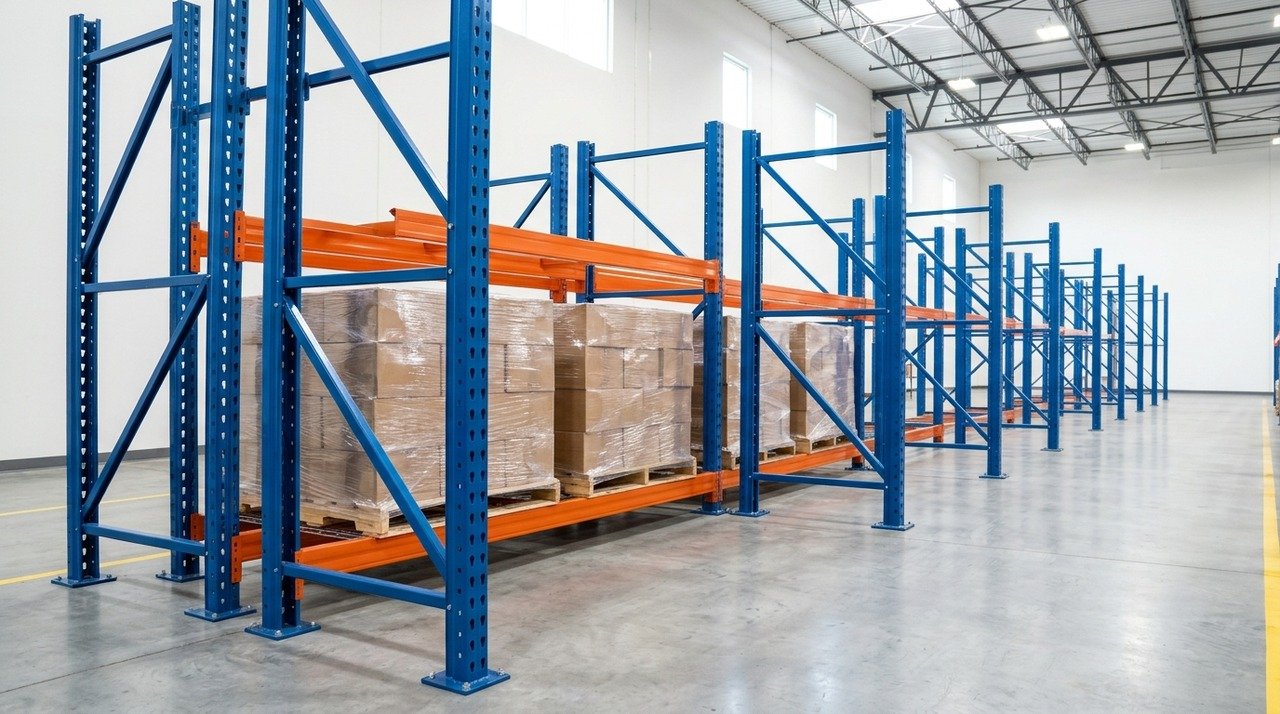
Pallet rack uprights are the vertical end frames of a rack, made from two steel columns joined by horizontal and diagonal bracing, with a footplate welded to the bottom of each column. Common depths run 24 to 48 inches, and a 42-inch frame is the usual match for a 48-inch-deep pallet, leaving about 3 inches of overhang front and back. Heights run from 8 feet to 25 feet or more. A typical 3-inch by 3-inch, 14-gauge teardrop frame is rated around 23,000 pounds at 36 to 48 inches of beam spacing, but that rating falls fast as the spacing grows. Frame capacity is shared by the two bays on each side of it. Every column should be anchored to the floor, and frames taller than six times their depth (measured to the top loaded beam) need anchors designed for extra side load.
Key Takeaways
- Frame depth is usually the pallet depth minus 6 inches, so a 48-inch pallet goes on a 42-inch frame.
- Upright capacity depends on the largest vertical gap between beam levels, not on frame height.
- Ridg-U-Rak’s lightest teardrop frame drops from 19,100 lb at 36-inch spacing to 6,500 lb at 96 inches.
- A 16-gauge frame and a 14-gauge frame can look identical. Check the column label or the spec sheet.
- ANSI MH16.1 calls for extra anchor design once the top loaded beam passes six times the frame depth.
What Pallet Rack Uprights Actually Are
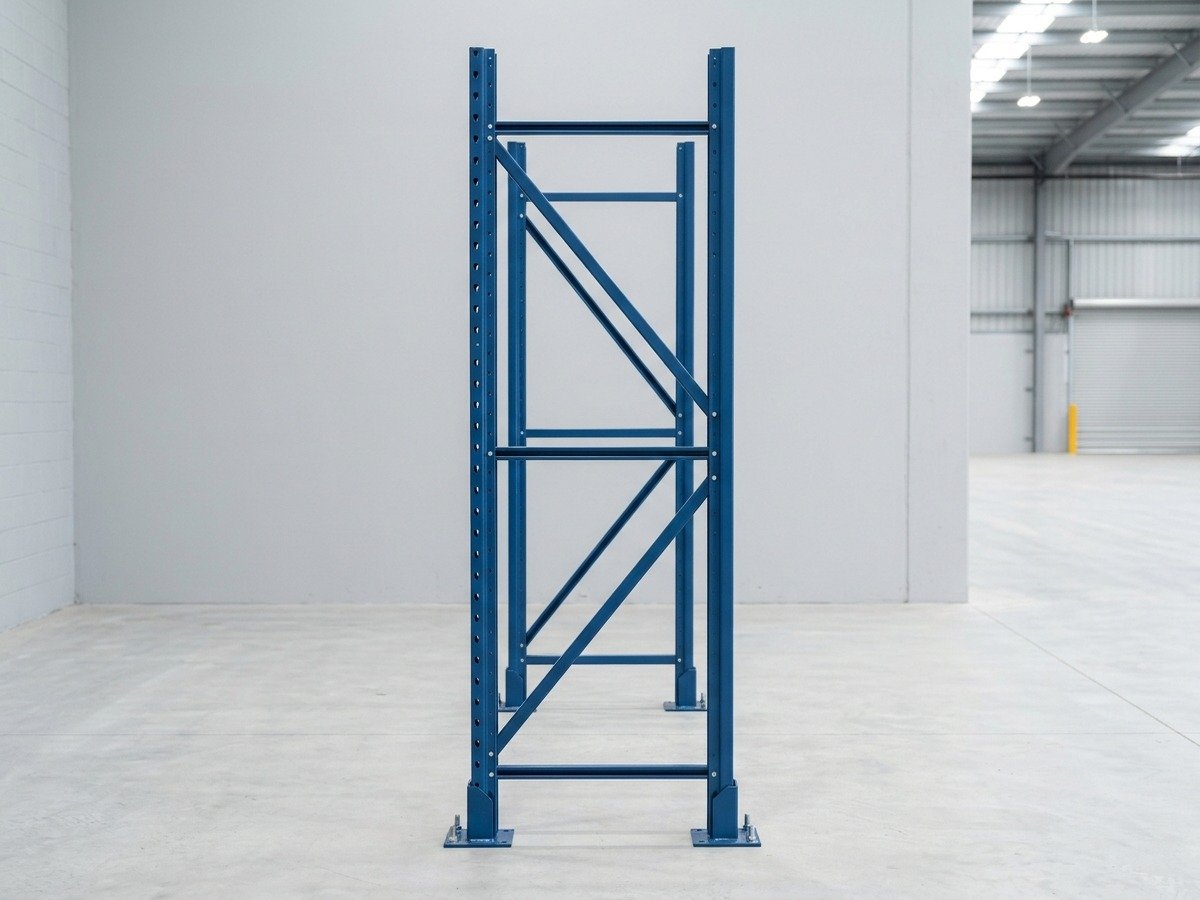
An upright, also called an upright frame or end frame, is the ladder-shaped part that stands at each end of a rack bay. Beams hook into it, and it carries every pound sitting on those beams down to the floor.
Each frame has four parts worth knowing by name:
- Columns. The two vertical posts. The front face is punched with slots (teardrop, keyhole or bolt holes) where the beam connectors lock in.
- Bracing. Horizontal and diagonal struts between the columns. They stop the frame from racking sideways and give the columns their strength.
- Footplates. Steel plates welded to the bottom of each column, with holes for floor anchors.
- Connection style. Welded frames come in one piece. Bolted frames ship as columns and braces you assemble, which makes it easier to replace a single damaged column.
The upright pairs with beams to form a bay. Two bays side by side share the frame in the middle, which matters a lot once you get to capacity.
Upright Depth: Match the Frame to Your Pallet
Depth is the front-to-back measurement of the frame, from the outside face of the front column to the outside face of the rear column. Most stock frames come in 36, 42 and 48 inches, with 24-inch frames used for shallow shelving and small loads.
The standard rule is simple. Take your pallet depth and subtract 6 inches. That leaves about 3 inches of pallet overhanging the front beam and 3 inches overhanging the back one, so the forklift driver has a little margin and the pallet’s bottom boards sit across both beams.
| Pallet depth | Usual frame depth | Overhang front and back |
|---|---|---|
| 36 in | 30 in | 3 in each |
| 42 in | 36 in | 3 in each |
| 48 in (standard 48 x 40 pallet) | 42 in | 3 in each |
| 54 in | 48 in | 3 in each |
Here’s where most people get this wrong. They buy a 48-inch frame for a 48-inch pallet because the numbers match. The pallet then sits flush with the beams, the driver has no room for error, and a pallet pushed slightly long falls behind the rack.
Going too shallow causes the opposite problem. Too much overhang puts the load on the outer pallet boards, and a weak pallet can sag between the beams. If your pallets vary, size for the most common one and add wire decking for the odd sizes.
Upright Height: Measure From the Top Beam Up
New frames are commonly stocked from 8 feet up to about 20 feet, and many suppliers build 24 to 25-foot frames to order. Height is easy to overthink. What you really need is the height of your top beam level plus the height of the load sitting on it.
Start with three numbers:
- The clear ceiling height, minus any sprinkler heads, lights or heaters hanging below it.
- Your forklift’s maximum lift height with the forks level.
- The tallest load you plan to store on the top level.
Pick the frame height that puts your top beam where the lift can reach it, with the load still clearing everything overhead. Your local fire marshal sets the sprinkler clearance, so ask before you finalize the layout. A taller frame than you need costs more and raises the overturning ratio covered below.
Most teardrop frames let you move beams every 2 inches, so small height errors at the lower levels are easy to fix. The frame height itself is fixed once it’s bolted to the floor.
Column Size and Steel Gauge
The column profile does most of the work in setting frame capacity. The two sizes you’ll see on most listings are 3 inches by 3 inches and 3 inches by 1-5/8 inches, measured face width by side depth.
Gauge is the steel thickness, and lower numbers mean thicker steel. Most stock teardrop frames are 14 gauge or 16 gauge. The difference rarely shows from across the warehouse, but it shows up on the capacity chart.
Current listings show how much it matters. All Rack Solutions sells a 3 x 3 frame with a 5 x 8 inch base plate in two weights: 16 gauge rated at 16,100 lb and 14 gauge rated at 23,300 lb, both at 36-inch maximum beam spacing. Same footprint, same look, roughly 45 percent more capacity in the heavier frame.
Supplier part numbers often encode the column. A Hannibal frame listed as “3014 5×8” and a U.S. Pallet Racks frame with SKU IF3014 both carry a 3 x 3 inch, 14-gauge column. If a quote just says “heavy duty,” ask for the gauge in writing.
| Column | Typical gauge | Where you see it |
|---|---|---|
| 3 x 1-5/8 in | 16 ga | Light-duty selective rack, shorter frames, retail backrooms |
| 3 x 3 in | 16 ga | General warehouse storage with moderate loads |
| 3 x 3 in | 14 ga | The common heavy-duty stock frame for 2,000 to 3,000 lb pallets |
| Larger or double columns | Heavier, engineered | Tall frames, heavy loads, high-traffic aisles |
How Upright Capacity Really Works
This is the section that saves people money and trouble. Frame capacity is the total load one upright can carry, and it’s set by the longest unsupported column length. In plain terms, that’s the biggest vertical gap between beam levels (or between the floor and the first beam, if that’s larger).
Closer beams brace the columns more often, so the columns resist buckling better. Spread the beams apart and the same steel carries much less.
Ridg-U-Rak publishes static capacities for its teardrop frames (REV 4, February 2024). Here are three of its frame styles, from lightest to heaviest:
| Beam spacing | UF-S31I | UF-S33I | UF-H43I |
|---|---|---|---|
| 36 in | 19,100 lb | 28,600 lb | 62,600 lb |
| 48 in | 16,700 lb | 25,100 lb | 58,100 lb |
| 60 in | 13,800 lb | 21,100 lb | 52,400 lb |
| 72 in | 10,800 lb | 17,000 lb | 46,000 lb |
| 96 in | 6,500 lb | 10,500 lb | 32,800 lb |
Look at the lightest frame. At 36 inches it holds 19,100 lb. Stretch the gap to 96 inches and it holds 6,500 lb, about a third as much. Nothing about the frame changed except where the beams went.
Shared Frames and Bay Math
Each interior upright supports half of the bay on its left and half of the bay on its right. So its load is roughly one full bay’s worth. End frames carry half a bay, which is why runs are sized by the interior frames.
Run the numbers this way:
- Add up the beam level loads in one bay. Three levels of two 2,000 lb pallets is 12,000 lb.
- Find your largest vertical beam gap, say 60 inches.
- Check the chart. The lightest frame above holds 13,800 lb at 60 inches, so it covers 12,000 lb with a small margin.
- Now move the top beam up and stretch that gap to 72 inches. Capacity drops to 10,800 lb, and the same frame is no longer enough.
Beams have their own ratings too, per pair, and they depend on beam length. Our guide to rack beam capacity and span math covers that side of the calculation.
Why Charts Are Only a Starting Point
Ridg-U-Rak’s own sheet warns that static frame tables no longer settle the question under the current RMI specification, ANSI MH16.1-2021. Real ratings come from a system analysis that looks at the beam connectors, the number of levels, base plates, anchors, seismic location and the frame’s height-to-depth ratio.
On a small, low, non-seismic setup, a published chart with a sensible margin is how most buyers start. For anything tall, heavily loaded or in a seismic zone, ask the supplier for an engineered load rating, and post it on the rack. The Rack Manufacturers Institute standards are where those requirements live.
Footplates and Anchoring
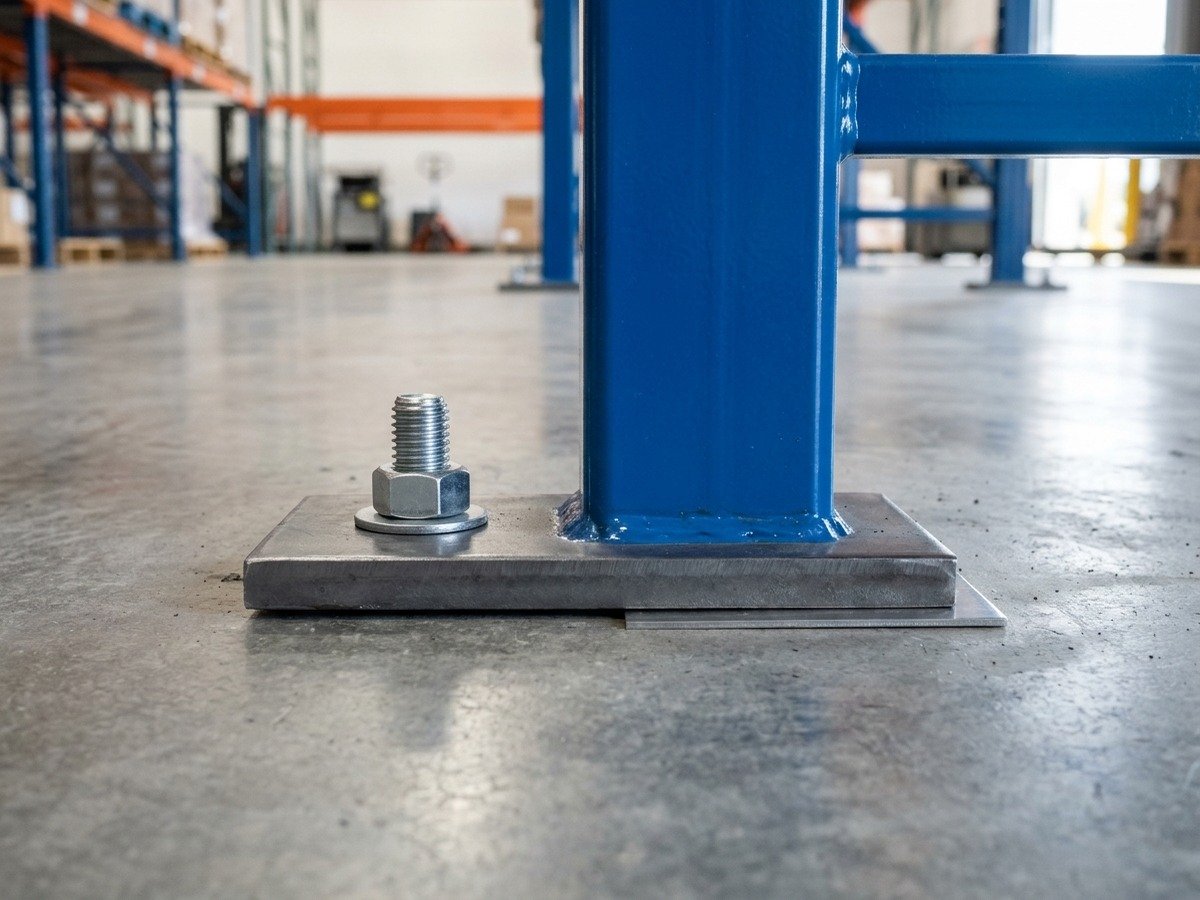
Footplates spread each column’s load into the concrete and give the anchors something to hold. Sizes vary more than buyers expect. A U.S. Pallet Racks 192 x 42 inch frame uses a 4.5 x 3.25 x 0.187 inch footplate, while All Rack Solutions frames ship with a 5 x 8 inch base plate.
Bigger plates are common on tall frames and in seismic areas, where some frames carry 8 x 8 inch plates. If your building is in a seismic region, the plate size and anchor pattern should come from the rack engineer, not from a catalog.
Anchor Every Column
Each column gets at least one floor anchor through its footplate. Skipping anchors is the shortcut that turns a forklift bump into a collapsed run. Use the anchor type, diameter and embedment the rack manufacturer specifies, and make sure the slab is thick enough to hold it.
If the floor isn’t level, use steel shims under the footplate to plumb the frame. Don’t stack washers or wood, and don’t shim so high that the anchor loses embedment.
The 6:1 Overturning Rule
ANSI MH16.1 sets a stability check based on the ratio of the top loaded beam’s height to the frame depth. Note that it’s the top loaded beam, not the frame’s total height. A 42-inch frame that’s 240 inches tall with its highest loaded beam at 120 inches has a ratio of about 2.9 to 1.
Once that ratio passes 6 to 1, the base plates and anchors must be designed for an extra 350 lb side load applied at the top loaded beam. That load stands in for a forklift hitting the top level. Past 8 to 1, the standard treats the frame as possibly unstable and suggests tying it to another rack or to the building.
For a single-row run against a wall, this matters most. A 42-inch frame hits 6 to 1 when the top loaded beam reaches 252 inches, or 21 feet. Back-to-back rows tied with row spacers behave much more like one deep frame.
Teardrop, Bolted and Structural Uprights
Most new uprights sold today are roll-formed teardrop frames. The teardrop slots let beams lock in without bolts, and adjusting a level takes minutes. Structural uprights use hot-rolled channel columns and bolted beam connections, which cost more but take impacts better in high-traffic aisles.
Mixing brands is the bigger risk. Teardrop slot spacing differs between manufacturers, with some frames punched on 2-inch centers and others on 4-inch centers. Beams that look like a fit can seat loosely or not lock at all. Before you add frames to an existing system, check our teardrop pallet rack compatibility guide for how to identify what you already have.
New vs Used Uprights and What They Cost
New stock frames are not expensive compared with what they hold up. A Speedrack 48 x 96 inch teardrop upright lists at $101.73. All Rack Solutions prices its 16-gauge 3 x 3 frames from $133.19 for 96 x 36 inches to $204.37 for 144 x 42 inches, before freight.
Freight and anchors often add a real share of the total, especially for tall frames that ship on a flatbed. Ask for a delivered price, and ask if the frames come assembled or as loose columns and braces.
Used uprights can cut that cost, but every frame needs a close look before it goes up. Check each one for:
- Bent, twisted or dented columns, especially in the bottom 4 feet where forklifts hit.
- Torn, kinked or missing bracing.
- Cracked welds at the footplates and brace joints.
- Elongated or torn beam slots from overloaded or forced beams.
- Rust that has eaten into the steel, not just the paint.
- A legible manufacturer label, so you can find its capacity chart.
Pass on any frame with column damage. Repair kits exist, but they’re an engineering decision, not a weekend fix. Our used pallet racking inspection guide walks through the full checklist.
Upright Safety After Installation
Damage to uprights is the most common rack failure, and it almost always starts low, where forklifts and pallet jacks make contact. A column that’s bent at the base has lost capacity for every level above it.
Federal rules keep it short. OSHA’s materials storage rule requires stored material to be stable and secure against sliding or collapse. In practice, that means anchored frames, posted load ratings and damaged parts taken out of service quickly.
A few habits keep uprights healthy:
- Fit column guards or end-of-aisle protectors on frames that face traffic.
- Walk the racks on a schedule and look at the bottom of every column.
- When a column is hit, unload both bays it supports before anyone judges the damage.
- Replace damaged frames with the same make, depth, gauge and slot pattern.
- Re-check the load rating any time you move beam levels or relocate the rack.
That last point catches many shops. Raising one beam level to fit taller pallets can widen the largest gap and drop frame capacity below what the bay holds.
Frequently Asked Questions
What size pallet rack upright do I need for a 48 x 40 pallet?
Most 48 x 40 pallets are stored with the 48-inch side running front to back, so a 42-inch-deep upright is the usual pick. That gives about 3 inches of overhang at the front and back beams. Beam length sets how many pallets fit side by side.
How much weight can a pallet rack upright hold?
It depends on the column, the gauge and the largest beam spacing. Common 3 x 3 inch frames run from about 16,000 lb in 16 gauge to about 23,000 lb in 14 gauge at 36-inch spacing. Wider spacing lowers those numbers sharply, so always read the chart at your actual beam gap.
Do pallet rack uprights have to be anchored?
Yes. The rack industry standard expects every column to be anchored to the floor through its footplate. Taller frames, those past a 6 to 1 ratio of top loaded beam height to depth, need anchors and base plates designed for added side load.
Can I mix uprights from different manufacturers?
You can only if the slot shape, slot spacing and beam connectors truly match. Teardrop frames from different makers often use different hole spacing, so beams may not lock properly. When in doubt, buy beams and frames from the same line.
Can I make an upright taller later?
Some manufacturers sell bolt-on upright extensions for their own frames. The extended frame needs a new capacity check, because the height-to-depth ratio and the beam layout both change. Never splice columns from different brands.
Choosing Uprights Without the Guesswork
Get the pallet depth first and subtract 6 inches for the frame depth. Set the height by your top beam and load, not by the ceiling. Then pick the column and gauge from a capacity chart at your largest beam gap, remembering that interior frames carry about one full bay.
Anchor every column, watch the 6 to 1 ratio on single rows, and keep the manufacturer’s load rating posted. Do those things and the uprights will be the last part of the rack you worry about.
Bookmark this page for your next rack quote, and read our racking system installation guide before the frames arrive.