Quick Answer: Selecting Commercial & Industrial Cabinet Metal Storage
When investing in cabinet metal storage for commercial and industrial facilities, structural integrity depends primarily on steel gauge, unibody weld construction, and locking hardware. Commercial-grade cabinets require 14-gauge to 16-gauge cold-rolled steel, while heavy industrial machine shops require 12-gauge all-welded unibody steel capable of supporting 1,000 to 1,500 pounds per shelf. For high-security environments, select 3-point cremone locking systems featuring solid 3/8-inch vertical steel latch rods rather than stamped sheet metal tabs. Storing hazardous chemicals mandates double-walled NFPA 30 and OSHA 1910.106 compliant safety cabinets with built-in spill containment sumps.
Key Takeaways
- All-Welded vs. Flat-Pack: Factory-welded 12-gauge and 14-gauge cabinets arrive fully assembled with unibody rigidity, eliminating fastener fatigue and wobble under heavy dynamic tool loads.
- Steel Gauge Rules: Remember that lower gauge numbers signify thicker steel; 14-gauge steel (0.0747 inches) is 60% thicker and twice as rigid as consumer 18-gauge sheet metal.
- 3-Point Cremone Locking: Heavy-duty cremone handles drive solid steel rods into the top and bottom door headers while latching at the center, resisting aggressive crowbar prying attempts.
- Mandatory Flammable Codes: Chemical and solvent storage requires dedicated yellow cabinets built with double-walled 18-gauge steel, 1.5-inch air gaps, and 2-inch leak-tight liquid sumps under OSHA 1910.106.
The Anatomy of Heavy-Duty Cabinet Metal Storage
Modern industrial plants, automotive maintenance facilities, aerospace machine shops, and distribution hubs demand rugged, secure storage infrastructure. While consumer-grade utility cabinets may look adequate in catalog photos, placing thousands of pounds of steel tooling, pneumatic machinery, and toxic chemicals into light-gauge sheet metal creates severe workplace safety risks and rapid equipment failure. For complementary shop storage strategies, explore our comprehensive warehouse racking supplies buyer guide.
A professional commercial cabinet metal storage unit is an engineered steel enclosure designed to withstand decades of relentless forklift vibrations, heavy tool drops, and corrosive workplace environments. Industrial cabinets differ from consumer models across four primary engineering criteria:
- Substrate Metallurgy: Built using heavy-gauge cold-rolled steel (CRS) sheet conforming to ASTM A1008 commercial quality specifications, delivering superior tensile strength and surface finish.
- Formed Structural Flanges: Shelf panels and door perimeter edges feature multi-bend box flanges that multiply resistance against bending deflection under concentrated point loads.
- Industrial Electrostatic Coatings: Finished with thermoset polyester-epoxy powder coatings cured at 400°F, creating a scratch-resistant, solvent-impermeable barrier that prevents oxidation.
- Integrated Anti-Tip Baseplates: Heavy steel base channels engineered with pre-punched anchor holes for bolting directly to concrete floor slabs, preventing accidental tip-overs during heavy door swings.
All-Welded Unibody vs. Knock-Down Bolt-Together Assembly
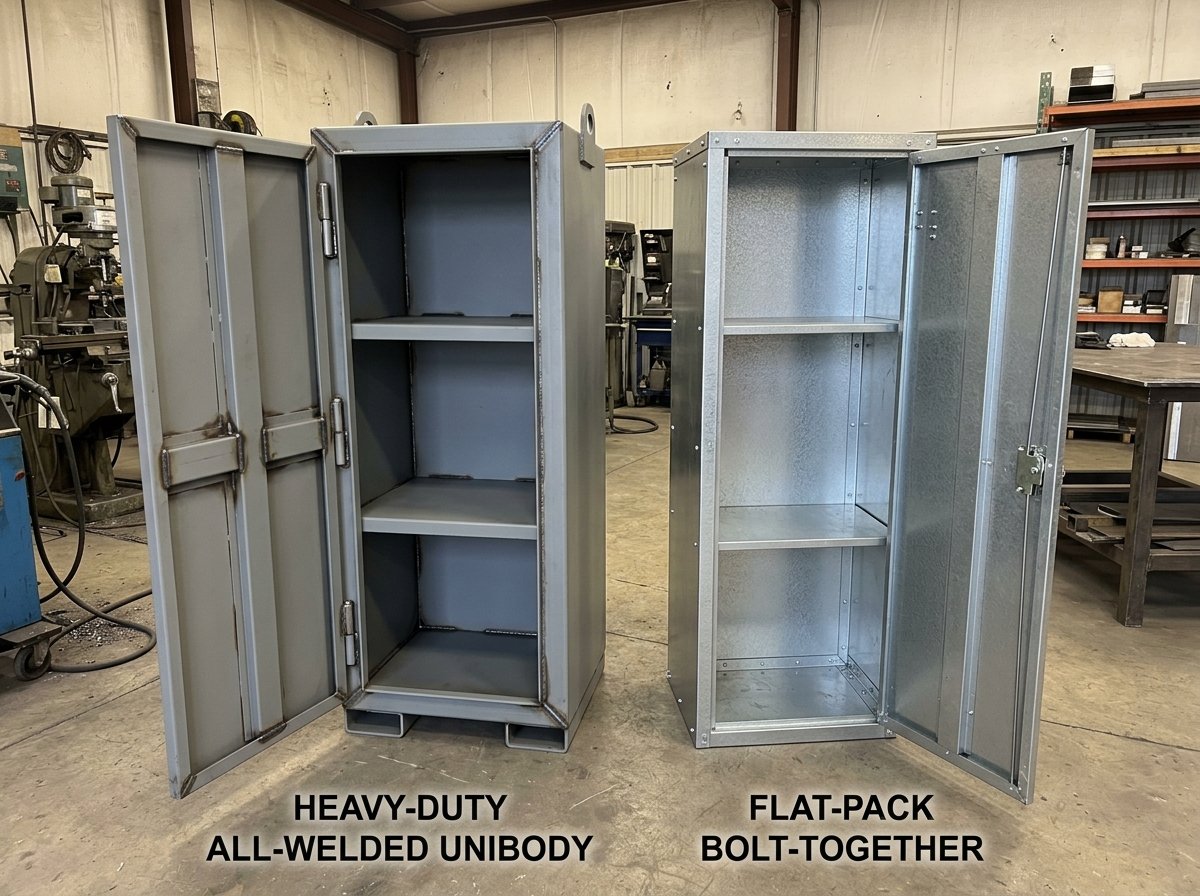
When procuring cabinet metal storage systems, facility managers face a foundational architectural choice: factory-assembled all-welded unibody units or knock-down ready-to-assemble (RTA) bolt-together kits.
The Engineering Strength of All-Welded Unibody Cabinets
In an all-welded cabinet, the top cap, side walls, back panel, and base frame are permanently fused at the factory using continuous resistance seam welds and robotic MIG spot welds. This creates an uncompromised structural unibody. Door frames are reinforced with welded corner gussets, and continuous 14-gauge piano hinges are spot-welded down the entire door height. If you need portable workstation tool storage, review our guide to rolling tool cabinet steel gauge and casters.
The operational advantages of all-welded steel cabinets include:
- Zero Fastener Loosening: Industrial shops experience constant acoustic vibration and forklift traffic. Bolt-together units gradually loosen, sag, and bind along the door frames; all-welded cabinets retain true factory squareness indefinitely.
- Massive Load Carrying Capacity: Heavy-gauge welded unibody cabinets routinely support total internal capacities exceeding 3,000 to 5,000 pounds without frame racking.
- Zero Assembly Labor: Welded cabinets arrive palletized and ready for immediate service, eliminating the 2 to 3 hours of expensive technician labor required to assemble complex sheet metal kits.
When Do Knock-Down Bolt-Together Cabinets Make Sense?
Knock-down bolt-together cabinets ship flat-packed in compact cardboard cartons. While they lack the massive load capacity of welded industrial units, they offer distinct advantages in specific logistical scenarios:
- Tight Building Access: Facilities with narrow stairwells, mezzanine ladders, low basements, or small service elevators cannot accommodate a fully assembled 72-inch welded unibody cabinet. Flat-pack components can be hand-carried into confined rooms.
- Lower Freight Shipping Costs: Flat-packed cartons occupy significantly less cube volume on freight trucks, lowering shipping charges for small orders across long distances.
- Light Commercial Duty: For standard office supplies, safety goggles, spare uniforms, and cleanroom consumables, quality 18-gauge bolt-together cabinets provide adequate durability at a budget-friendly price point.
Steel Gauge Standards and Load Ratings: 12-Gauge to 22-Gauge
Steel thickness is measured in standard Sheet Metal Gauge numbers. Because gauge is an inverse scale, a lower number indicates a thicker, heavier sheet of steel. Choosing the correct gauge for your cabinet metal storage prevents catastrophic shelf collapse and door sagging. For general freestanding open steel storage, compare our steel shelving units capacity guide.
| Steel Gauge | Nominal Thickness | Typical Shelf Load (UDL) | Structural Application | Assembly Type |
|---|---|---|---|---|
| 12-Gauge | 0.1046″ (2.66 mm) | 1,200 – 1,800 lbs | Extreme industrial: tool & die, engine blocks, steel billets | 100% All-Welded Unibody |
| 14-Gauge | 0.0747″ (1.90 mm) | 800 – 1,200 lbs | Heavy commercial: maintenance shops, military, fleet depots | All-Welded Unibody |
| 16-Gauge | 0.0598″ (1.52 mm) | 400 – 650 lbs | Standard commercial: school supply, warehouse logistics, tools | Welded or Heavy RTA |
| 18-Gauge | 0.0478″ (1.21 mm) | 250 – 400 lbs | Light commercial: office files, medical records, janitorial | Bolt-Together / RTA |
| 20/22-Gauge | 0.0359″ (0.91 mm) | 100 – 175 lbs | Consumer residential: laundry rooms, lightweight home storage | Thin Flat-Pack Sheet |
Understanding Uniformly Distributed Loads (UDL)
Shelf load ratings published by commercial manufacturers reflect a Uniformly Distributed Load (UDL). This assumes the weight is spread evenly across the entire surface area of the steel shelf. If you place a compact 400-pound steel stamping die directly in the center of an 18-gauge shelf rated for 400 lbs UDL, the concentrated point load will cause permanent shelf sag. For heavy tooling and uneven point loads, select 12-gauge or 14-gauge cabinets featuring reinforced underside hat-channel stiffeners.
Industrial Locking Systems: 3-Point Cremone Hardware & Security
Securing high-value assets—such as calibrated measurement equipment, pneumatic hand tools, copper fittings, and controlled chemical inventory—requires tamper-proof locking hardware. Low-grade office cabinets utilize thin stamped cam locks that can be forced open in seconds using a flathead screwdriver.
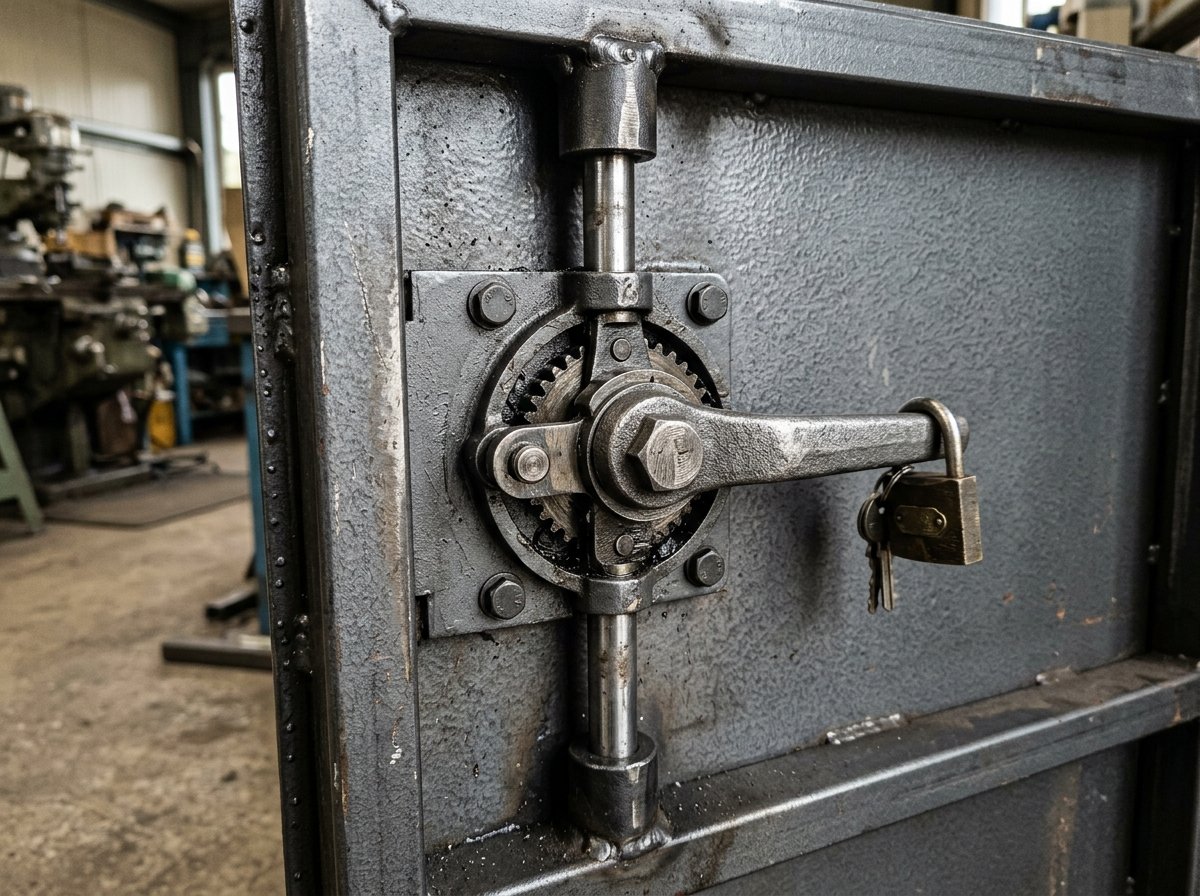
How 3-Point Cremone Locking Works
Heavy-duty industrial metal storage cabinets utilize a mechanical cremone latching system. Turning the heavy exterior cast-iron handle simultaneously drives three independent locking points:
- Top Latching Rod: A solid 3/8-inch or 5/16-inch round steel rod extends vertically upward into a heavy steel strike socket in the cabinet top frame header.
- Bottom Latching Rod: A matching solid steel rod extends vertically downward into a reinforced strike hole in the bottom cabinet base sill.
- Center Cam Latch: A heavy steel center pawl rotates behind the opposing door or vertical center frame jamb.
By engaging the top, bottom, and center of the door frame simultaneously, the cremone system prevents pry bars from bending the corners of the door. For residential and garage security alternatives, review our dedicated metal storage cabinets steel gauge and locking guide.
Padlock Hasp vs. Cylinder Keyed Handles
In active production facilities, master-keyed cylinder locks are often lost, jammed with dust, or compromised. Premier industrial cabinets utilize heavy cast steel turn handles with integrated padlock hasps accepting 3/8-inch commercial hardened steel padlocks. This allows facility managers to implement OSHA-compliant Lockout/Tagout (LOTO) security protocols or assign personalized digital combinations to individual shop technicians.
Specialized Cabinet Types: Flammable, Mobile, and Modular Systems
Standard storage cabinets are built for general tools and dry inventory, but specialized applications demand purpose-built containment and mobility solutions. For heavy-duty rack alternatives, examine our industrial storage racks guide.
1. NFPA 30 & OSHA 1910.106 Flammable Safety Cabinets
Storing combustible liquids, solvents, paints, and aerosol cans requires specialized yellow safety cabinets engineered to prevent workplace fires. These cabinets must comply strictly with federal safety mandates:
- Double-Wall Insulated Steel: Constructed from 18-gauge steel featuring a continuous 1.5-inch insulating air gap between the outer and inner walls to retard heat transfer during an external fire.
- Leak-Tight Containment Sump: The cabinet floor features a 2-inch deep liquid-tight containment basin to capture ruptured containers and chemical spills.
- Dual Flame Arrestor Vents: Equipped with dual 2-inch threaded vent bung holes fitted with internal brass flame screens to prevent vapors from igniting.
- Self-Closing Doors: Heat-activated fusible links automatically trigger door closure when ambient temperature exceeds 165°F, sealing flammable contents inside.
2. Mobile Heavy-Duty Industrial Cabinets
Maintenance teams and millwrights require mobile tool storage that can travel across concrete warehouse floors. Heavy-duty mobile cabinets mount on reinforced tubular steel subframes with 5-inch to 6-inch industrial casters rated for 2,000 to 4,000 pounds total rolling capacity. Always verify that mobile units feature two rigid casters paired with two swivel casters equipped with total-lock brakes that freeze both wheel rotation and swivel tracking during workstation use.
3. Modular Workstation Cabinet Suites
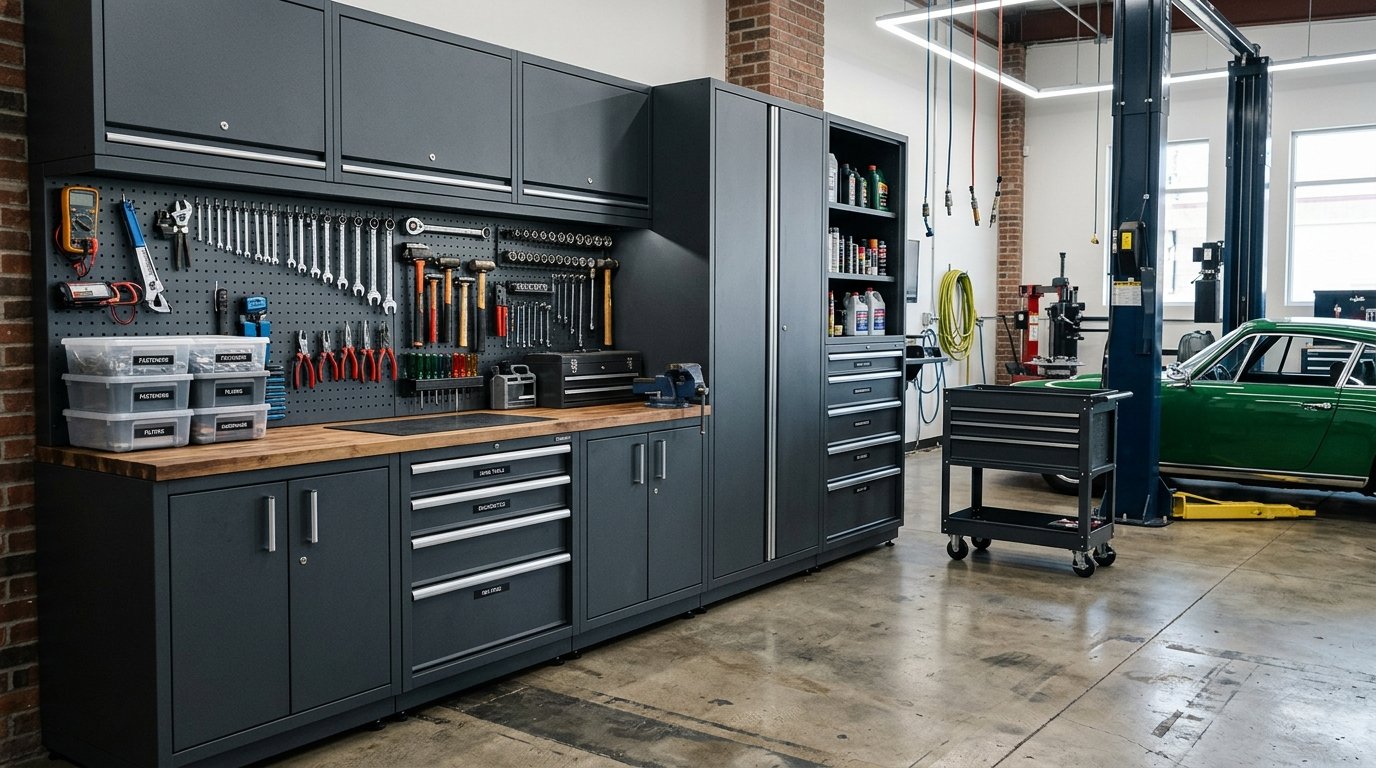
In manufacturing cells and assembly bays, modular steel cabinet suites integrate upper wall-mounted cabinets, base drawer banks, and heavy 1.5-inch laminated maple butcher block or 12-gauge steel work surfaces. Interior door panels often feature welded steel louvered racks to hang plastic parts bins or square-perforated pegboard patterns for quick-reach tool hanging.
Compliance Standards: ANSI/BIFMA X5.9 and OSHA Regulations
Procuring commercial cabinet metal storage involves compliance with commercial building codes, worker safety regulations, and industry performance standards.
ANSI/BIFMA X5.9 Performance Testing
In commercial and institutional environments, high-end storage cabinets are engineered to meet standards established by the Business and Institutional Furniture Manufacturers Association (BIFMA). The ANSI/BIFMA X5.9 standard subjects cabinets to punishing mechanical laboratory tests, including:
- Shelf Retention and Deflection: Testing shelves under 150% rated load to verify zero structural detachment and recovery within elastic limits.
- Cycle Durability: Opening and closing cabinet doors 20,000 to 50,000 consecutive cycles without hinge sagging or latch binding.
- Dynamic Racking Impact: Applying lateral horizontal forces to ensure unibody cabinet frames resist twisting when loaded.
OSHA 1910.106 Flammable Liquid Storage Mandates
Federal workplace safety rules enforced by OSHA 1910.106 flammable liquids storage regulations restrict the volume of flammable liquids stored outside approved cabinets. Facilities may not store more than 25 gallons of Category 1 flammable liquids or 120 gallons of Category 2/3 flammables without housing them inside certified safety cabinets designed under NFPA 30 Flammable and Combustible Liquids Code standards. Violating these storage thresholds leads to immediate workplace safety citations and fire code penalties.
Seismic Floor Anchoring and Anti-Tip Protection
Tall steel cabinets (exceeding 60 inches in height) present serious tip-over hazards when upper shelves are loaded or when both heavy doors swing open simultaneously. In seismic risk zones (IBC Seismic Design Categories D through F), municipal building codes require anchoring cabinet base channels directly into the concrete floor slab with 3/8-inch wedge anchors, or securing the cabinet top header to structural wall studs using engineered steel seismic straps.
Frequently Asked Questions
What steel gauge is best for industrial cabinet metal storage?
For heavy industrial environments like machine shops, maintenance depots, and manufacturing plants, 14-gauge steel (0.0747 inches thick) or 12-gauge steel (0.1046 inches thick) is the professional standard. These gauges provide the structural rigidity needed to support 800 to 1,500 pounds per shelf and resist denting from dropped tools or pallet contact. For light commercial storage or office supplies, 16-gauge or 18-gauge steel provides reliable daily service at a lower cost.
What is the difference between an all-welded cabinet and a bolt-together cabinet?
An all-welded cabinet is completely fused at the factory using robotic continuous seam welds, creating a solid unibody structure with zero assembly required and exceptional resistance to racking. A bolt-together cabinet arrives flat-packed and requires assembly using nuts, bolts, or snap-together tabs. While bolt-together units are easier to transport into tight spaces and carry lower initial shipping costs, they cannot match the load capacity or long-term durability of all-welded unibody steel.
Why are flammable storage cabinets painted yellow and double-walled?
Flammable storage cabinets are painted high-visibility safety yellow to instantly alert emergency responders and workers to hazardous chemical contents. They are engineered with double-walled 18-gauge steel separated by a 1.5-inch insulating air space, compliant with OSHA 1910.106 and NFPA 30 standards. This air barrier slows temperature rise inside the cabinet during an active warehouse fire, preventing flammable vapors from reaching their auto-ignition threshold.
How much weight can an industrial steel storage shelf support?
Shelf weight capacity depends on steel gauge, width, depth, and underside reinforcement. Standard commercial 18-gauge shelves hold 200 to 350 pounds of uniformly distributed load (UDL). Reinforced 14-gauge shelves with welded box flanges support 800 to 1,200 pounds, while heavy-duty 12-gauge industrial shelves support up to 1,500 to 1,800 pounds per shelf level. Concentrated point loads will reduce these ratings by up to 50%.

Callum Langham
Founder & Technical Storage Editor
Callum Langham is the founder and technical editor of Rack System. With over 12 years of hands-on field experience in warehouse logistics, garage organization, and industrial storage installations, Callum specializes in engineering safety standards, beam load calculations, and OSHA/RMI compliance. Every guide on Rack System is audited against verified steel gauge tolerances and municipal building codes.