Quick Answer: Best Garage Wall Shelves Setup
Heavy-duty garage wall shelves must be anchored directly into wood wall studs spaced 16 or 24 inches on center using 5/16-inch by 3-inch structural lag screws or GRK RSS fasteners. Triangular welded steel gusseted brackets provide the highest load capacity, safely supporting 300 to 500 pounds per stud pair. Never rely on drywall anchors or hollow-wall toggle bolts for deep garage shelving, as cantilever rotational torque pulls upper fasteners straight out under the weight of loaded storage totes.
Key Takeaways
- Cantilever Depth Multiplier: A 24-inch deep shelf doubles the pulling force on top fasteners compared to a 12-inch shelf holding identical weight.
- Structural Fasteners Only: Use 5/16-inch structural wood screws driven at least 2 inches into solid wood studs; drywall screws snap under shear loads.
- Drywall Compression Trap: Torquing heavy brackets directly against drywall can crush gypsum; install a solid 2×4 wood ledger board for maximum load transfer.
- Vehicle Hood Clearance: Install high perimeter wall shelves at 52 to 56 inches above the concrete slab to park vehicle hoods safely underneath.
The Mechanics of Heavy-Duty Garage Wall Shelves
Garage wall shelves are more than simple storage ledges; they are cantilevered structural systems engineered to carry substantial static loads while suspended above vehicles and equipment. Understanding the underlying physics, from fastener tension ratings to stud withdrawal resistance and bracket geometry, is the difference between decades of reliable storage and catastrophic drywall failure. This guide breaks down the core engineering and installation principles required to build truly heavy-duty garage wall shelving.
Heavy-Duty Garage Wall Shelving Systems Compared
Different garage storage demands require different structural approaches. The four primary heavy-duty systems each present specific mechanical advantages, load limits, and installation requirements.
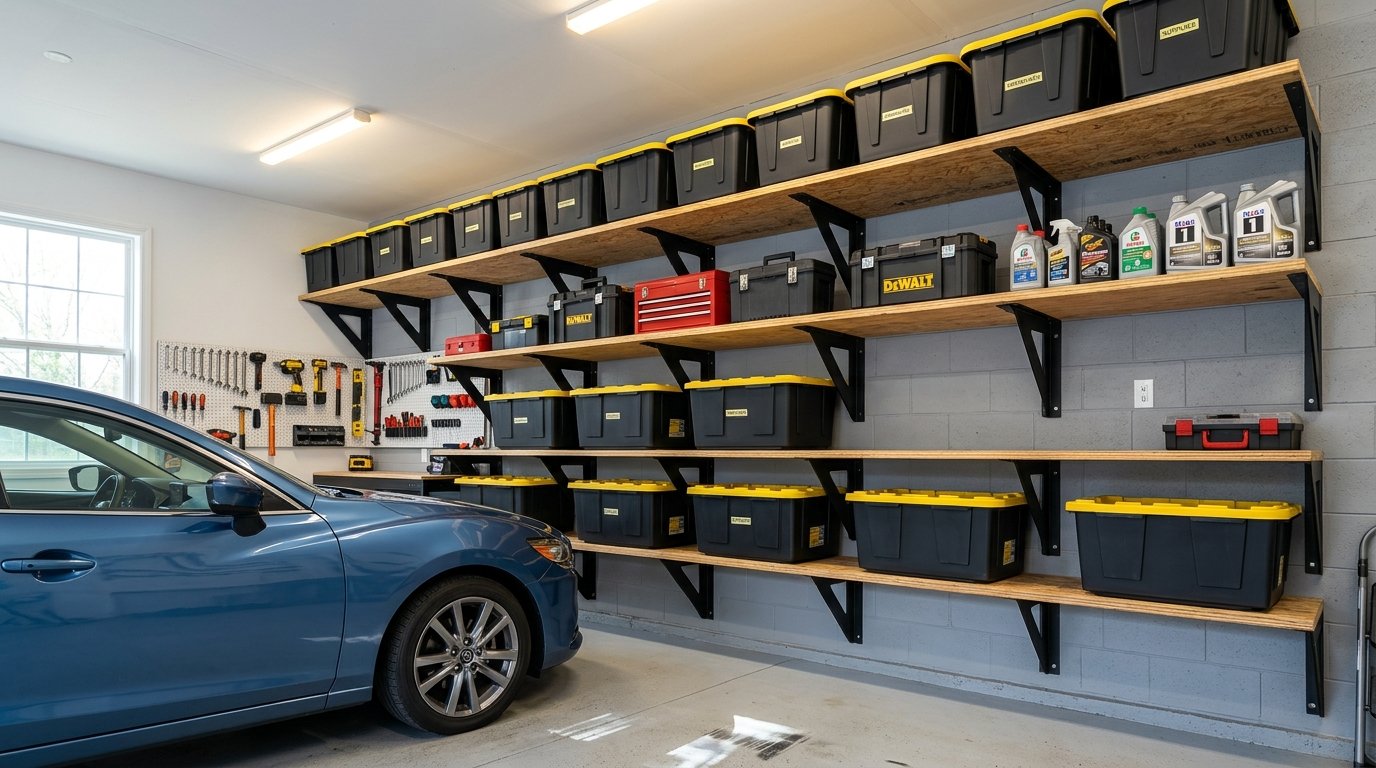
Welded Triangular Steel Gusset Brackets
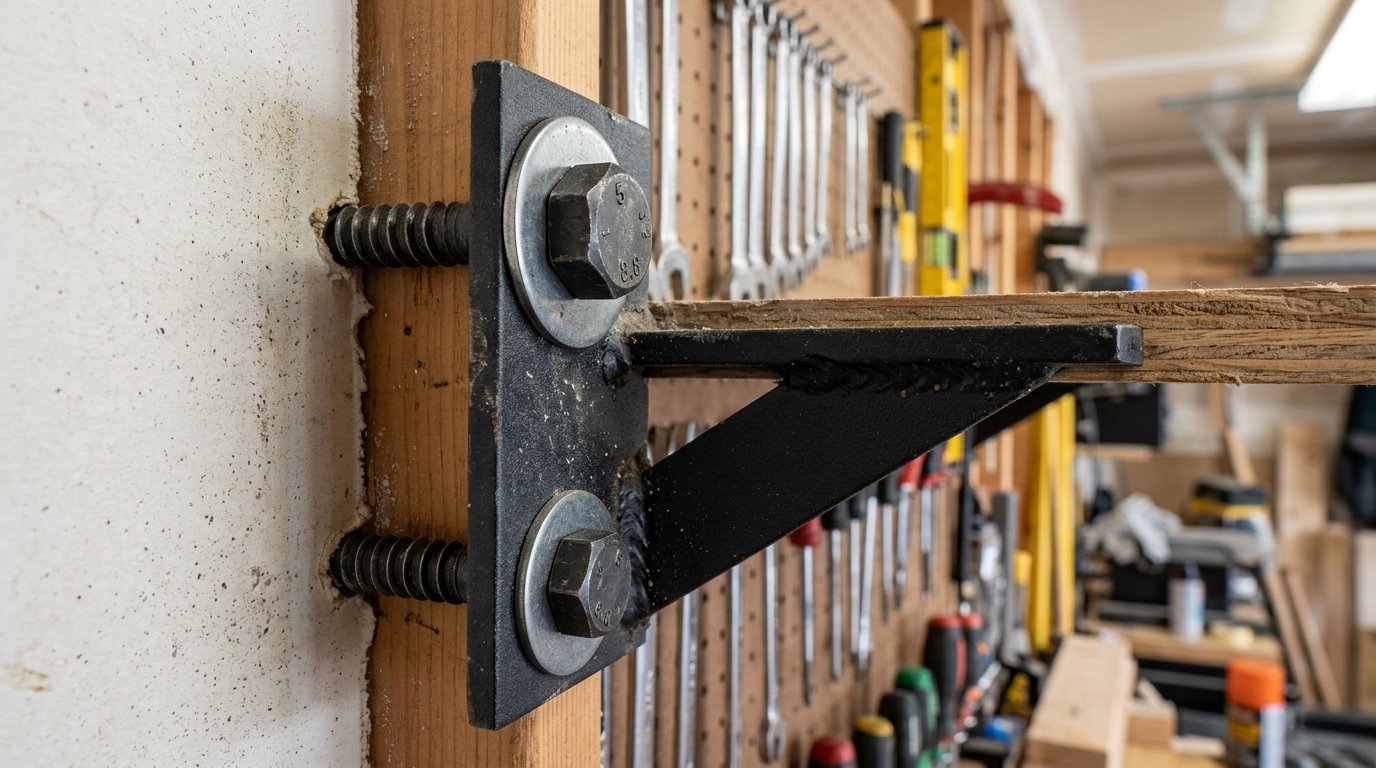
Triangular steel gusset brackets derive their exceptional rigidity from geometric triangulation. The diagonal strut transfers the downward vertical load into two opposing forces: a direct shear load pushing down on the lower fasteners and an intense tensile pull-out load on the upper fasteners.
- Material & Construction: Fabricated from 11-gauge to 14-gauge cold-rolled steel with fully welded diagonal seams and powder-coated finishes to resist humidity.
- Load Capacity: Typically rated between 300 and 500 pounds per pair when anchored into solid wood studs with 5/16-inch lag screws.
- Key Strengths: Extreme structural rigidity, zero joint deflection, and long-term durability under heavy toolboxes and machinery parts.
- Limitations: Fixed shelf depths and non-adjustable heights once anchored into the wall framing.
Modular Track-and-Bracket Systems (Standards and Brackets)
Twin-track vertical standards are mounted vertically along wall studs, with slotted brackets clicking into place at adjustable 1-inch or 2-inch increments.
- Material & Construction: Heavy commercial standards utilize 14-gauge to 16-gauge cold-rolled steel channels secured at 12-inch vertical intervals.
- Load Capacity: Quality twin-track systems carry 150 to 250 pounds per bracket when every mounting hole engages a solid stud.
- Key Strengths: Exceptional flexibility to reconfigure shelf heights as storage bins change size over time.
- Limitations: Single-track consumer standards flex under heavy off-center loads. Only commercial twin-track systems should be used for heavy storage.
Heavy Wire Grid Wall-Mounted Shelves
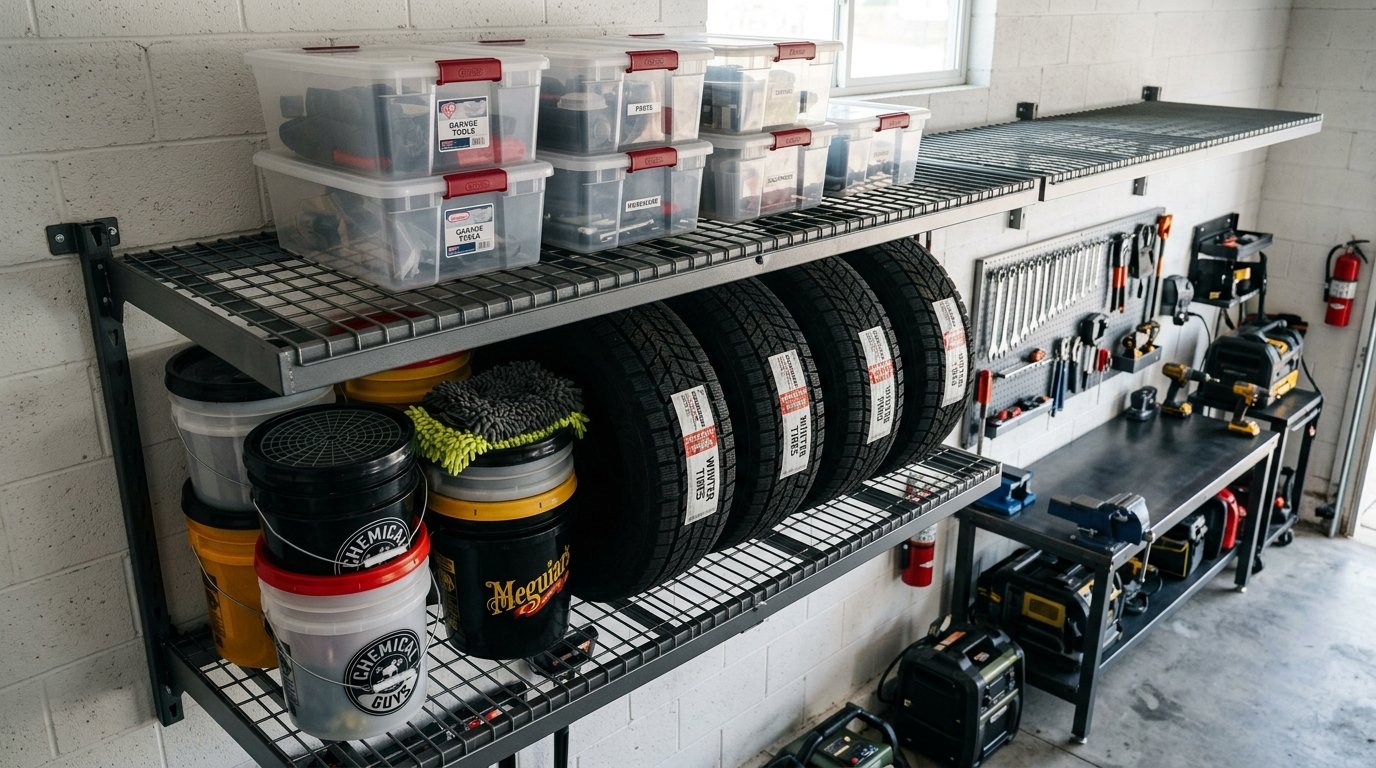
Wire grid decks combine heavy-gauge welded wire with perimeter steel angle frames, supported by diagonal tie rods or under-shelf gussets.
- Material & Construction: Welded 6-gauge to 8-gauge steel wire grids with baked enamel or industrial powder coating.
- Load Capacity: Rated for 400 to 600 pounds across a full 4-foot to 8-foot run with proper wall anchoring.
- Key Strengths: Superior light transmission, zero dust accumulation, and bottom visibility for high-mounted upper storage.
- Limitations: Small hardware and loose items fall through open wire grids without auxiliary shelf liners or solid tote bins.
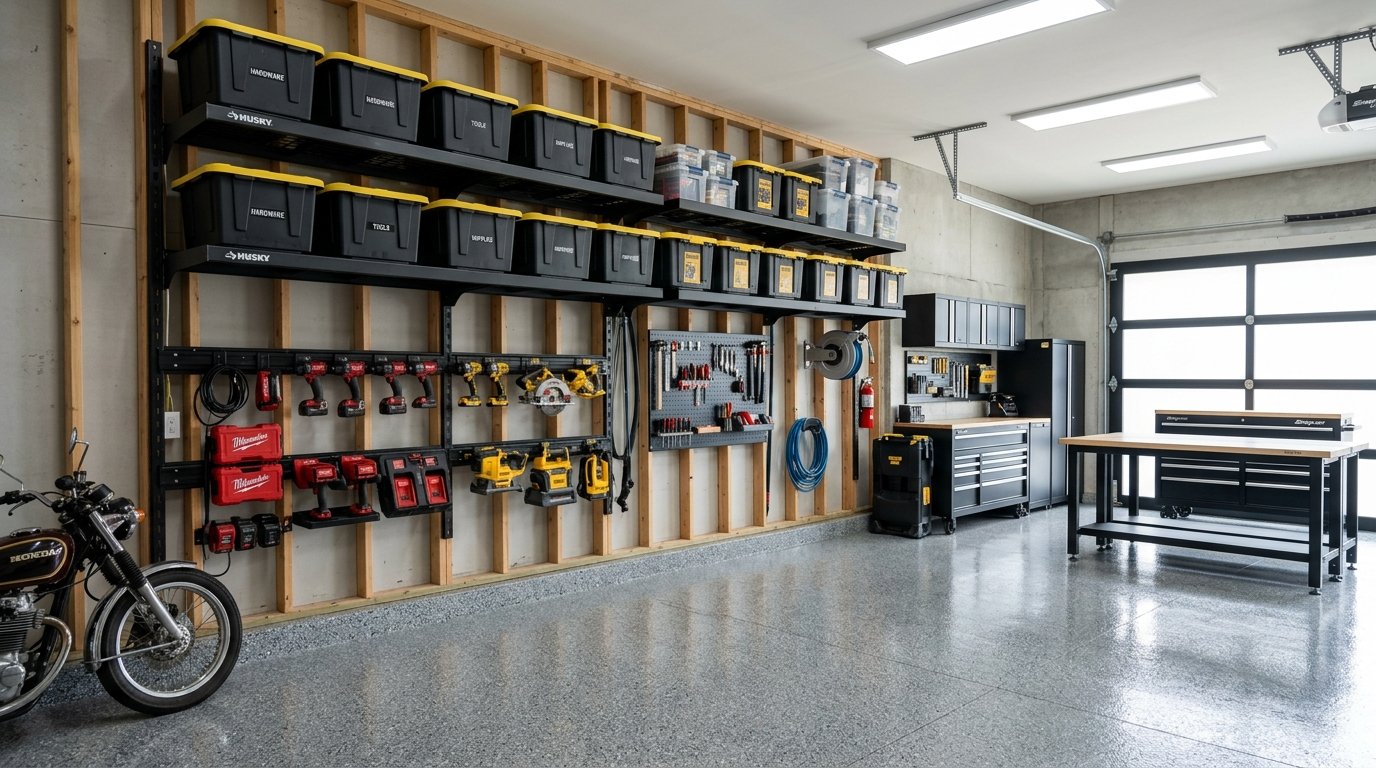
DIY 2×4 Lumber Frames with Plywood Tops
Custom site-built wooden shelving remains a shop favorite due to its adaptability to non-standard wall dimensions.
- Material & Construction: Framing is built with No. 2 Spruce-Pine-Fir (SPF) 2×4 lumber and topped with 3/4-inch CDX or BCX exterior plywood.
- Load Capacity: Continuous ledger designs easily handle 400 to 800 pounds distributed across an 8-foot span.
- Key Strengths: Highly cost-effective per linear foot, easily modified with under-shelf hooks and power strips, and forgiving to install.
- Limitations: Requires carpentry tools and adds significant dead weight to the wall framing compared to steel.
Shelf Sizing Considerations and Stud Spacing
Selecting the right shelf dimensions requires balancing storage capacity against the physical limits of wall leverage.
Shelf Depth Selection
- 12-Inch Depth: Best for paint cans, spray lubricants, fasteners, and hand tools. Minimizes outward rotational torque on upper screws, making it the safest choice for tight spaces above workbenches.
- 16-Inch Depth: The most versatile garage depth. Accommodates standard 12-gallon totes and tool cases while preserving comfortable walkway clearance.
- 20-Inch Depth: Fits heavy 27-gallon industrial storage totes with minimal overhang. Requires heavy triangular gussets.
- 24-Inch Depth: Maximum practical wall depth for bulky items, storage bins, and luggage. Imposes severe cantilever rotational stress on wall fasteners and requires strict adherence to structural fastening schedules.
Stud Spacing: 16-Inch vs. 24-Inch On-Center
- 16-Inch On-Center (OC): Standard residential stud spacing. Provides robust bracket support every 16 inches, allowing 3/4-inch plywood to carry heavy point loads with virtually zero sag.
- 24-Inch On-Center (OC): Common in pole barns, detached garages, and non-load-bearing perimeter walls. This wider span increases shelf deck deflection by more than double. Spans of 24 inches require stiffer 3/4-inch plywood decks, front edge 2×4 stiffeners, or brackets installed on every single stud.
Fasteners: Structural Screws, Lag Bolts, and Drywall Risks
A garage shelving system is only as strong as the physical connection between the bracket and the wall stud. Understanding fastener mechanics prevents sudden shear or withdrawal failures.
Modern Structural Screws (GRK RSS / Simpson SDWS)
Modern heat-treated structural wood screws have largely replaced traditional lag bolts in professional construction. Featuring built-in washer heads, aggressive serrated threads, and hardened alloy steel cores, structural screws (5/16-inch or 1/4-inch diameter) provide superior shear strength without requiring pre-drilled pilot holes in SPF studs.
Traditional Hex-Head Lag Bolts
Standard 5/16-inch or 3/8-inch steel lag bolts remain an industry benchmark for securing thick 2×4 ledger boards to studs. When installing lag bolts, always follow these rules:
- Pre-Drill Pilot Holes: Drill pilot holes sized to 70% of the bolt’s shank diameter (3/16-inch for 5/16-inch lags) to prevent splitting the stud.
- Use Hardened Flat Washers: A heavy steel washer prevents the hex head from crushing through the bracket steel or ledger wood during final torque down.
- Verify Thread Embedment: Fasteners must penetrate a minimum of 2.0 to 2.5 inches into solid stud wood, excluding the 1/2-inch drywall layer.
Why Drywall Screws and Hollow-Wall Anchors Fail
Drywall screws are made from brittle, case-hardened steel designed solely to hold sheetrock against studs. When subjected to the lateral shear and outward tensile forces of loaded shelves, drywall screw heads snap off cleanly with zero warning. Hollow-wall anchors (plastic toggles, butterfly anchors) clamp onto soft gypsum paper. Under cantilevered shelf loads, they instantly punch out a circular plug of drywall, dropping the entire assembly.
Engineering Mechanics: Cantilever Torque, Deflection, and Load Limits
To safely engineer wall storage, you must account for how gravity and lever arms multiply weight. For broader storage framing principles, review our wall storage systems guide and our comprehensive metal shelves and brackets mounting guide.
Pull-Out Tension vs. Downward Shear
Every cantilevered shelf acts as a simple lever. Weight placed on the deck acts downward, pivoting around the lower edge of the bracket. This creates two distinct forces:
- Bottom Fasteners: Experience pure shear force (downward vertical cutting stress). Wood studs possess immense shear resistance.
- Top Fasteners: Experience intense tension pull-out force (horizontal withdrawal stress). This force attempts to yank the screw straight out of the wood grain.
Span Deflection Limits
Shelf decks sag when spans between brackets are too wide. Structural engineering evaluates sag using standard deflection ratios:
- L/240 (Utilitarian Standard): Max allowable sag equals span length divided by 240. Across a 48-inch span, this allows 0.20 inches of visible deflection under full load.
- L/360 (Heavy Commercial Standard): Max allowable sag equals span length divided by 360 (0.13 inches across 48 inches). Recommended for heavy tote storage to prevent stacked bins from sliding toward the center.
For 3/4-inch plywood, keep bracket spacing at 16 inches for heavy loads (over 75 lbs/sq ft) or 24 inches for general storage. If using OSB, span stiffness is roughly 15% lower, requiring a front edge 1×2 or 2×2 wood stiffener to avoid permanent sag.
Total System Load vs. Stud Withdrawal Resistance
A bracket might boast a “500 lb load rating,” but that rating represents steel yield strength in a factory laboratory test jig. The true weak link is the wood stud’s withdrawal resistance. In Spruce-Pine-Fir (SPF) framing, a 5/16-inch structural screw embedded 2 inches provides roughly 350 to 450 pounds of ultimate withdrawal force. Applying a standard 3:1 safety factor leaves an allowable design withdrawal load of approximately 120 to 150 pounds per screw. For commercial safety regulations, consult Material Handling Industry storage standards and OSHA general storage and walking-working surface safety requirements.
Critical Installation Factors Most DIYers Overlook
Careful attention to structural carpentry details separates durable installations from dangerous shelf failures.
The “Drywall Compression Trap”
When you bolt a heavy steel bracket directly against 1/2-inch sheetrock, tightening the lag bolt compresses the chalky gypsum core. Over months of garage temperature swings, humidity fluctuations, and repeated loading, that compressed gypsum crumbles into powder. This loosens the clamping friction between the bracket and stud face, allowing the bracket to sag downward and magnifying bending stress on the fastener shank.
The Fix: For heavy-duty shelving, mount a solid 2×4 lumber ledger directly to the studs, or cut neat 2-inch drywall clearance access holes and install solid wood blocking flush with the drywall surface.
The Cantilever Depth Multiplier
The lever arm equation is simple: Torque = Force × Distance. Consider what happens when placing 100 pounds at the front edge of a shelf with a 6-inch vertical bracket mounting hole spread:
- 12-Inch Deep Shelf: Rotational torque = 100 lbs × 12 in = 1,200 lb-in. Pull-out tension on the upper screw = 1,200 / 6 = 200 pounds.
- 24-Inch Deep Shelf: Rotational torque = 100 lbs × 24 in = 2,400 lb-in. Pull-out tension on the upper screw = 2,400 / 6 = 400 pounds.
Doubling the shelf depth exactly doubles the pull-out force on your top fasteners. When installing 24-inch shelving, you must use heavy 12-inch vertical bracket legs or add ceiling diagonal support struts.
Finding and Hitting True Stud Centers
A common error is grazing the outer edge of a 1.5-inch stud. An edge-driven fastener only bites into 1/4-inch of wood fibers, splitting the stud edge under load and leading to sudden pull-out. Always locate both stud edges with a magnetic or deep-scanning stud finder, mark the exact 3/4-inch center, and verify solid wood engagement with an 1/8-inch test bit before driving structural fasteners.
Car Hood Clearance: Sizing Upper Wall Shelves
When installing perimeter storage above parking bays, measure vehicle hood elevations carefully. Typical car and SUV hood heights range from 38 to 48 inches from the garage floor slab. To ensure ample clearance for vehicle hoods, parking clearance, and engine bay maintenance, the bottom edge of your lowest wall shelf should measure at least 52 to 56 inches above the garage concrete slab.
Garage Wall Shelving Systems Summary
| Shelving System Type | Shelf Depth & Span | Load Rating Per Stud Pair | Recommended Fasteners & Wall Anchoring |
|---|---|---|---|
| Welded Triangular Steel Gussets | 16 to 24 inches (32″ span) | 300 to 500 lbs per pair | 5/16″ x 3″ structural lag screws into wood studs |
| Modular Track-and-Bracket Standards | 12 to 18 inches (16″ or 32″ span) | 150 to 250 lbs per bracket | Twin-track vertical standards lagged at every stud |
| Heavy-Duty Steel Wire Grid Decks | 18 to 24 inches (48″ to 96″ run) | 400 to 600 lbs total deck | Heavy perimeter wall cleats + ceiling diagonal braces |
| DIY 2×4 Lumber Frame with Plywood | 20 to 24 inches (4ft to 8ft continuous) | 400 to 800 lbs continuous | 2×4 ledger board secured with 3/8″ lag bolts |
Frequently Asked Questions
How much weight can garage wall shelves hold?
Heavy-duty commercial steel garage wall shelves typically hold between 200 and 600 pounds per 4-foot section when anchored into solid 2×4 wall studs. Custom DIY 2×4 wood framed shelves secured with 3/8-inch lag bolts can support 400 to 800 pounds across an 8-foot span. The critical limitation is never the shelf deck itself, but the withdrawal pull-out resistance of the fasteners anchored into the wood framing.
What size lag bolts should I use for garage shelf brackets?
Use 5/16-inch or 3/8-inch diameter lag bolts that achieve a minimum of 2.0 to 2.5 inches of embedment into solid wood stud framing past the drywall. For a bracket mounted over 1/2-inch drywall, use a 3.5-inch long lag bolt. Always pre-drill pilot holes using a 3/16-inch bit for 5/16-inch bolts to prevent splitting the stud, and install a hardened flat washer under the bolt head. High-tensile structural screws like GRK RSS 5/16-inch are an equally strong modern alternative that eliminates pre-drilling.
How far apart should brackets be on garage wall shelves?
For heavy loads exceeding 75 pounds per linear foot, bracket spacing should be 16 inches on center, matching standard wood wall studs. For lighter loads or shelves constructed with 3/4-inch plywood and front stiffening rails, 24-inch or 32-inch spacing (every second stud) is acceptable. Never exceed 32 inches between brackets on garage wall shelving without adding a full subframe, as excessive deck deflection will cause permanent sagging.
Can you hang garage shelves without studs?
No. You absolutely cannot hang heavy-duty garage storage shelves without fastening directly into wall studs. Drywall screws, hollow-wall anchors, and toggle bolts are rated only for static shear loads on flat walls and cannot withstand the severe outward rotational torque generated by a loaded 16-inch to 24-inch cantilevered shelf. Attempting to hang garage shelves directly on drywall will result in structural failure and wall collapse. If studs do not align with your bracket holes, install a continuous 2×4 or 3/4-inch plywood ledger board lagged into adjacent studs first.

Callum Langham
Founder & Technical Storage Editor
Callum Langham is the founder and technical editor of Rack System. With over 12 years of hands-on field experience in warehouse logistics, garage organization, and industrial storage installations, Callum specializes in engineering safety standards, beam load calculations, and OSHA/RMI compliance. Every guide on Rack System is audited against verified steel gauge tolerances and municipal building codes.