The average American garage holds over $4,000 worth of stored items — yet more than 25% of homeowners say they can’t fit a car inside because of clutter, according to the U.S. Department of Energy’s research on residential garages. A garage storage rack is one of the simplest fixes available to you, and it costs a fraction of what professional organizers charge.
You don’t need to be a handyman or spend a weekend sweating through a complicated installation. A good garage storage rack system can transform dead floor space into vertical storage in a few hours. This guide covers what garage storage racks are, every major type you’ll encounter, how to pick the right one, and the mistakes that trip up most beginners.
By the time you finish reading, you’ll know exactly what type of rack fits your garage, how much weight it can hold, and which materials last the longest. Let’s get into it.
What Is a Garage Storage Rack?
A garage storage rack is a structural shelving or framework system designed specifically to store items in a garage environment. Unlike indoor shelving, these racks handle heavier loads, resist humidity and temperature swings, and fit the irregular shapes of garage gear — think bikes, power tools, seasonal decorations, and lawn equipment.
Racks differ from standard shelves in one key way: they’re built for access as much as storage. You need to grab things quickly, often with dirty hands or in dim lighting. Good rack systems make that easy.
The term “garage storage rack” covers everything from a simple bolt-together steel unit you slide into a corner, to a full ceiling-mounted overhead platform. Knowing the difference before you buy saves you money and frustration.
The 7 Main Types of Garage Storage Racks
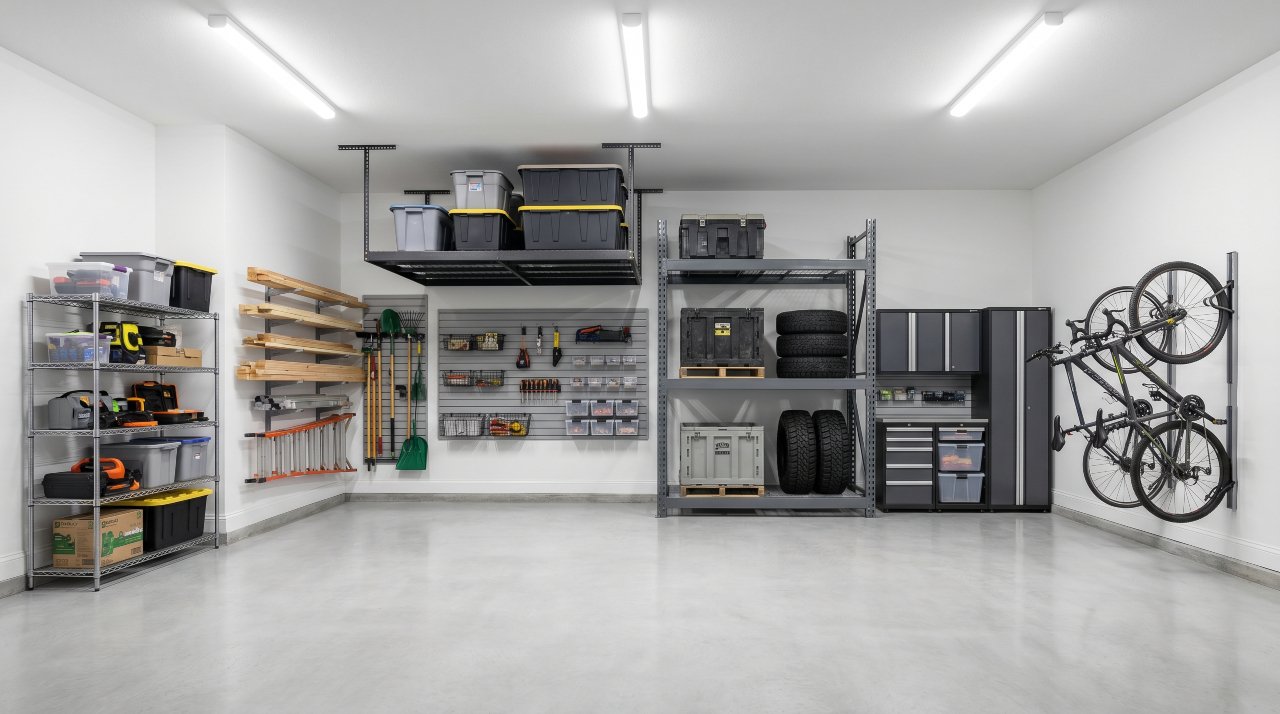
Not every rack works for every garage. Here’s a clear breakdown of the most common types you’ll find in the US market.
1. Freestanding Steel Shelving Racks
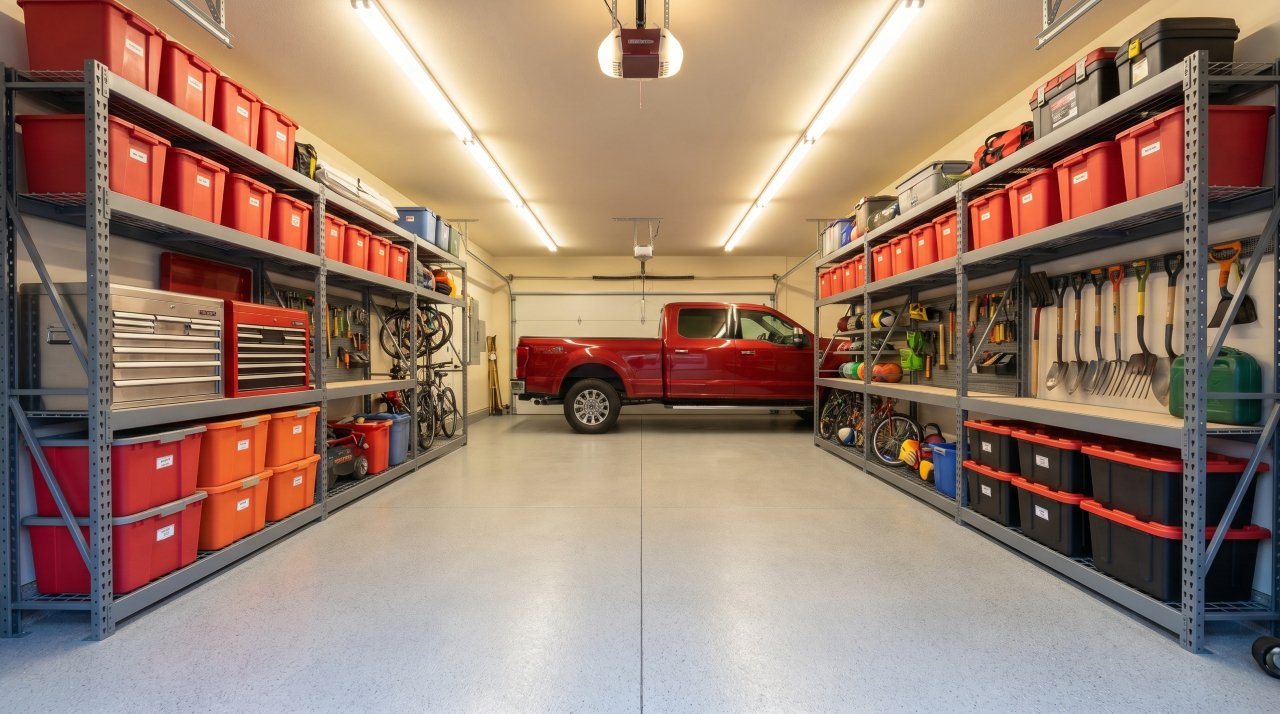
Freestanding racks are the most popular starting point for beginners. You don’t need to drill into walls. You simply assemble the unit on the floor and load it up.
Most freestanding steel racks hold between 1,500 and 3,000 pounds total when weight is distributed evenly across shelves. Brands like Edsal and Muscle Rack are common examples you’ll see at Home Depot or Lowe’s. They’re affordable, portable, and easy to reconfigure.
The downside is footprint. They sit on your floor, which limits how much driving or walking space you have. If your garage is tight, a freestanding rack might cost you more in usable floor space than it saves.
2. Wall-Mounted Garage Racks
Wall-mounted racks bolt directly to your garage wall studs. Because the wall carries the load, these systems open up floor space completely. You get storage and walkable floor space at the same time.
A quality wall-mounted rack can hold 500 to 1,000 pounds per section, depending on stud spacing and anchor quality. They work best in owned homes where you can drill into studs without worrying about damage deposits. If you’re renting, check your lease before mounting anything.
The installation requires a stud finder, a level, and basic drill skills. It’s manageable for most beginners, but allow 2–3 hours for your first installation.
3. Ceiling-Mounted Overhead Racks
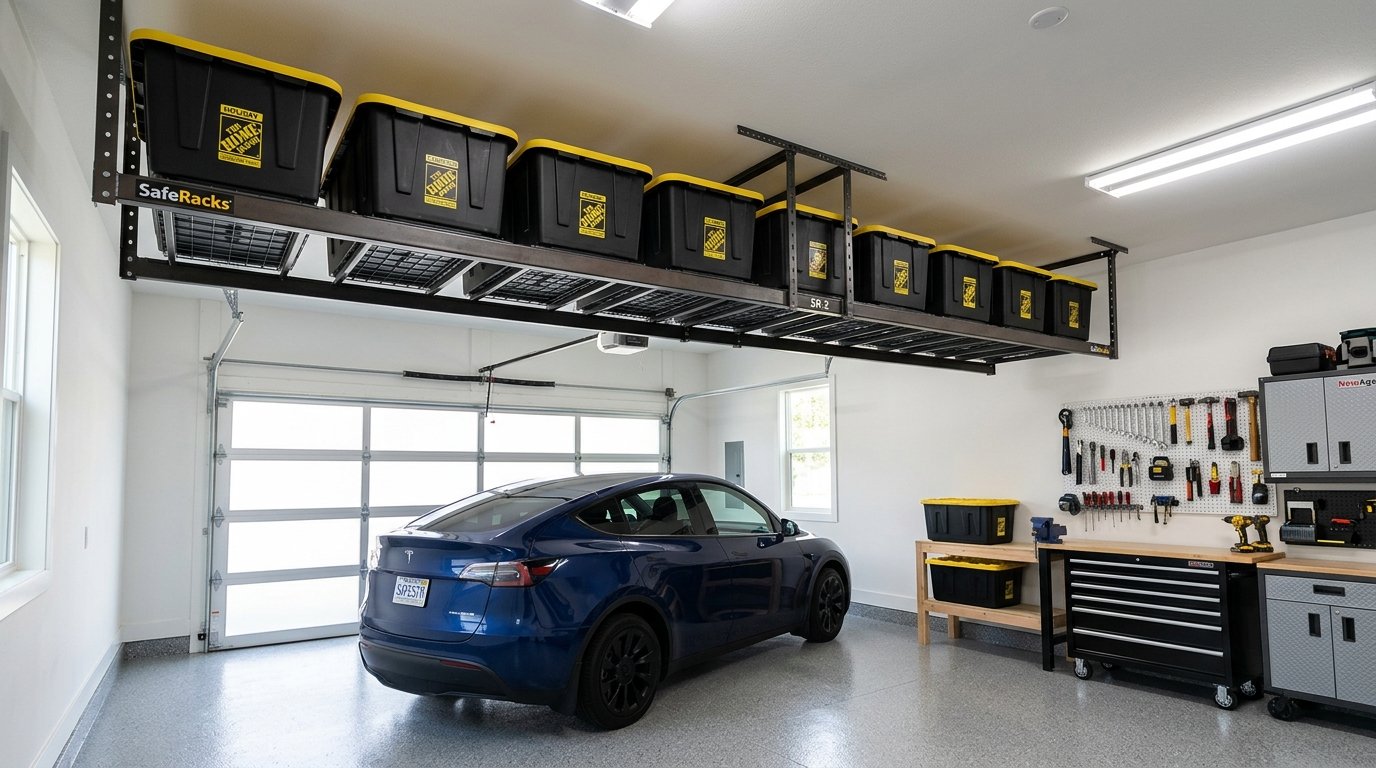
Overhead ceiling racks hang from your garage ceiling joists and create a floating storage platform above your head. This is the most space-efficient option because it uses the one area almost no one else is using — the 8 to 12 feet of air space above your car.
These racks typically hold between 400 and 600 pounds, and the most popular designs — like those from Fleximounts ceiling storage solutions — allow you to adjust the height as needed. They’re ideal for seasonal items you don’t need often, like holiday decorations, camping gear, or luggage.
One honest limitation: ceiling racks require your ceiling joists to be in good condition. In older garages, joists may be spaced at 24 inches rather than 16 inches, which reduces the safe load. Always check joist spacing before purchasing.
4. Slatwall Panel Rack Systems
Slatwall panels attach to your garage wall and feature horizontal grooves that accept a wide range of hooks, bins, and small shelves. Think of it as a customizable pegboard for heavier loads.
Slatwall systems are popular with tool collectors and hobbyists because you can rearrange accessories without re-drilling anything. They handle lighter loads per hook — typically 25 to 75 pounds per accessory — so they’re not suited for bulk storage. Use them for hand tools, garden implements, and sports equipment.
5. Heavy-Duty Pallet-Style Racks
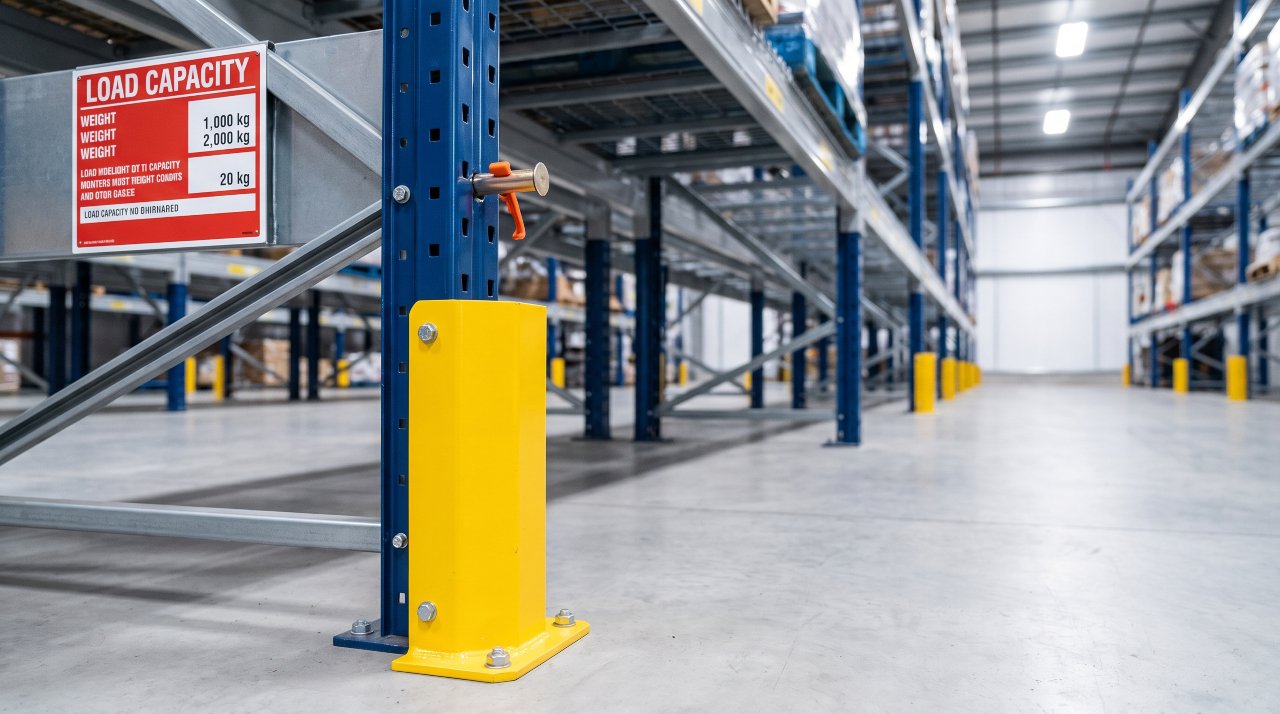
If you store truly heavy items — engine blocks, large generators, steel parts, or construction materials — a pallet-style industrial rack is what you need. These units come directly from the warehouse and fulfillment center world, scaled down for residential garages.
Single bays can hold 2,000 to 6,000 pounds, and some commercial-grade versions go higher. The Occupational Safety and Health Administration (OSHA) publishes guidelines on safe rack loading that are worth reading even in a home garage context. Overloading any rack is a genuine safety risk, not just a theoretical one.
These racks are overkill for most homeowners. But if you run a home business, work on cars, or store heavy materials, they’re the right call.
6. Modular Bin and Locker Systems
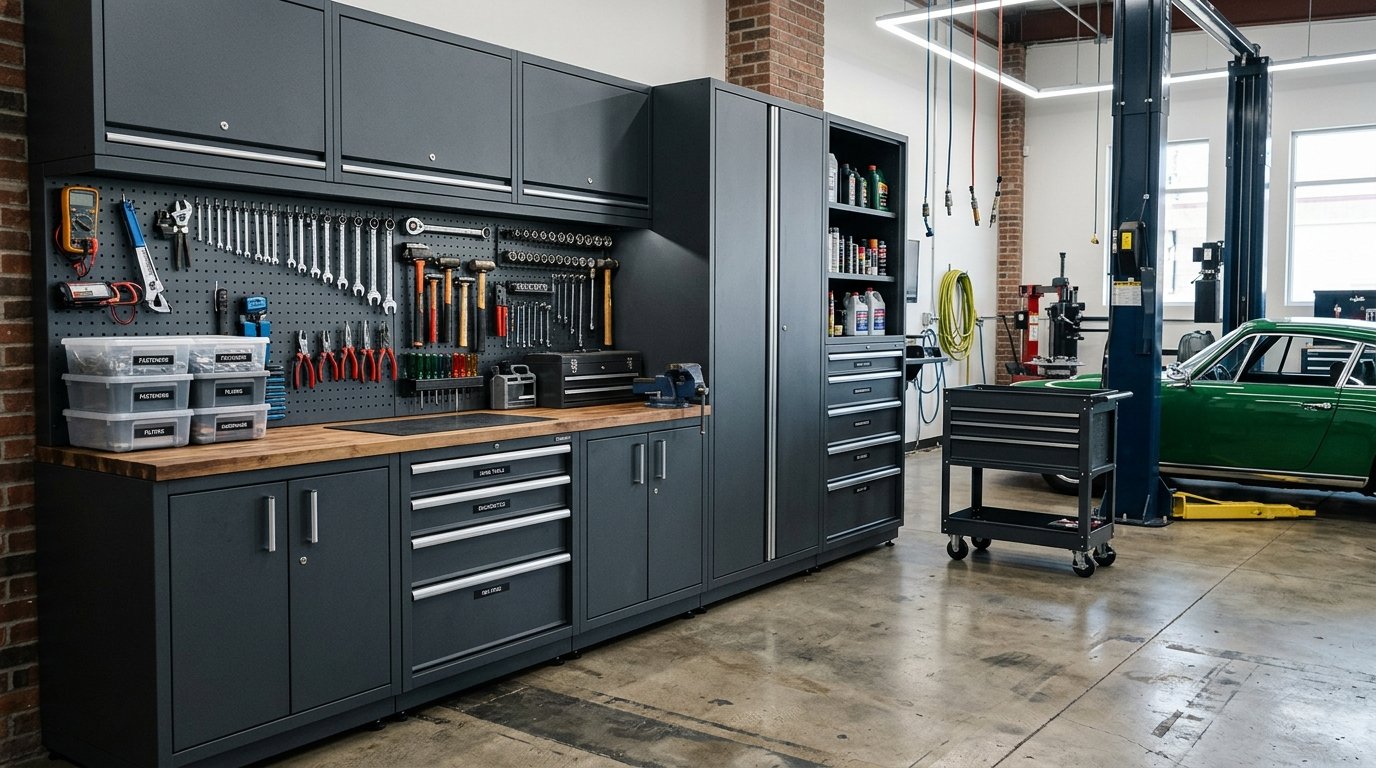
Modular bin systems combine a rack frame with enclosed plastic or metal bins. Instead of open shelves, you get organized compartments that keep small parts, hardware, and supplies protected from dust and moisture.
These work exceptionally well in workshop-style garages where you need to store hundreds of small parts — screws, bolts, electrical components, plumbing fittings. The enclosed design also makes them cleaner looking if your garage doubles as a workspace or showroom.
7. Bike and Sports Equipment Racks
Specialized racks exist specifically for bikes, skis, kayaks, and other oddly-shaped sports gear. A bike rack, for example, stores two to six bikes vertically against a wall, taking up as little as 18 inches of floor space.
These aren’t generic racks — they’re purpose-built, and trying to improvise with a general shelving unit for bikes usually ends in frustration or scratched frames. If sports gear is your primary storage problem, a dedicated sports rack is the smarter investment.
How to Choose the Right Garage Storage Rack

Choosing the right rack comes down to four questions.
1. Do you own or rent the garage?
Renters should stick to freestanding racks to avoid lease violations. Homeowners have every option available.
2. What are you storing?
Heavy items (tools, equipment, supplies) need steel racks with verified weight ratings. Light seasonal items work fine on overhead platforms.
3. How much floor space can you sacrifice?
If every square foot matters, go vertical — wall-mounted or ceiling-mounted systems are your best options.
4. What’s your garage wall made of?
Concrete block walls require masonry anchors, not standard wood screws. Drywall alone can’t support wall-mounted racks — you must hit studs. Knowing your wall type before you buy prevents an expensive mistake.
Garage Storage Rack Materials Compared
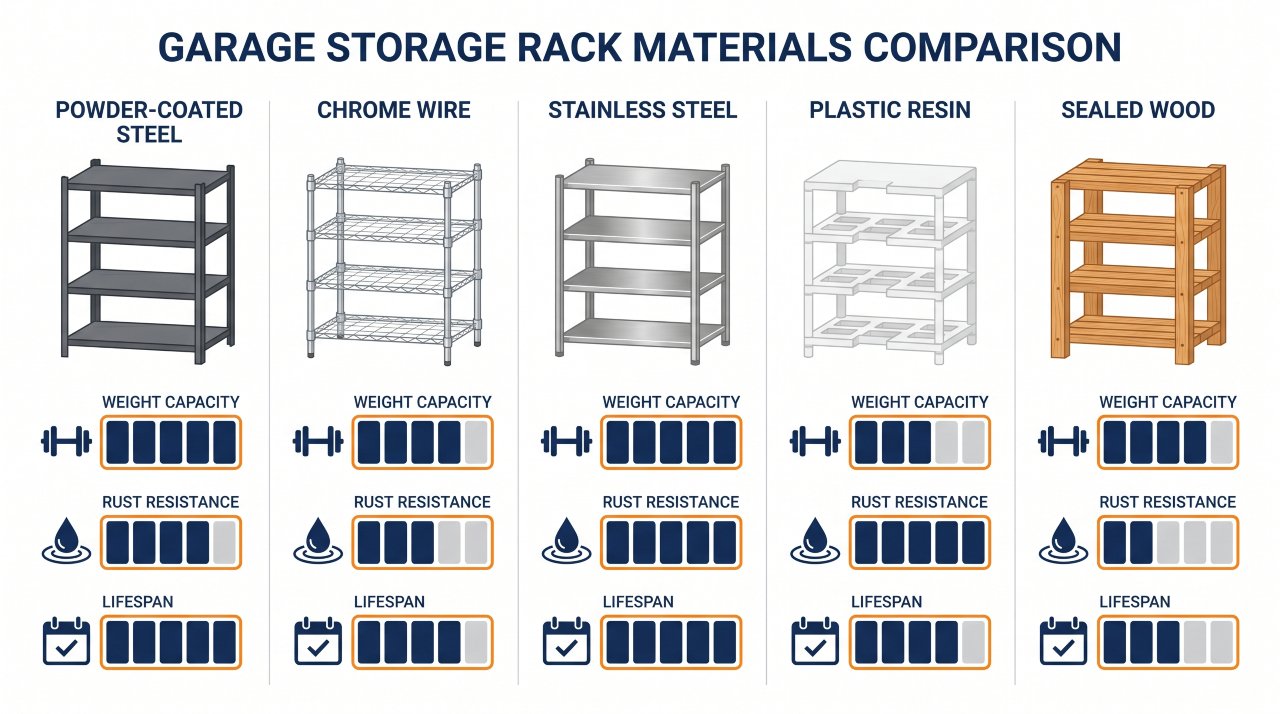
The material your rack is made from directly affects how long it lasts in a garage environment. Garages expose storage systems to temperature extremes, moisture, and the occasional bump from a car bumper. Here’s how the common materials stack up:
| Material | Best For | Average Weight Capacity | Rust Resistance | Typical Lifespan |
|---|---|---|---|---|
| Powder-coated steel | Heavy loads, general storage | High (1,500–3,000 lbs) | Good | 15–25 years |
| Chrome wire | Light loads, visibility | Medium (300–800 lbs) | Moderate | 8–15 years |
| Stainless steel | Humid or wet garages | High | Excellent | 20+ years |
| Plastic/resin | Very light loads | Low (100–300 lbs) | Excellent | 10–20 years |
| Wood (sealed) | Aesthetic setups, DIY | Medium | Poor unless sealed | 5–15 years |
Powder-coated steel is the most practical choice for most US garages. It handles heavy loads, resists corrosion reasonably well, and costs significantly less than stainless steel.
Weight Capacity: What the Numbers Actually Mean
Weight capacity numbers on product labels deserve more scrutiny than most buyers give them. A rack rated at “2,000 pounds” isn’t always what you think.
Most manufacturers test under ideal laboratory conditions with evenly distributed static loads. Your real-world garage use involves dynamic loading — dropping a box, setting a heavy item on one edge of a shelf, or stacking things unevenly. Real-world safe capacity is typically 60–75% of the stated maximum to give yourself a genuine safety margin.
For a rack rated at 2,000 pounds total, plan to store no more than 1,200–1,500 pounds. That buffer matters more than most people realize, and it’s something you’ll rarely see mentioned on the product page.
You can find more technical guidance on shelving load limits through resources like the American National Standards Institute (ANSI) MH16.3 standard for industrial shelving, which sets the bar for how commercial rack manufacturers must test and label their products.
The Most Common Garage Storage Rack Mistakes
Even experienced garage organizers make these errors. If you’re new to this, knowing them in advance saves you real money.
Buying on price alone. Cheap racks often skip key safety certifications and use thinner steel gauges. A rack that fails under load doesn’t just cost you replacement money — it costs you whatever was stored on it.
Ignoring wall and ceiling structure. The rack is only as strong as what it’s attached to. Many installation failures happen because someone mounted a rack into drywall without hitting studs.
Overloading unevenly. Stacking everything on one side of a rack — or loading all heavy items on the top shelf — creates tip and collapse risks even on well-built units.
Not accounting for clearance. Ceiling racks mounted too low become a headache hazard. Wall racks mounted too close to the garage door track get in the way. Always measure clearances before you buy.
Skipping assembly instructions. Nearly every rack has a specific assembly order. Skipping steps or reversing the order leaves bolts loose or frames misaligned in ways you won’t notice until something goes wrong.
How Much Does a Garage Storage Rack Cost?
Garage storage rack pricing covers a wide range depending on type, size, and material quality.
- Basic freestanding steel shelving: $40–$150 per unit
- Wall-mounted rack systems: $80–$400 per section
- Ceiling overhead platforms: $100–$500 per unit
- Slatwall panel systems: $150–$600 for a starter wall setup
- Heavy-duty industrial racks: $300–$1,500+ per bay
Installation costs vary. Freestanding racks cost nothing to install beyond your time. Wall and ceiling mounts might run $100–$300 if you hire a handyman, though most beginners handle them independently with basic tools.
Budget for both the rack and any mounting hardware, which isn’t always included. Anchor bolts, lag screws, and wall brackets can add $20–$50 to a project that looked cheaper on the product page.
FAQ: Garage Storage Rack Questions Answered
What is the best garage storage rack for heavy items?
For heavy items, powder-coated steel freestanding or heavy-duty pallet-style racks are your best options. Look for units with a verified total load capacity of at least 2,000 pounds and individual shelf ratings of 400 pounds or more. Always stay within 70% of the stated maximum for safety.
Are ceiling garage storage racks safe?
Yes, when installed correctly into sound ceiling joists. The key requirement is mounting into actual structural joists — not just drywall or insulation. Most ceiling racks come with joist-finding instructions and mounting templates. A unit from a reputable manufacturer, properly anchored, is very safe for loads under 600 pounds.
How do I organize my garage with racks?
Start by grouping items by how often you use them. Frequently used items go on accessible shelves at waist-to-shoulder height. Heavy items go on lower shelves or the floor. Seasonal or rarely used items go overhead. Place racks along the perimeter walls to keep your center floor clear for vehicles or work space.
What weight can garage shelving hold?
It depends on the rack type and material. Basic freestanding units hold 1,500–3,000 pounds total. Wall-mounted systems typically hold 500–1,000 pounds per section. Overhead ceiling racks hold 400–600 pounds. Always plan to use 60–75% of the stated maximum as your real working limit.
What material is best for garage shelves?
Powder-coated steel is the best material for most garages. It handles heavy loads, resists rust better than bare steel, and costs less than stainless steel. If your garage has very high humidity or you live near the coast, stainless steel is worth the extra investment for its superior corrosion resistance.
Can I use indoor shelving in a garage?
You can, but most indoor shelving isn’t built for the temperature swings, moisture, and heavy loads typical of a garage. Particleboard shelves in particular absorb moisture and sag or warp over time. If you must use indoor shelving, seal all wood surfaces and avoid storing heavy items on it.
Closing
The most important thing you’ve learned here is this: the right garage storage rack depends entirely on your specific situation — what you’re storing, how your garage is built, and whether you rent or own. There’s no single “best” answer, but there is a best answer for you.
Your next step is simple. Measure your garage walls and ceiling height today. Write down the five heaviest items you need to store. Then match that information to the rack types in this guide. You’ll have a clear shortlist of options in under 20 minutes — and a much better garage to show for it.

Callum Langham
Founder & Technical Storage Editor
Callum Langham is the founder and technical editor of Rack System. With over 12 years of hands-on field experience in warehouse logistics, garage organization, and industrial storage installations, Callum specializes in engineering safety standards, beam load calculations, and OSHA/RMI compliance. Every guide on Rack System is audited against verified steel gauge tolerances and municipal building codes.