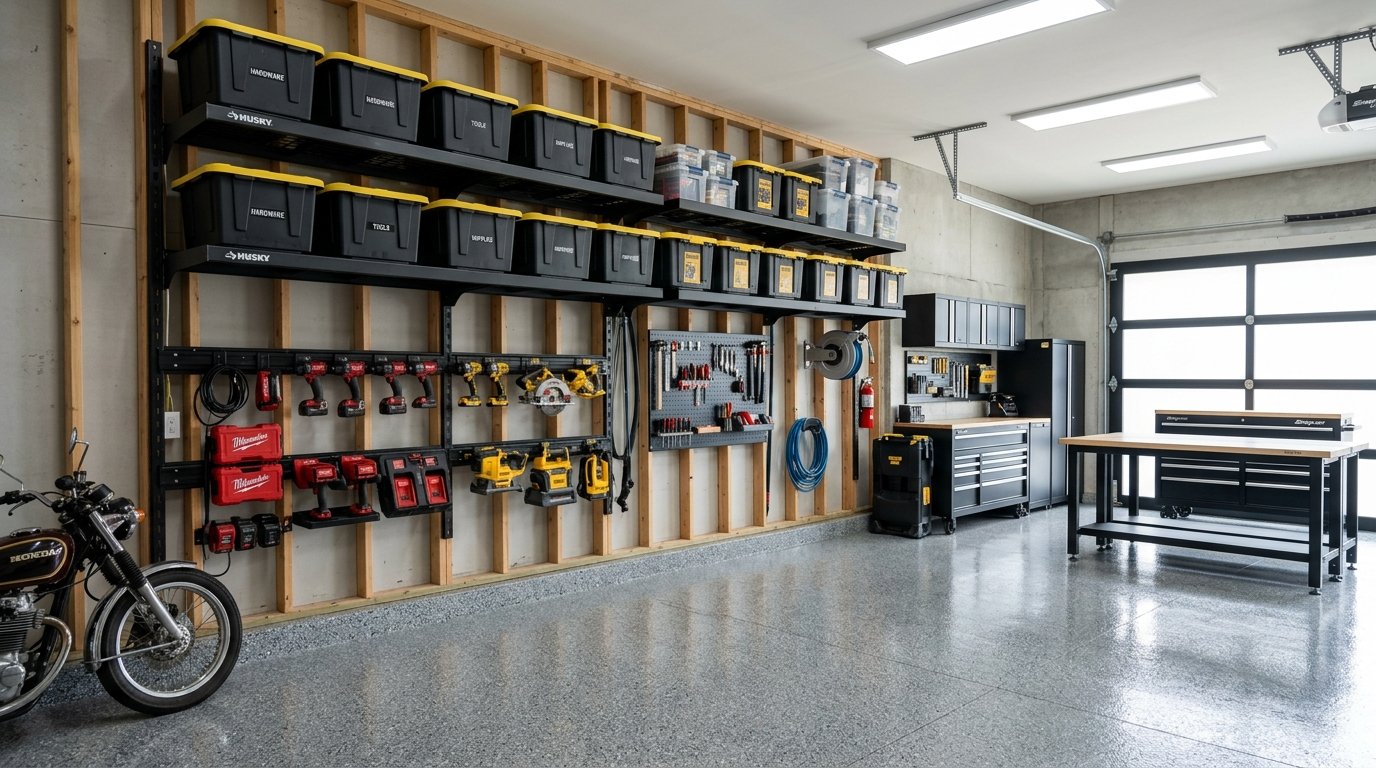
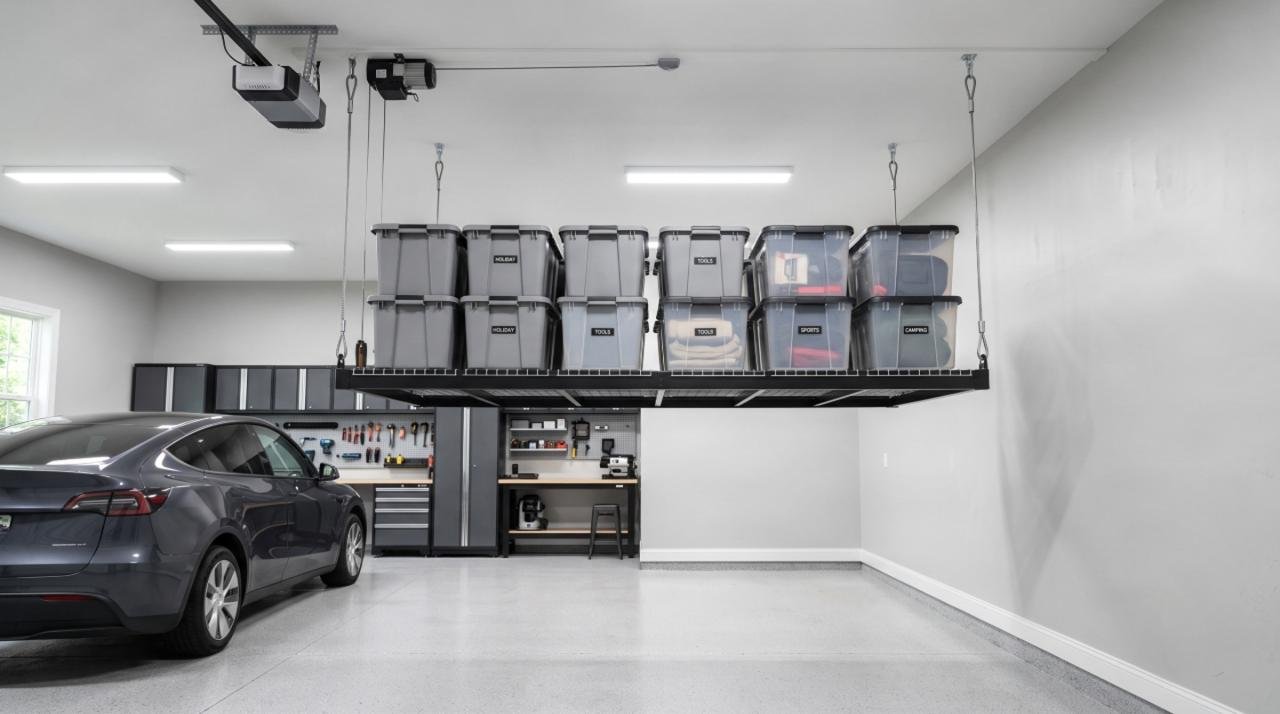
Fixed ceiling racks are great for taking clutter off your garage floor, right up until you have to haul a 60-pound tub of holiday decorations down a steep step ladder. According to OSHA ladder safety guidelines, ladder falls are one of the leading causes of home and workplace injuries. That’s when most homeowners realize the flaw in static overhead storage: accessing your items is inconvenient and dangerous.
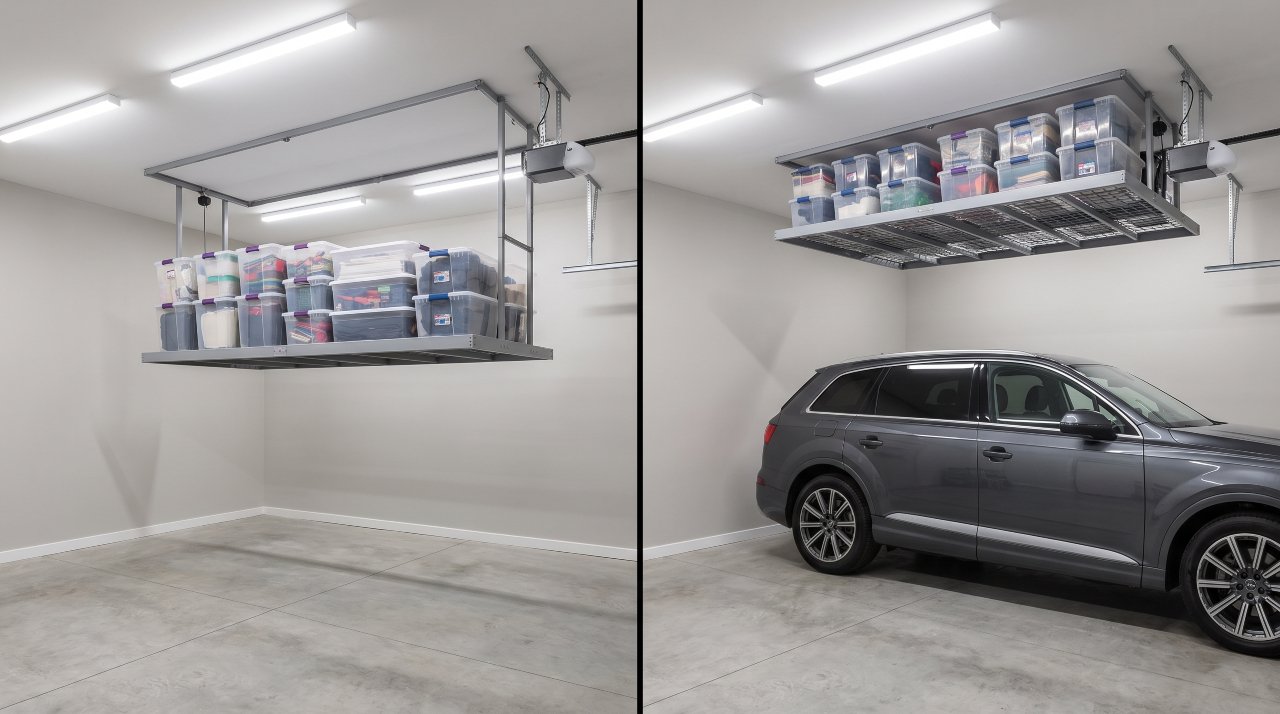
An overhead garage storage rack that can be lowered eliminates the ladder. These systems bring your storage platform down to chest or waist level with the push of a button, a hand crank, or a power drill attachment. You load or unload your bins safely on the ground, then raise the rack back up to the ceiling.
Here’s what most buyers overlook: a lowering ceiling rack has two different weight capacity ratings. The static load capacity is what the rack holds when fully raised and locked against the ceiling. The dynamic lifting capacity is what the motor or winch can safely raise and lower while in motion. Confusing those two numbers is how motors get burned out and cables snap.
This guide breaks down every type of lowering overhead garage storage rack, how the lifting mechanisms work, weight limits, ceiling joist requirements, and the top installation mistakes to avoid.
How Lowering Overhead Storage Racks Work
Lowering overhead storage systems replace static mounting brackets with steel cables or heavy-duty woven webbing connected to a central winding axle. That axle is driven by an electric motor, a manual hand crank, or a power drill adapter.
When you activate the system, the cables unwind evenly from the spool, lowering the steel platform toward the floor. Once loaded, the drive mechanism winds the cables back around the axle, pulling the platform up to the ceiling.
Most drop down garage rack models offer drop distances between 6 feet and 16 feet. That makes them compatible with standard 8-foot garage ceilings as well as high 12-to-16-foot vaulted ceilings where static racks are impossible to reach by ladder.
1. Motorized Overhead Garage Storage Lifts
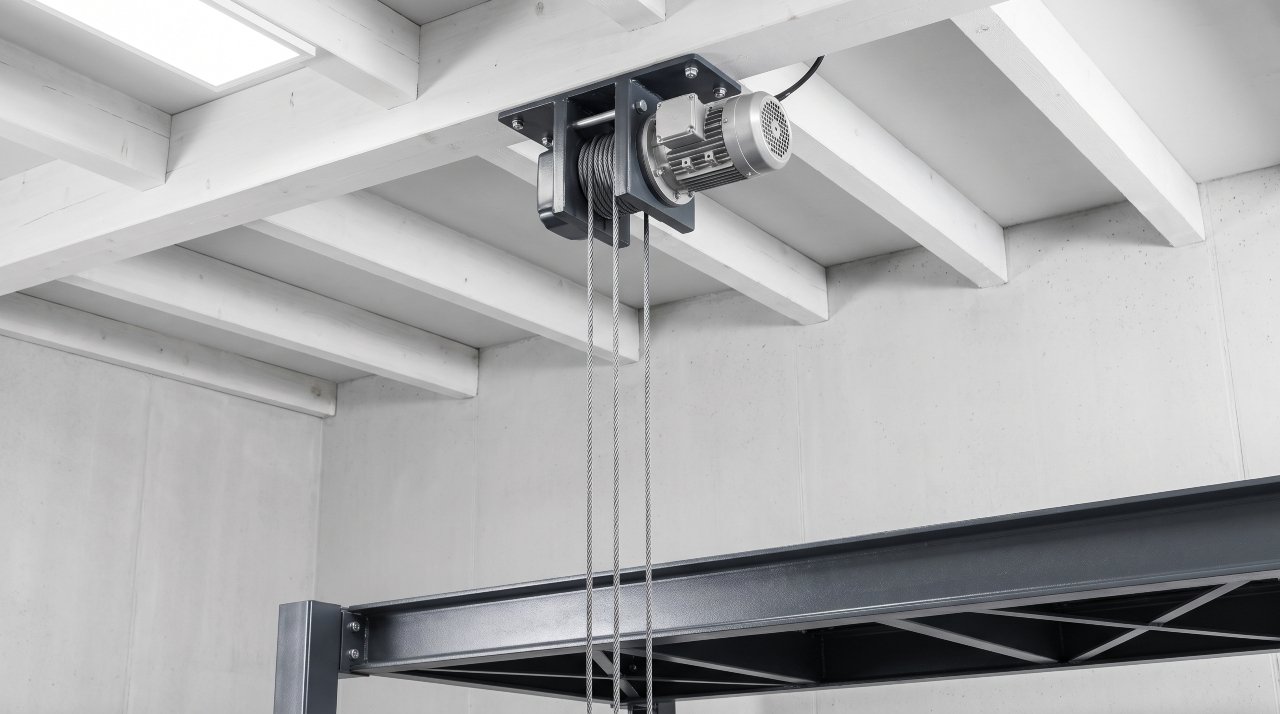
Motorized systems use an electric drive motor, typically operating on standard 120V household power, mounted directly to your ceiling joists. You operate the lift with a wall switch, a wireless remote control, or a smartphone app.
Electric lowering racks are the most convenient option available. Pressing a button raises or lowers the rack without physical exertion, making them ideal for heavy storage bins, spare tires, generator units, or kayak storage.
Typical specs: Platform sizes range from 4×4 feet up to 4×8 feet. Lifting capacity spans 300 lbs to 800 lbs depending on the motor rating. Drop distance runs up to 16 feet.
Safety features: Quality motorized units include auto-stop limits that prevent the rack from hitting the ceiling or floor, active-press controls that stop movement if you release the button, and thermal overload shut-offs on the motor.
Where buyers go wrong: Not installing a dedicated 120V outlet near the ceiling mount point. Running extension cords across your ceiling joists violates National Electrical Code residential wiring rules in most regions and creates a fire hazard..
2. Manual Hand-Crank Lowering Racks
Manual hand-crank systems use a mechanical gear-reduction winch mounted to the wall or ceiling. You attach a removable hand crank handle to the winch socket and turn it to raise or lower the platform.
Because the internal gear ratio does the heavy lifting, cranking a 250-pound load feels like lifting roughly 15 to 20 pounds of force at the handle. These systems cost significantly less than motorized units and require zero electrical wiring.
Typical specs: Platform sizes are usually 4×4 feet or 4×6 feet. Lifting capacity is typically rated between 250 lbs and 500 lbs.
Best for: Seasonal storage that you only access two or three times a year, or garages where adding a ceiling electrical outlet is difficult or expensive.
Where buyers go wrong: Mounting the crank winch in an awkward location behind parked cars or behind tall shelving, making it frustrating to turn the handle freely.
3. Drill-Operated Ceiling Storage Hoists
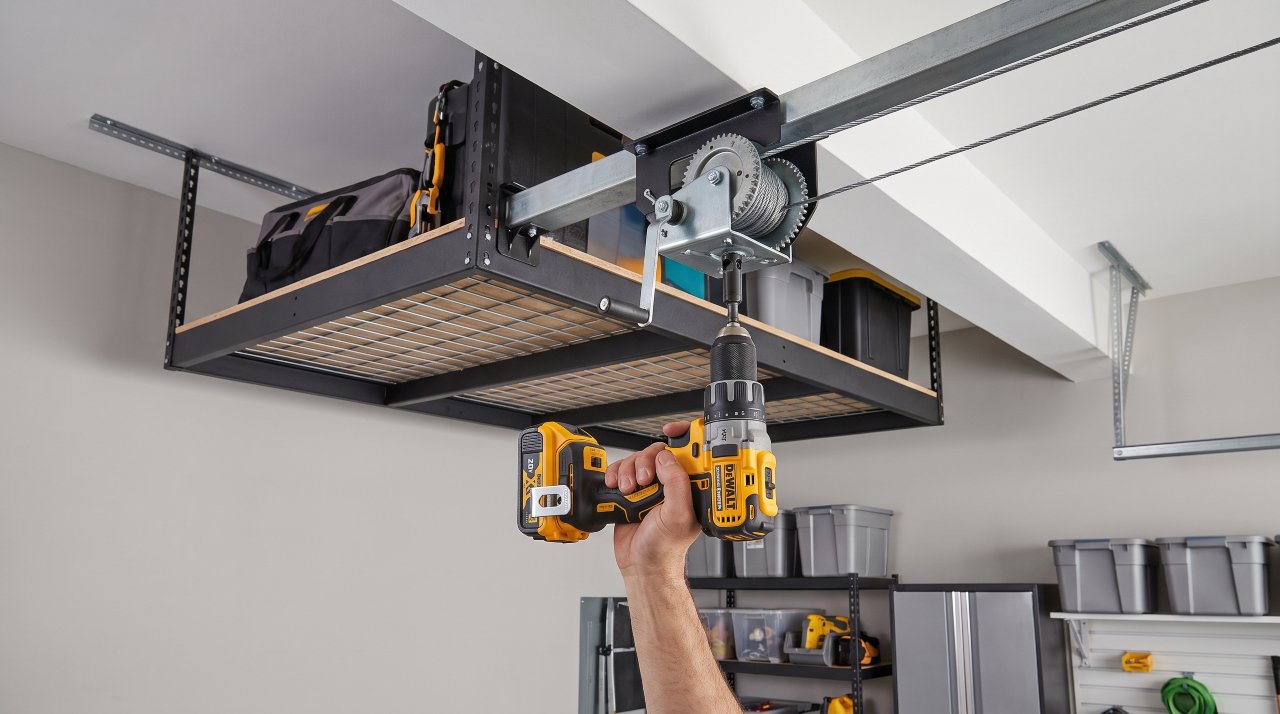
Drill-driven lowering racks combine the affordability of a manual system with the speed of a motorized lift. Instead of a built-in electric motor, the winch mechanism features an external drive spindle designed to attach to a standard cordless power drill.
You insert a hex bit into your power drill, attach it to the drive socket, and squeeze the drill trigger to raise or lower the rack in seconds.
Typical specs: Lifting capacities generally range from 300 lbs to 600 lbs. Platform sizes mirror standard 4×4-foot and 4×8-foot layouts.
Best for: DIY homeowners who already own an 18V or 20V cordless drill and want fast motorized performance without paying for an integrated motor.
Where buyers go wrong: Using a low-torque 12V drill or a drill with a depleted battery, causing the drill motor to stall mid-raise under a heavy load. Use a fully charged 18V or 20V brushless drill on low gear for smooth lifting.
4. Pulley and Cable Bike/Kayak Hoists
For smaller items like bicycles, kayaks, ladders, or single cargo boxes, individual rope-and-pulley hoists offer a lightweight lowering solution. Instead of a full platform rack, these use twin hooks suspended from ceiling pulleys connected to a locking rope cleat.
You hook the bike or kayak at ground level, pull the hoist rope down to raise the item to the ceiling, and lock the rope into the integrated safety brake.
Typical specs: Weight ratings range from 50 lbs to 150 lbs per hoist.
Best for: Bicycles, kayaks, paddleboards, ladders, and long sport equipment.
Where buyers go wrong: Buying cheap hoists with single-braided ropes that fray over time or lack an automatic safety rope lock. If the rope slips without a safety brake, the item drops directly onto whatever is below.
Comparison: Lowering Overhead Rack Types
| System Type | Drive Mechanism | Weight Capacity | Power Required | Effort Level | Relative Cost |
|---|---|---|---|---|---|
| Motorized Lift | 120V Electric Motor | 300–800 lbs | Yes (120V Outlet) | Zero (Button/Remote) | High (500–1,200) |
| Manual Hand-Crank | Gear-Reduction Winch | 250–500 lbs | None | Low–Moderate | Medium (250–450) |
| Drill-Operated | Cordless Power Drill | 300–600 lbs | Battery Drill | Low | Medium (300–500) |
| Pulley & Cable Hoist | Manual Rope & Pulley | 50–150 lbs | None | Moderate | Low (30–90) |
Dynamic vs. Static Weight Capacity: Don’t Burn Out Your Lift
Understanding the difference between dynamic and static capacity is essential when choosing a lowering overhead garage storage rack.
Dynamic Lifting Capacity: The maximum weight the motor, winch gears, and cables can safely raise or lower while in motion. For example, a motorized unit might have a 400-lb dynamic lifting limit.
Static Holding Capacity: The maximum weight the rack structure can support when it is fully raised and locked in position at the ceiling. Some high-end systems have a static capacity of 600 lbs but a dynamic lifting limit of 400 lbs.
If you load 500 lbs onto a platform rated for 400 lbs dynamic lifting, the motor will overheat, trip its internal breaker, or strain the steel cables during ascent. Always calculate your total storage weight based on the lower dynamic lifting rating, not the higher static hold number.
Critical Installation Rules for Ceiling Storage Lifts
A lowering overhead garage storage rack puts heavy concentrated loads on your ceiling joists. Follow these rules during installation:
1. Anchor Directly into Solid Wood Joists
Never anchor a ceiling lift into drywall, plaster, or ceiling plywood alone. Every mounting bracket lag bolt must penetrate at least 2 to 3 inches directly into the center of a solid wood ceiling joist or engineered truss. Use a stud finder and verify joist edges by drilling small pilot holes.
2. Verify Joist Spacing and Alignment
Ceiling joists are typically spaced 16 inches or 24 inches apart on center. Most lowering storage racks feature adjustable mounting brackets designed to span across multiple joists. Ensure your brackets span at least two joists to distribute the weight across multiple structural members rather than pulling on a single joist.
3. Account for Garage Door Clearance
Measure your garage door path before drilling a single hole. When your garage door opens, it travels along overhead tracks and occupies vertical space near the ceiling. Ensure the rack platform, even when fully raised, clears the open garage door and motor rail by at least 2 to 4 inches.
4. Maintain Vehicle Roof Clearance
Check how far down the platform hangs when fully raised to the ceiling (typically 12 to 24 inches). Verify that tall vehicles like SUVs or trucks equipped with roof racks can park underneath without hitting the raised platform.
Frequently Asked Questions
What is a drop down garage rack?
A drop down garage rack is an overhead ceiling storage platform equipped with a lifting mechanism that allows the user to lower the rack to ground level for loading and raising it back to the ceiling for storage. This eliminates the need to climb ladders to access items stored overhead.
How much weight can a lowering overhead garage rack hold?
Weight capacity depends on the system type. Motorized ceiling lifts typically hold between 300 lbs and 800 lbs. Manual hand-crank and drill-operated lowering racks usually support 250 lbs to 600 lbs. Small bike and kayak pulley hoists carry 50 lbs to 150 lbs. Always check both the dynamic lifting capacity and the static holding capacity on the manufacturer spec sheet.
How do motorized overhead garage storage racks get power?
Motorized overhead garage storage racks plug into a standard 120V electrical outlet. Most systems come with a 6-to-10-foot power cord. If your ceiling lacks an outlet, hire a licensed electrician to install an overhead receptacle near the motor mounting location. Do not run permanent extension cords across ceiling joists.
Can you install a ceiling storage lift system on a sloped or vaulted ceiling?
Yes, many modern ceiling storage lift system models support sloped or vaulted ceilings. They utilize adjustable-length cable drops and angled mounting brackets that adapt to pitched ceiling angles while keeping the storage platform level. Verify that the product explicitly specifies sloped ceiling compatibility before ordering.
Is a lowering overhead garage rack safer than a fixed overhead rack?
Yes, for access safety. Lowering racks remove the risk of falling off step ladders while carrying heavy or bulky storage bins. However, because they contain moving parts, cables, and winches, they require proper structural installation and routine cable inspections to ensure long-term mechanical safety.
How to Choose the Right Lowering Rack: 4-Step Checklist
- Weigh your items: Calculate the total weight of your storage bins or gear. Pick a system where your total load is at least 20% below the max dynamic lifting capacity.
- Measure ceiling height: Ensure the lift’s maximum cable drop distance reaches your preferred loading height.
- Locate your joists: Confirm your joist direction and spacing (16″ or 24″ on center) before ordering.
- Choose your drive type: Pick motorized for maximum convenience, drill-operated for budget speed, or hand-crank for low-frequency seasonal use.
To explore how lowering racks compare with traditional static ceiling solutions, read our guide on overhead rack garage storage systems. If you are evaluating full organization upgrades across wall and floor layouts, check out our guide to the best garage storage systems.

Callum Langham
Founder & Technical Storage Editor
Callum Langham is the founder and technical editor of Rack System. With over 12 years of hands-on field experience in warehouse logistics, garage organization, and industrial storage installations, Callum specializes in engineering safety standards, beam load calculations, and OSHA/RMI compliance. Every guide on Rack System is audited against verified steel gauge tolerances and municipal building codes.